Anchor Text Optimization: Build a Natural Backlink Profile
Anchor text optimization is the practice of choosing the clickable words in a link so they describe the destination accurately, read naturally in the sentence, and fit a varied link profile. Get it right, and readers and search engines both know what sits on the other side of the click. Get it wrong, and a link profile starts to look built rather than earned.
Most guides on this topic are still stuck in 2013. They treat anchors as a keyword delivery system and hand you percentages to hit. That deserves some pushback, so this guide covers what Google actually says, which anchor types earn their place, how to handle anchors in guest posts, and how to repair a profile that has drifted.
What Is Anchor Text Optimization?
Anchor text is the visible, clickable part of a hyperlink. In HTML, it’s the text between the opening and closing anchor tags. Google’s own link best practices describe good anchor text as descriptive, reasonably concise, and relevant to both the page it sits on and the page it points to.
Two contexts, two sets of rules. Internal links join pages on your own site, and you write every word. Backlinks come from other sites, where you usually write none of them. Blur the two and you end up applying backlink caution to your own navigation, or internal-link freedom to paid placements.
Why Anchor Text Still Matters
Crawlers read anchor text, plus the words around it, as a summary of the destination. “Technical SEO checklist” tells them something. “Click here” tells them nothing, and it tells screen reader users nothing either, because assistive tools often list links out of context.
The business case is plain. A page you want to rank needs links that explain what it is, and that covers every internal link you control and every external link you earn.
AI search deserves a measured comment. Descriptive anchors make the relationships between your pages explicit, and anything parsing your content, AI answer features included, benefits from that clarity. Nobody outside Google can quantify the effect. Since descriptive anchors cost nothing, that uncertainty is a weak reason to skip them.
Types of Anchor Text, With Examples
Six types appear in nearly every link profile. Each has a job, and none should run the whole show.
| Type | Example | Best use | Risk level |
|---|---|---|---|
| Exact match | anchor text optimization | Internal links, occasional editorial links | Higher when repeated across many backlinks |
| Partial match | Tips for optimizing anchor text | Most contextual links | Low |
| Branded | Guest Posting Solution | Backlinks, citations, author mentions | Very low |
| Generic | click here, read more | Buttons and calls to action | Low, but wastes context |
| Naked URL | https://example.com | Citations and resource lists | Low |
| Image | Alt text: anchor text types chart | Linked graphics and logos | Low with descriptive alt text |
Partial match is the workhorse. It carries topic information without repeating the target keyword word for word, and it reads like something a writer would actually type.
Exact match isn’t banned. It’s just easy to overuse, and it’s the type that draws attention once it shows up at scale.
What Google Says About Anchor Text
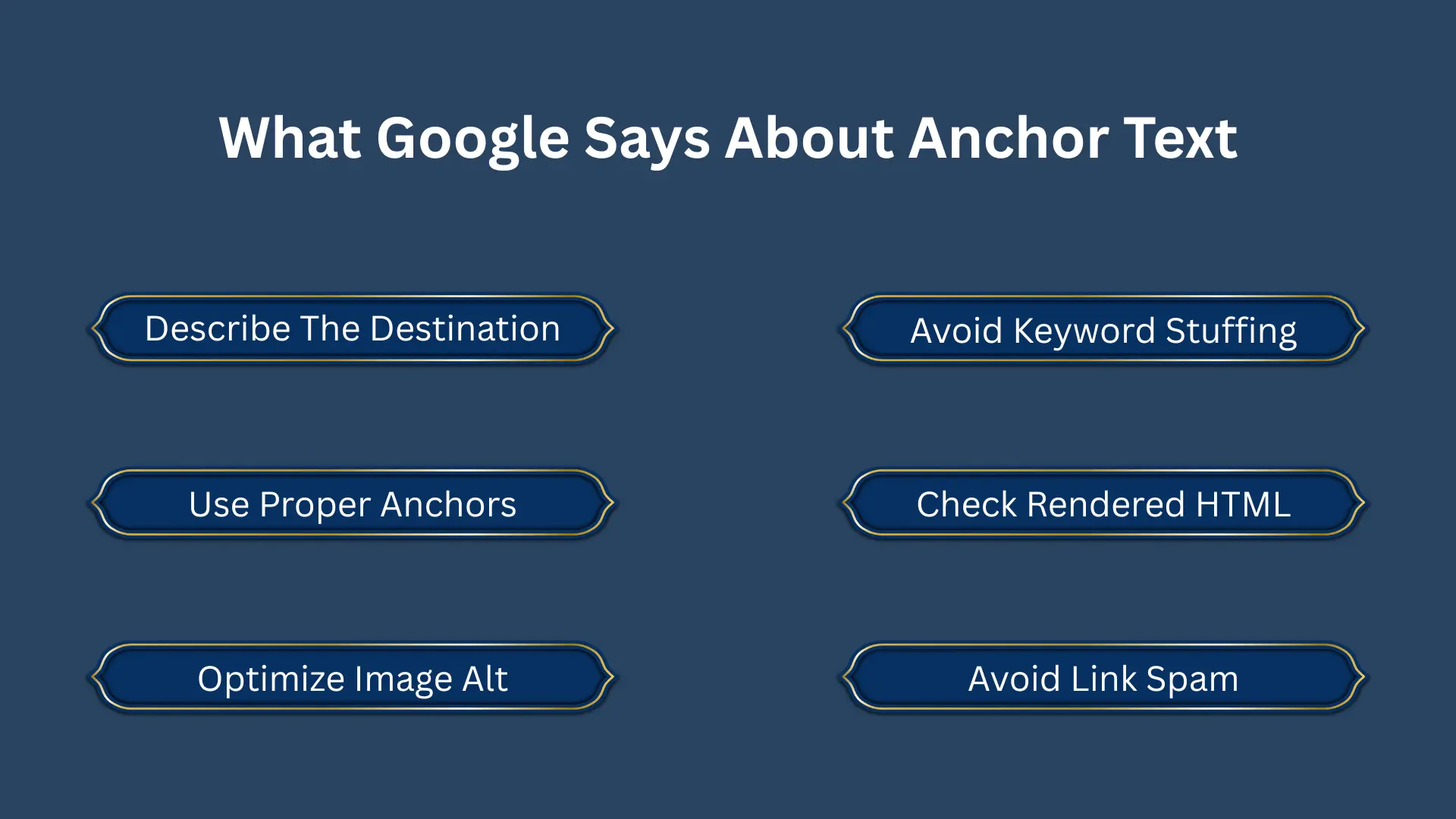
Google’s guidance is shorter than most blog posts about it. Describe the destination. If you’re forcing keywords in, you’ve gone too far. Links need to be anchor elements with an href attribute to be crawled, and if JavaScript injects the anchor text, confirm it appears in the rendered HTML with the URL Inspection tool. An image link borrows its alt text as the anchor, so empty alt text leaves the link blank. And skip the habit of lining links up back to back, since each one loses its surrounding context.
The risk side lives in the spam policies, which list large-scale guest posting campaigns with keyword-rich anchor text as link spam. Paid links get separate treatment: Google asks you to qualify outbound links with sponsored or nofollow when money changes hands.
Read all of that again and look for a target percentage. There isn’t one.
Anchor Text Ratio: Why the Percentages Mislead
Search the topic, and you’ll find confident splits. Branded at 40 to 50 percent. Partial match at 25 to 35. Exact match capped anywhere from under 5 percent to under 20 percent, depending on whose article you open.
That disagreement is the giveaway. These figures are observations from audited sites, repeated until they sound like rules. A profile that matches a pie chart perfectly can still be stuffed with weak links from irrelevant sites.
Pattern matters more than proportion. Dozens of unrelated domains pointing one commercial phrase at one page is a problem. A mix of brand names, partial phrases, bare URLs and the odd generic link, written by different people, looks like the web behaving normally.
A sturdier benchmark is whoever already ranks where you want to. A competitor backlink analysis shows what an earned profile looks like in your niche, which beats any generic table.
Internal Link Anchor Text vs Backlink Anchor Text
Internal and external links require different approaches.
Internal links
You control internal anchors, so you can be more deliberate. Exact and partial match anchors are fine when the sentence supports them, because no outside publisher is involved. Vary the wording across pages so one phrase doesn’t appear forty times, and give every important page at least one link from another page. A thorough SEO audit usually surfaces orphan pages and vague internal anchors in the first pass.
Backlinks
You rarely write these. Earned links carry whatever anchor the author picks, which is exactly why they look natural. Once you request specific anchors on placed links, you’re shaping the profile, and the shape has to be believable.
Branded and partial match anchors from relevant pages are the safest default. PBN backlinks tend to arrive with repetitive keyword anchors on thin sites, which is one more reason to avoid them.
Anchor Text in Guest Posts and Paid Placements
This is where most genuine anchor problems begin. Forty guest posts on unrelated blogs, all using the same money phrase, is the exact pattern Google describes. The fix isn’t abandoning link building. It’s planning anchors one placement at a time.
- Write for the sentence, not the keyword list. If the sentence doesn’t need the link, the link doesn’t belong there.
- Rotate on purpose. Alternate brand names, partial phrases and page-title style anchors, with exact match only now and then.
- Send links where they’re useful. Pointing everything at the homepage or a single money page makes the pattern obvious. Link to the page that actually answers the sentence.
- Choose publishers for relevance first. A list of dofollow backlink sites can help you find candidates, but a relevant audience matters more than the link attribute.
- Question the vendor. Buying backlinks carries risks that anchor planning can’t cancel out. Before you buy high-quality backlinks from anyone, get straight answers on who writes the content, who chooses the anchors, and whether you approve them.
One uncomfortable truth: Google wants paid links qualified, and plenty of placements sit in a gray area between paid and editorial. Anyone promising zero risk is selling certainty that doesn’t exist.
How to Audit and Fix Over-Optimized Anchor Text
- Export your anchors. Start with the Links report in Search Console, then add Ahrefs or Semrush for a fuller picture.
- Sort them by type. Branded, partial match, exact match, generic, URL, and image.
- Look for concentration. One commercial phrase aimed at one URL from many referring domains is the red flag.
- Judge the sources. Unrelated or low-quality referring sites usually matter more than the wording of the anchor.
- Dilute before you delete. Earn new branded and partial match links, update anchors on links you control, and ask for edits only where you have a real relationship.
- Treat disavow as a last resort. Google’s disavow tool is for clearly manipulative links you can’t get removed, not routine cleanup.
Then recheck every quarter. Profiles change as new links land.
Common Anchor Text Optimization Mistakes
Small anchor text decisions can create bigger problems across a backlink profile. The following mistakes are common in SEO campaigns and are easy to avoid when anchor selection is based on relevance rather than repetition.
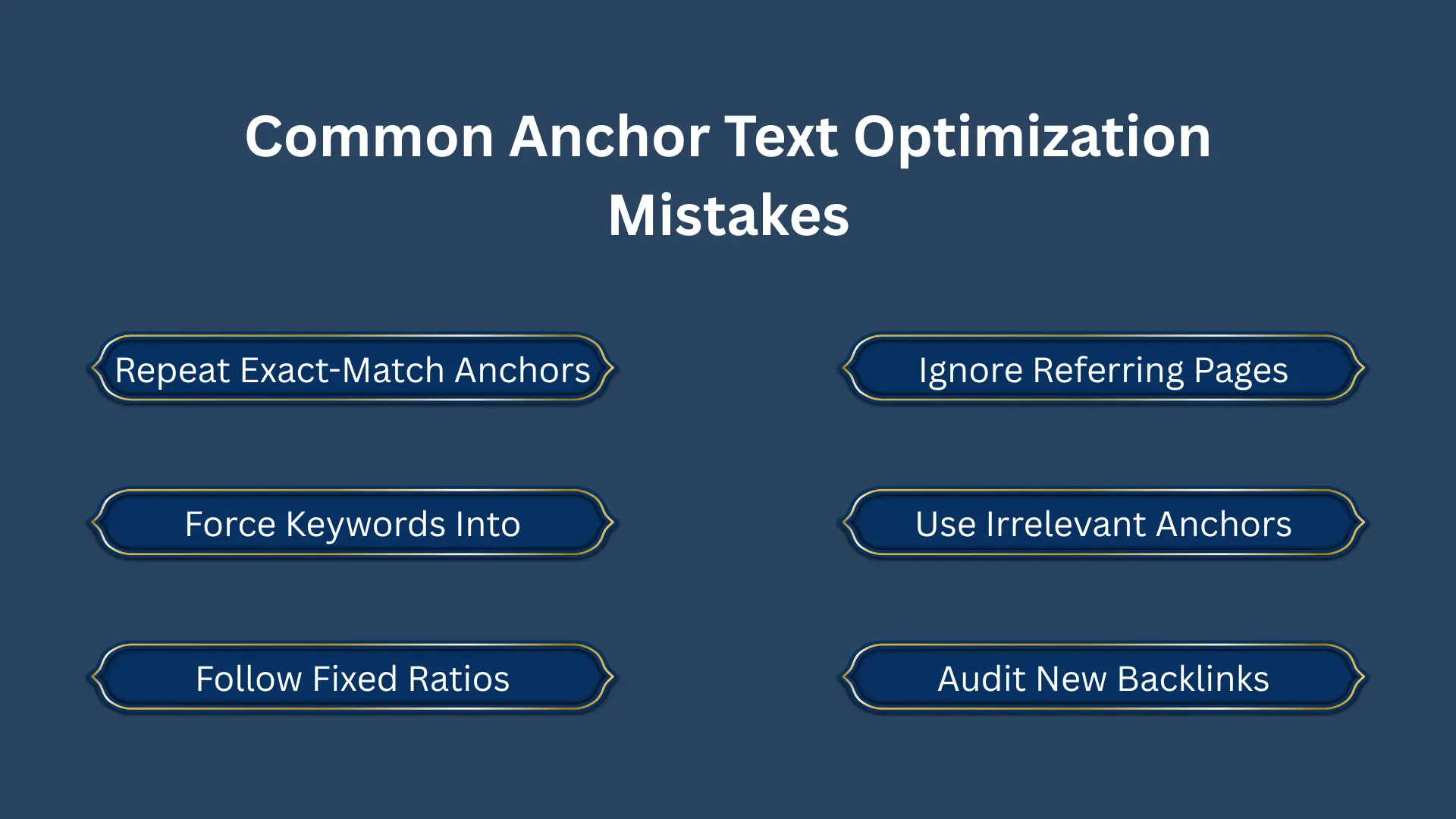
1. Repeating the Same Exact-Match Anchor
Using one target keyword across a large number of backlinks can make the profile look overly deliberate. Exact-match anchors have a place in SEO, but they shouldn’t become the default wording for every external link.
2. Ignoring the Referring Page
An anchor may match the target page perfectly but still feel out of place in the article linking to it. The referring page should cover a related topic, and the anchor should make sense within the sentence and surrounding discussion.
3. Forcing Keywords Into Anchors
Adding a keyword simply because it has search volume often produces awkward wording. If the anchor doesn’t read naturally to a person, choose a clearer variation that accurately describes the destination.
4. Using Irrelevant Anchor Text
An anchor should tell readers something useful about the page they are about to visit. Using unrelated or misleading wording can weaken topical relevance and creates a poor user experience.
5. Following Fixed Anchor Text Ratios
There’s no universal percentage that every website needs to follow for exact, partial, branded, or URL anchors. Treating an industry benchmark as a Google rule can lead to unnecessary optimization instead of decisions based on the site’s actual backlink profile.
6. Failing to Audit New Backlinks
Anchor text optimization doesn’t end after a campaign goes live. New backlinks can gradually change the profile, so regular monitoring helps identify repeated anchors, irrelevant links, and unusual concentrations before they become larger issues.
Build a More Natural Anchor Text Profile
If you’re building links at any volume, anchor planning belongs in the order itself, not in a cleanup project six months later. Guest Posting Solution places content through manual outreach on editorial sites, with articles written for the host publication so each link sits in a sentence that earns its place.
Explore the link building services available, or read how a guest posting agency should approach placements before you commit to one.
Conclusion
Anchor text optimization is easier when it’s part of a structured backlink campaign.
Guest Posting Solution can assess your existing backlink profile, review competitor link patterns, map target pages, and develop an anchor text approach suited to your wider SEO strategy. Its link building services incorporate backlink analysis, anchor text analysis, relevant publisher research, and contextual link placement.
The emphasis should remain on relevance. A backlink from a suitable website, placed in useful content with descriptive anchor text, has a much stronger editorial case than a link created solely to repeat a keyword.
For businesses already investing in SEO, that distinction can make the difference between a scattered backlink campaign and a structured authority-building strategy
FAQs
What is the best anchor text for backlinks?
Branded and partial match anchors from relevant pages are the safest default. They describe the destination without repeating one exact keyword, and they resemble what editors and writers choose on their own.
How many exact match anchors are too many?
Google gives no number. Third-party sources suggest anything from under 5 percent to under 20 percent. Pattern and link quality matter more: many unrelated sites using one commercial phrase for one page is the real warning sign.
Is “click here” bad anchor text?
It isn’t harmful on its own, but it gives search engines and screen reader users no context. Replace it with a short phrase that says what the reader will find after the click.
How do I check my anchor text profile?
Export anchors from the Search Console Links report, Ahrefs or Semrush, group them by type, and look for any single commercial phrase that dominates links to one page.
Is partial-match anchor text better than exact match?
Not automatically. Partial-match anchors can make it easier to describe a destination naturally without repeating the same keyword, but the best choice depends on the article context and target page.