Internal and External Links in SEO: How Both Boost Rankings
Most SEO advice treats internal links and external links like separate departments that barely talk to each other. Internal linking gets lumped into technical SEO. External link building gets handed to the outreach team. And somehow, people are surprised when their rankings plateau despite doing both.
Here’s the thing: Google doesn’t evaluate your links in silos. It reads your entire link ecosystem, who links to you, where your own pages link to each other, and how authority moves through your site. Get either side wrong, and the other side can only do so much.
This guide covers what internal and external linking in SEO is, how each type works, how they’re fundamentally different, and, most importantly, why a strategy that combines both is the only one that actually compounds over time.
What Are Internal Links in SEO?
An internal link is any hyperlink that connects one page on your website to another page on the same domain. Simple enough. But the role they play in SEO is anything but basic.
When you publish a new blog post and link it from an older, well-ranked article, you’re doing two things simultaneously: helping users discover that content, and telling Google’s crawlers exactly where to go next. Search engines follow links. No internal link often means no crawl, no index, no ranking.
Types of Internal Links Worth Knowing
Not all internal links carry equal weight, and the placement matters more than most people realize.
- Contextual links sit inside your body content. They’re surrounded by relevant text, which gives them semantic context. These are your most valuable internal links, Google reads the surrounding words to understand what the linked page is about.
- Navigation links live in your header, footer, or sidebar. They help users get around but carry less SEO weight than contextual links because every page gets them, which dilutes their signal.
- Breadcrumb links are underrated. They reinforce your site hierarchy and give search engines a clean structural map of how your content is organized.
A new page you care about ranking needs contextual internal links from existing pages that are already doing well. That’s how you pass momentum forward.
What Are External Links in SEO?
External links either come from other websites pointing to yours, or go from your pages pointing out to the wider web. Both directions matter, though for very different reasons.
Inbound External Links (Backlinks)
Backlinks are what most people mean when they say “link building.” When another website links to your content, they’re essentially casting a vote of confidence in your page. Google treats this as an endorsement, and the quality of who’s endorsing you matters enormously.
A single backlink from a high-authority, niche-relevant publication can do more for your rankings than 50 links from low-quality directories. Domain authority, organic traffic of the linking site, niche relevance, and whether the link is editorially placed (not paid or automated), these are the variables that determine how much a backlink actually moves the needle.
External link building SEO isn’t about volume. It never really was, though plenty of agencies still sell it that way. It’s about earning links that signal trust to Google, and guest posting on credible sites remains one of the most reliable ways to do that.
Outbound External Links (Outgoing Links)
Here’s where a lot of site owners get nervous. “If I link out to another website, am I giving away my SEO value?”
The short answer: no. In fact, linking out to authoritative, relevant sources is a positive signal for your content’s credibility. When you cite a study from a respected research institution or reference documentation from a known industry source, you’re showing Google that your content is well-researched and grounded in reliable information. That’s an E-E-A-T signal.
The rule of thumb for outbound links SEO is simple: link out when it genuinely adds value for the reader. Don’t link to competitors, avoid low-quality sites, and don’t scatter external links throughout a post just to seem thorough. A few high-quality outbound links per article is the right approach.
Dofollow vs Nofollow External Links
This distinction matters more on external links than anywhere else.
- A dofollow link passes link equity (ranking signals) to the destination page. It’s the default state of any hyperlink unless you say otherwise.
- A nofollow link (rel=”nofollow”) tells Google not to pass PageRank through that link. It was originally designed to combat comment spam, but it’s now used more broadly.
Beyond those two, rel=”sponsored” tells Google the link is part of a paid arrangement, and rel=”ugc” marks links added by users (comment sections, forums). These attributes matter for compliance; Google expects you to tag paid links correctly.
For outbound links SEO, the practical rule is: use nofollow or sponsored on any affiliate or paid external link, and leave editorial outbound links as dofollow. For backlinks you’re earning through guest posting, you want those to be dofollow; that’s where the link equity SEO value actually lives.
Internal Links vs External Links: The Key Differences
Understanding the contrast between internal links and external links helps you plan where to invest your time and budget.
| Factor | Internal Links | External Links (Backlinks) |
|---|---|---|
| Domain | Same website | Different website |
| Control | Fully yours | Earned or built |
| Primary SEO Role | Crawlability, equity flow, UX | Authority, trust, domain strength |
| Anchor Text | You decide | Chosen by the linking site |
| Build Method | Content planning and editing | Outreach, guest posting, link insertion |
| Impact Speed | Immediately after crawl | Depends on the external site crawl cycle |
The most important distinction is control. Your internal linking structure is entirely in your hands; you can fix, add, and optimize it anytime. External links require someone else’s decision to link to you, which makes earning high-quality backlinks slower and more competitive.
That’s also why neglecting internal links is such a costly mistake. It’s the one lever you have complete control over, and most sites leave it underoptimized.
How Internal and External Links Work Together in SEO
This is where the strategy actually gets interesting.
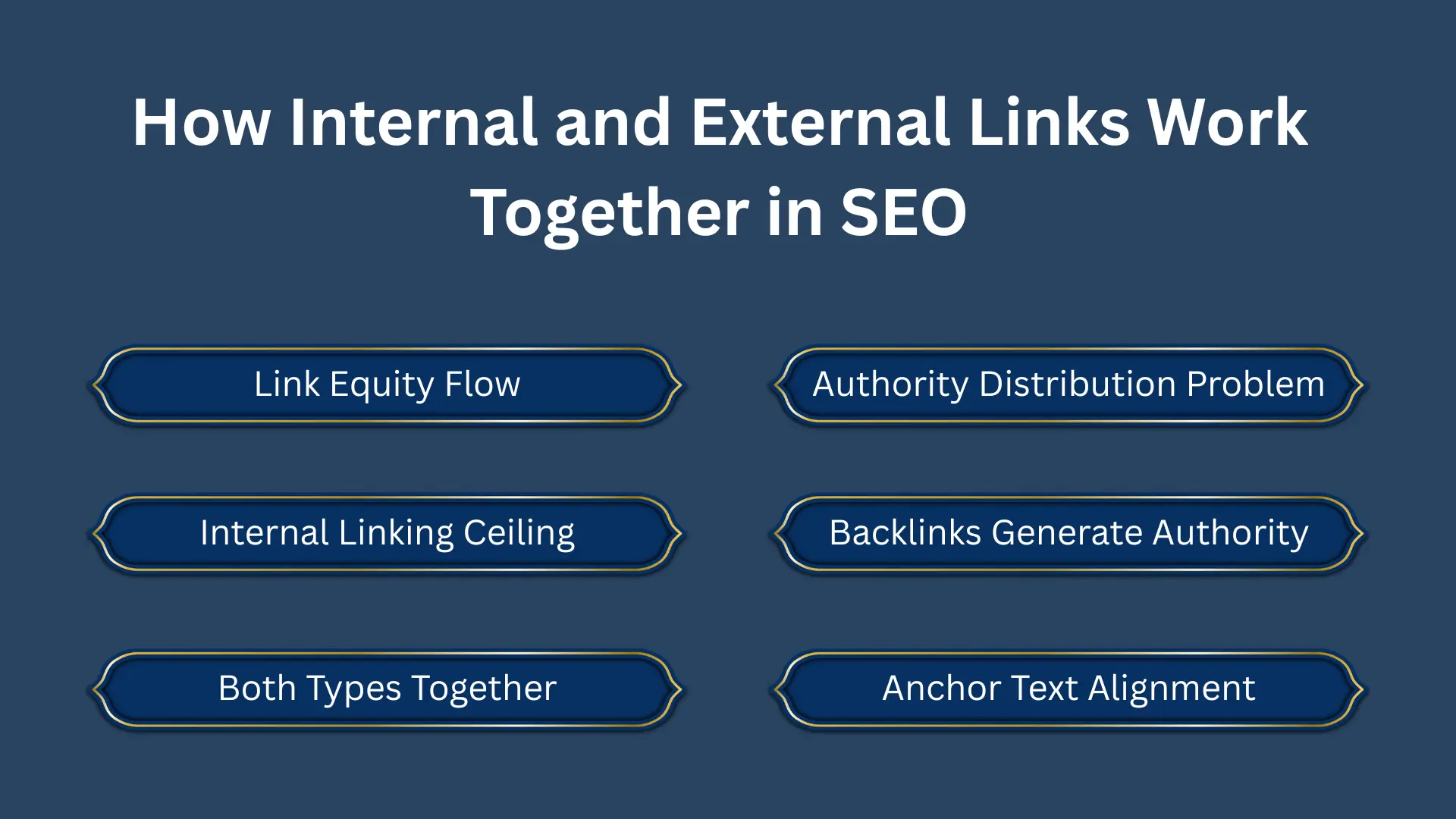
The Link Equity Chain
Every backlink you earn deposits authority into your domain. Where that authority goes next depends entirely on your internal link structure.
You publish a guest post on a high-DR marketing publication. It links back to your homepage with a dofollow backlink. That backlink lifts your domain’s authority, but your homepage alone isn’t what you’re trying to rank. Your pillar service page is. Your conversion-focused blog post is. If those pages aren’t connected to your homepage through strong contextual internal links, the authority stalls exactly where it lands and never moves deeper into your site.
Now flip it. That same homepage has three well-placed contextual links pointing to your pillar service page. That pillar page links to two supporting articles targeting related keywords. The authority travels through each connection, strengthening every page in that cluster.
Link equity SEO is a distribution problem as much as it is an acquisition problem. Most attention goes to earning links. Far less goes to ensuring those links actually benefit the pages that need to rank. Both decisions matter equally.
Why You Can’t Rely on Just One
A site with strong backlinks but weak internal linking is a common pattern, and a frustrating one to diagnose. Domain authority looks solid. Branded terms rank fine. But product pages, service pages, and blog content chronically underperform because authority never reaches them.
The opposite problem is just as real. Meticulous internal linking with no external link building creates a ceiling that no amount of internal optimization can raise. Internal links redistribute existing authority; they don’t generate it. You need backlinks to bring fresh ranking signals in from outside.
The sites that compound their SEO growth consistently are the ones investing in both, treating them as a single system rather than two separate line items.
Anchor Text Alignment Across Both Types
Your combined anchor text profile, across internal and external links, tells Google what your pages are about and how authoritative they are on that topic.
For internal anchor text, descriptive and varied is the standard. Each anchor should reflect the destination page’s topic clearly, without repeating exact-match phrases so often it looks mechanical.
For external anchor text, you have partial control. In a guest post you wrote, the anchor pointing back to your site should be natural and topically relevant, not keyword-stuffed. An over-optimized external anchor profile reads as manipulation. A clean internal anchor strategy paired with a natural external profile reads as a credible, well-structured domain. That’s the signal worth building toward.
For more useful insights, explore our other blog post, “Clean URL Structure Tips for Better SEO Performance”. Discover more to deepen your understanding.
External Link Building SEO: What Actually Moves Rankings
Not all link-building tactics age well. Some that worked five years ago now carry real risk. Here’s what’s still worth your time.
Guest Posting
Guest posting remains one of the most reliable external link-building SEO methods when done properly. Publishing original, valuable content on a relevant, high-DR site that links back to your domain is exactly the kind of editorial link Google respects.
The critical variables are: niche relevance (a link from a marketing site to another marketing site carries far more weight than a link from a food blog), domain authority, organic traffic of the host site, and whether the link placement feels natural within the content.
What doesn’t work is spray-and-pray guest posting on low-traffic, low-authority sites just to inflate your backlink count. Google’s gotten very good at detecting that pattern.
Link Insertion
Link insertions, also called niche edits, involve placing your link into existing, already-indexed content on another site. Because the page is established and already ranks, the link can carry more immediate authority than a link on a brand-new guest post.
It’s a faster tactic when the placement is genuinely relevant. The risk is that low-quality link insertion services often place links on pages that are low-traffic or clearly monetized for links rather than readers. Relevance and context are still everything.
What Makes a High-Quality Backlink
The checklist is shorter than most people make it:
- Relevance: The linking site operates in your niche or a closely related one.
- Authority: The domain has real organic traffic and a reasonable DR/DA score.
- Editorial context: The link sits naturally within the content, not shoved into a footer or sidebar.
- Dofollow: It passes link equity.
- Unique domain: A second link from the same domain adds far less value than a first link from a new root domain.
Diversity of linking domains is one of the most undervalued factors in external link building SEO. Ten links from ten different relevant sites will outperform ten links from the same site every time.
Outbound Links: Friend or Enemy?
The skepticism around outbound links is mostly a myth that refuses to die.
The concern that linking out sends users away, and leaks PageRank, made some sense in the early 2000s. Today, Google’s algorithms are sophisticated enough to understand that well-researched content cites its sources. Refusing to link out doesn’t make your content look authoritative. It often makes it look thin.
That said, a few practical rules apply:
- Link to sources that actually deserve it. A citation to a major research institution, a respected industry publication, or official documentation strengthens your content’s credibility. A link to a random article with no clear authority does nothing useful.
- Use nofollow or sponsored for commercial links. If you’re linking to an affiliate product, a paid tool, or anything you have a financial relationship with, tag it correctly. This isn’t optional; Google expects it.
- Keep a reasonable ratio. For a 2,000-word article, two to five outbound external links are a natural range. More than that starts to look like you’re compensating for a lack of original depth.
- Use target=”_blank” thoughtfully. Opening external links in a new tab keeps users on your site, which is a small but real UX improvement.
How to Audit Internal and External Links in SEO Together
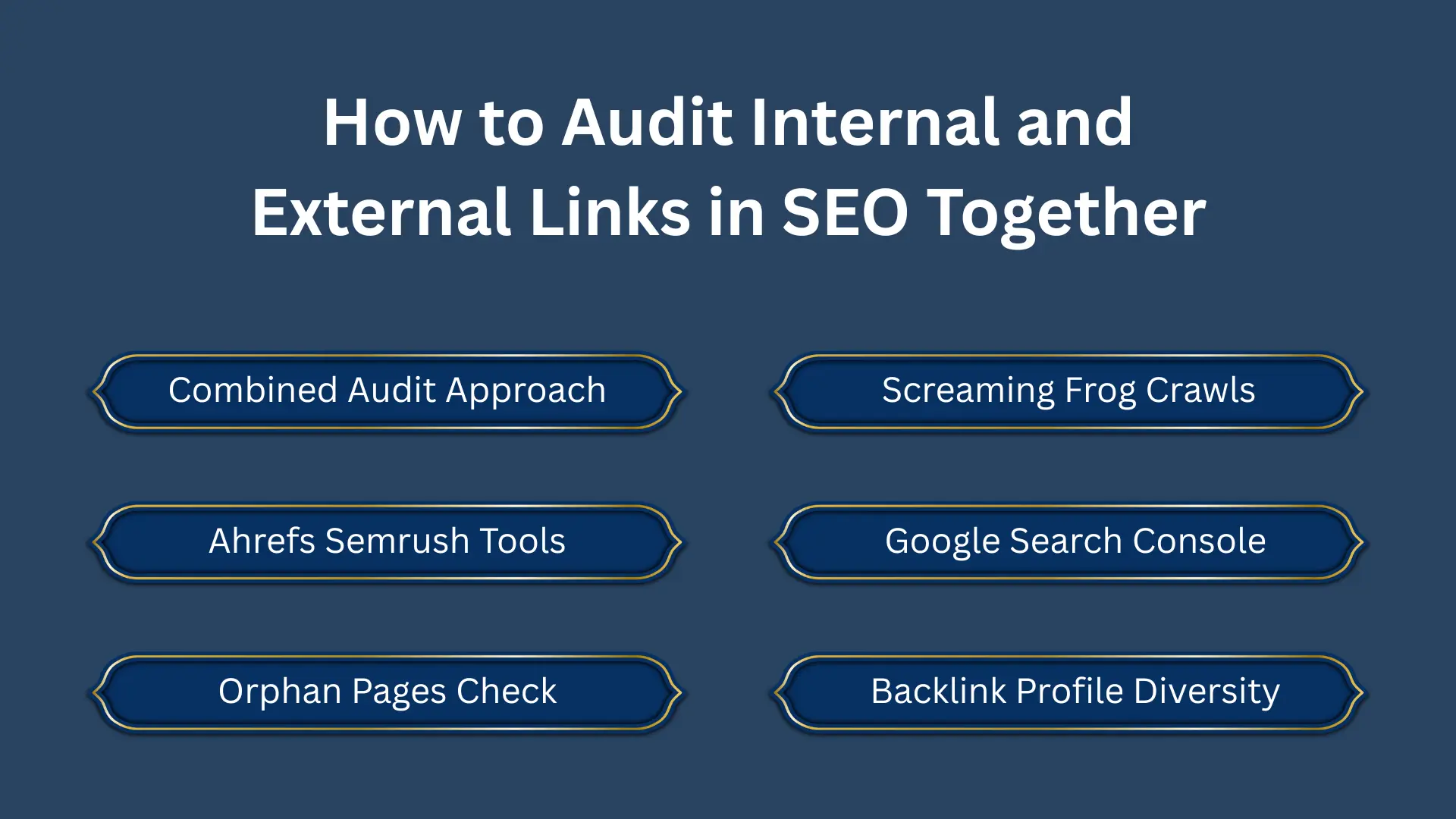
Most link audits focus on one type or the other. A combined audit gives you the full picture.
Tools That Handle Both
- Screaming Frog crawls your site and surfaces internal linking issues, orphan pages, broken links, crawl depth problems, and also flags broken outbound external links. It’s indispensable.
- Ahrefs and Semrush are better for the external side: your backlink profile, anchor text distribution, toxic link detection, and referring domain diversity. Both also include internal link reports that show which pages are most and least linked internally.
- Google Search Console gives you data straight from Google, internal linking summaries, coverage issues, and manual action notifications. Always start here.
For fixing specific internal link issues uncovered in your audit, the How to Fix Broken Internal Links guide covers the full step-by-step process.
A Combined Link Audit Checklist
Run through this when you’re doing a full site review:
- Are your most important pages (service pages, pillar content, money pages) reachable within three clicks from the homepage?
- Do you have orphan pages, content with zero internal links pointing to it? These pages are essentially invisible to search engines.
- Are your high-traffic, high-authority pages passing link equity to the pages you actually want to rank?
- Is your backlink profile diverse in root domains, or are you over-reliant on a handful of sources?
- Are any of your outbound external links broken, redirecting, or inadvertently dofollow on paid placements?
How Guest Posting Solution Helps You Build Internal and External Links
A smart link strategy covers both sides of the equation, not just acquiring backlinks, but making sure your site’s internal structure is ready to turn those backlinks into rankings.
Guest Posting Solution builds white-hat editorial backlinks through guest posting and link insertion on high-authority, niche-relevant sites. Every placement is a dofollow link designed to pass real link equity to your domain.
On the internal side, the on-page SEO services include internal link optimization, making sure the authority flowing in from backlinks is distributed to the right pages, not wasted in a disorganized structure.
And if you suspect your existing backlink profile has toxic or spammy links dragging your rankings down, a backlink audit identifies exactly what needs to go and what’s worth keeping.
The brands that grow fastest are the ones treating both link types as part of a single system, not two separate tactics.
Final Thoughts
Internal links and external links aren’t competing priorities. They’re two sides of the same mechanism.
Backlinks raise your authority ceiling. Internal links determine which pages benefit from it. Build one without the other, and you’re leaving serious ranking potential untouched.
The smartest thing you can do for your SEO right now is look at both together. Map where your authority is coming from, trace where it goes once it lands on your site, and make sure it reaches every page that deserves to rank.
That’s not a complicated idea. It’s just one of the sites haven’t actually been executed.
FAQs
Do outbound external links hurt your SEO?
No, linking out to authoritative, relevant sources is generally a positive signal. It shows Google that your content is well-researched and credible. The risk comes from excessive outbound links to low-quality sites, or dofollow links on paid placements that should be tagged as sponsored.
What’s the difference between dofollow and nofollow external links?
A dofollow link passes link equity (PageRank) from the linking page to the destination. A nofollow link (rel=”nofollow”) instructs Google not to pass ranking signals through that connection. For backlinks you earn, dofollow is what you want. For paid, affiliate, or user-generated outbound links, nofollow or the appropriate attribute (sponsored, ugc) is the correct approach.
Which matters more for rankings: internal links or backlinks?
Neither can replace the other. Backlinks bring domain authority into your site from outside; they’re a core ranking signal that Google has used since its earliest days. Internal links distribute that authority across your site to the pages that need it. A site strong in only one area will hit a ceiling that the other side alone can’t raise. A balanced strategy compounds both.
How many internal links per page is ideal?
There’s no fixed number. The practical standard most SEO professionals follow is three to eight contextual internal links per article, depending on length. The priority is relevance; every internal link should point to a page that genuinely adds value for the reader in that context.