Buying Backlinks in 2026: What Google Allows & How to Verify Every Link
Buying backlinks is legal. It is also, in most forms, against Google’s spam policies. Both statements hold at once, and the space between them is where most buyers lose money.
Google’s documentation lists paying for links that pass ranking credit as link spam. The same page says that buying and selling links is a normal part of the web economy for advertising and sponsorship, provided the link is qualified with a nofollow or sponsored attribute. Plenty of SEO professionals buy links anyway. One survey of 755 SEOs, reported by PressWhizz, found that 74% admitted to it. So the useful question is not whether people do this. It is how to do it with the least exposure, at a fair price, and with proof that you received what you paid for.
This guide covers what Google’s policy says in practice, the main kinds of paid links, current price benchmarks, a checklist to run before you pay, and a verification routine to run after. Most guides stop before that last part.
Key Takeaways
- Paying for links is not illegal, but paying for links that pass ranking credit conflicts with Google’s spam policies.
- Exposure depends on the source site, the anchor text, and the shape of your whole link profile, not on one purchase in isolation.
- Placements on real, relevant sites usually cost $100 to $300 or more per link. Offers under $50 typically come from networks or low-traffic sites and carry more exposure.
- Check traffic, relevance, and editorial standards before you pay. Check the live link, its attributes, and its indexation after.
- Buy at a steady pace, vary anchors, and treat paid links as one input next to earned coverage.
Is Buying Backlinks Legal, and Does Google Allow It?
No law anywhere prohibits paying for a link. The restriction comes from Google’s spam policies, which put buying or selling links for ranking purposes under link spam. The examples include exchanging money for links or for posts that contain links, and advertorials or guest posts that carry optimized anchor text and pass ranking credit.
The same policy contains an exception. Advertising and sponsorship links are acceptable when the outbound link is qualified with rel=”sponsored” or rel=”nofollow”. A qualified link passes little or no ranking credit, which protects you from a penalty and also removes most of the SEO reason to buy it.
That is the trade every buyer of dofollow links makes, and it deserves a plain statement. A paid dofollow link delivers ranking value because it is not qualified, and that is exactly what the policy targets. We would rather say so than pretend otherwise. What you control is how much exposure you take on.
What Happens When Google Detects Bought Links?
Google says pages or sites that break its spam policies may rank lower or drop out of results, and that it finds them through automated systems and human review. In practice, one relevant placement on a real site rarely draws attention. Dozens of exact-match anchors from unrelated sites, bought inside a short window, are far more likely to. That is our reading of how risk scales. Google does not publish a threshold.
Why Do So Many SEOs Buy Backlinks Anyway?
Three reasons come up again and again. Speed, because cold outreach takes weeks and often ends in silence. Control, because you choose the page, the anchor, and the topic of the article. Predictability, because a price and a delivery date are easier to plan around than a reply rate.
The costs sit on the other side. Policy exposure, uneven quality, and links that disappear. Some sellers remove links after a few months, and others sell the same site to every competitor in your niche. Those are the problems the rest of this guide is built to catch.
What Types of Paid Backlinks Can You Buy?
Not every paid link is the same product, and price alone will not tell you which one you are getting.
| Type | What you get | Exposure | Suits |
|---|---|---|---|
| Guest post (sponsored article) | A new article on a third-party site with a contextual link | Moderate. Depends on site quality and anchor choice | Building relevance for a specific page |
| Niche edit or link insertion | Your link added to an existing, indexed article | Moderate. The page already has history, but insertions can read as forced | Pages that need links sooner |
| Sponsored editorial or newsletter placement | Paid coverage with a disclosed, qualified link | Low, because the link is qualified, but it passes little ranking credit | Brand reach and referral traffic |
| Network (PBN) links | Links from sites built or owned to sell links | Higher. Common ownership and site patterns can be detected | Supporting links, with informed expectations |
How Much Does It Cost to Buy Backlinks in 2026?
The cost of buying backlinks varies widely based on the publisher’s authority, organic traffic, niche relevance, content requirements, placement type, and outreach effort. A guest post may cost around $100 to $300, while a niche edit can range from roughly $100 to $250 or more. Placements on stronger, highly relevant websites can cost considerably more, especially when content creation and manual outreach are included.
Very low-cost backlinks often come from websites with limited organic visibility, weak editorial standards, or large numbers of commercial outbound links. Price alone doesn’t determine backlink quality, so evaluate the website’s relevance, traffic, authority, content quality, and link profile before paying for a placement.
Your budget should also depend on the actual link gap you’re trying to address. If competing pages have substantially more relevant referring domains than yours, that doesn’t mean you need to purchase an equivalent number of links. A competitor backlink analysis can identify which referring domains are relevant, which pages need authority, and where genuine link opportunities exist.
The goal isn’t to buy as many backlinks as possible. It’s to allocate your budget toward relevant, credible opportunities that support your broader SEO strategy.
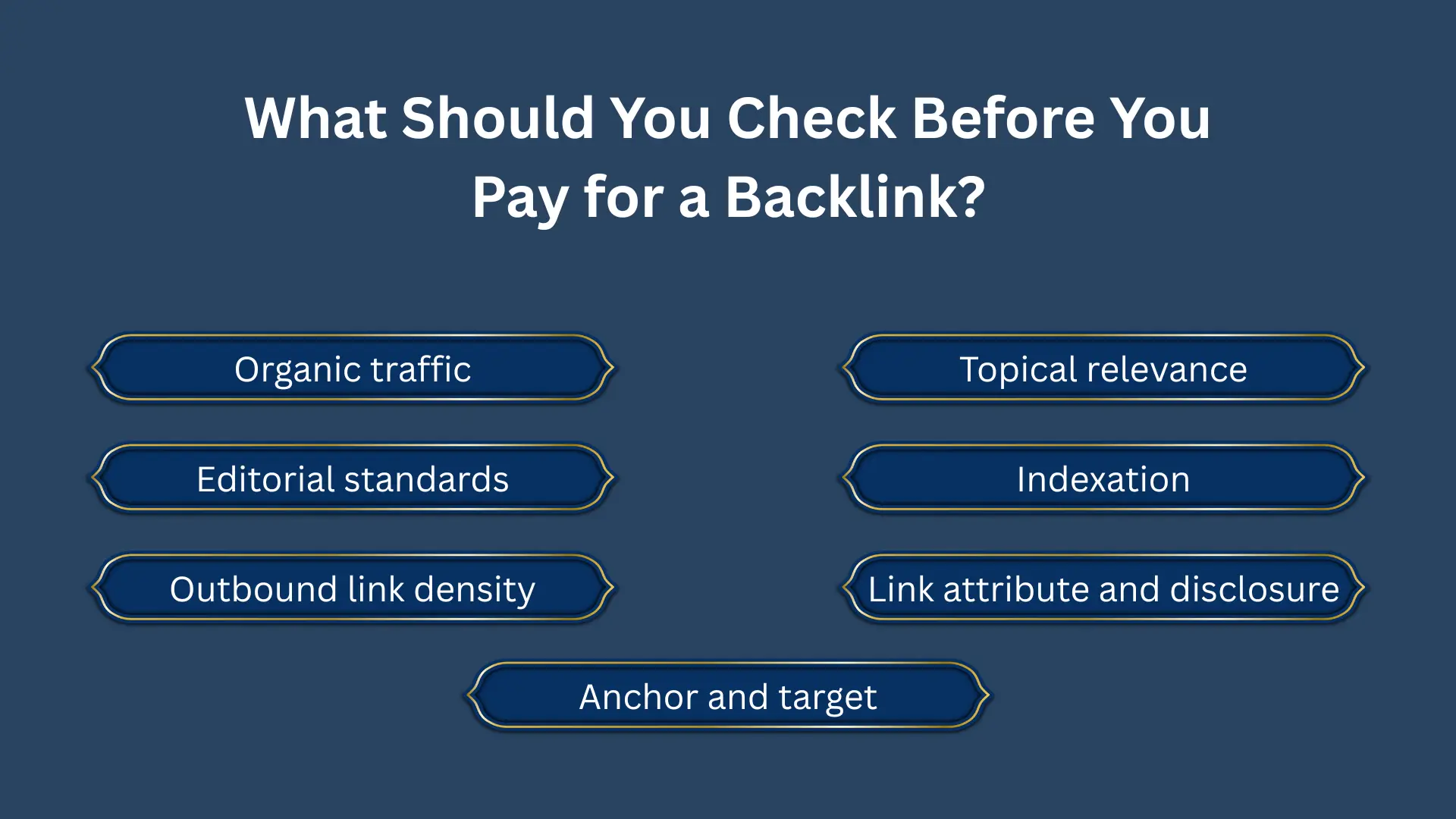
What Should You Check Before You Pay for a Backlink?
A domain rating is a first filter, not a verdict. Ask the seller for the site or a shortlist before you order, then run each candidate through these checks.
- Organic traffic and its trend. Open the site in Semrush or Ahrefs. A high rating attached to traffic that has fallen sharply usually means the site lost rankings, and that is often when owners start selling links.
- Topical relevance. The site’s categories should sit close to your own. A cooking blog linking to a mortgage broker persuades neither readers nor algorithms. In narrow verticals, the bar is higher still, as our guide to real estate backlinks shows.
- Editorial standards. Scroll the blog. A site that publishes on every subject, advertises “write for us” and “sponsored post” pages, and links to unrelated commercial sites in nearly every article is one that many other buyers use.
- Indexation. Search site:domain.com in Google. If the site returns nothing, a link from it will pass nothing.
- Outbound link density. Count external links in the last five or six posts. Several commercial links per article is a bad sign.
- Link attribute and disclosure. Ask in writing whether the link will be dofollow, sponsored, or nofollow, and whether the post will be labelled as sponsored. Decide with that information.
- Anchor and target. Agree on a brand name or natural phrase. Google’s own examples of link spam feature keyword-rich anchors repeated across paid articles.
For a wider comparison of sellers, see our guide to the best place to buy backlinks.
How Do You Verify a Backlink After You Buy It?
Most buyers stop at the delivery email. We treat delivery as the start of verification.
- Open the live URL. Confirm it loads as a normal page and that the article is visible to a visitor, not tucked into a hidden section.
- Check the source code. Search the page source for your domain. Confirm that the anchor text, the target URL, and the rel attribute match what you ordered.
- Confirm the page can be indexed. There should be no noindex tag, and the canonical tag should point to the page itself.
- Check Google indexing after a couple of weeks. Search a distinctive sentence from the article, or use the site: operator with the full URL.
- Look for the link in a backlink tool. New links commonly take days to weeks to appear. If yours has not shown up after 30 days, ask the seller to look into it.
- Watch referral traffic. In GA4, check sessions from the source domain. A few visits show that real readers exist.
- Recheck at 30, 90, and 365 days. Links that vanish are a known problem with paid placements, and a one-year guarantee only helps if someone checks. Put the dates in a calendar on the day of delivery.
How can you buy backlinks without creating a risky pattern?
- Vary anchors. Most should be your brand name, your bare URL or a natural phrase. Exact-match commercial anchors on every link are the clearest signal of manipulation.
- Spread the targets. Sending every link to one money page is easy to see. Point some at guides, resources, and category pages that deserve links on their own.
- Control the pace. A few links each month looks like growth. Thirty in a week does not.
- Pair paid with earned. Publish useful content and pursue mentions alongside purchases, so bought links make up a share of your profile rather than all of it.
- Refuse sites that sell to everyone. If a site’s blog is a queue of sponsored posts on unrelated topics, skip it, whatever its rating.
There is a search visibility angle too. AI-generated answers can only draw on pages that are indexed and accessible, and they tend to favor brands that appear credibly across several sites. A relevant placement that names your brand adds one more such place.
For more useful insights, explore our other blog post, “How to Get Backlinks From Wikipedia (Without Getting Your Edit Reverted)”. Discover more to deepen your understanding.
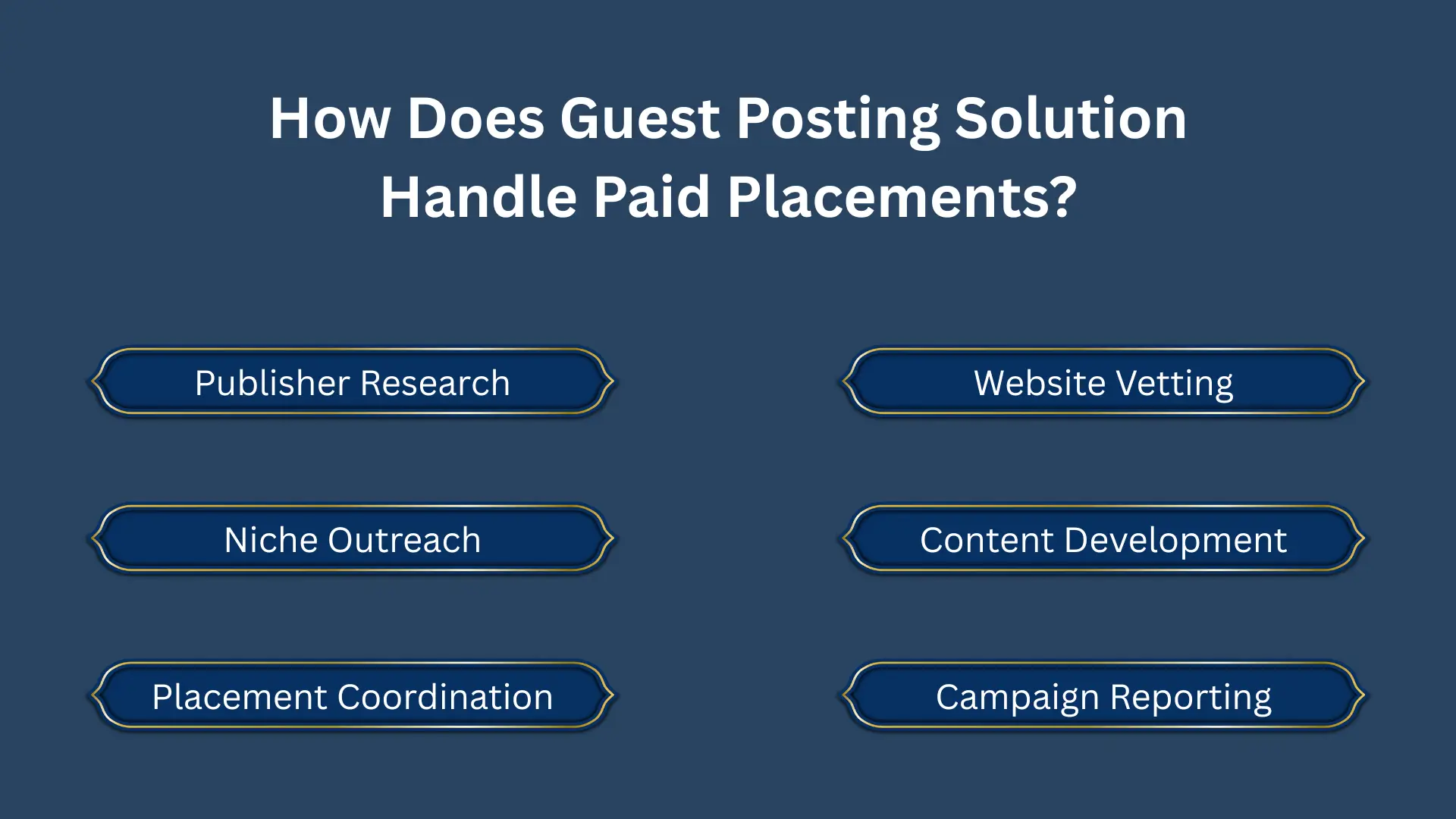
How Does Guest Posting Solution Handle Paid Placements?
Guest Posting Solution manages paid placements through a structured guest posting and link-building service focused on relevant publishers and contextual content. The process includes publisher research, website vetting, niche-specific outreach, content development, placement coordination, and campaign reporting.
Each opportunity can be assessed for domain authority, domain rating, organic traffic, topical relevance, editorial quality, and outbound link patterns before placement. Rather than relying on bulk backlink packages, the service connects brands with targeted publishing opportunities across relevant industries. Businesses can use these placements as part of a broader SEO strategy, content marketing, blogger outreach, and off-page SEO campaign, while reviewing each placement based on its purpose and quality. Our network includes more than 20,000 bloggers worldwide, with country-specific options such as UK, Australia, and Germany link building.
Conclusion
Buying backlinks works best as a narrow, deliberate tactic. A few relevant placements, natural anchors, honest expectations about Google’s policy, and proof after delivery. It works badly as a bulk shortcut. Size the gap first, choose sources on traffic and relevance rather than rating alone, and verify each link at 30, 90, and 365 days.
FAQs
Does Google Penalize Buying Backlinks?
It can. Google says sites that break its spam policies may rank lower or be removed from results, and it uses automated systems and human review to find them. Exposure rises with volume, exact-match anchors, and unrelated or low-quality source sites.
Are Bought Backlinks Worth It?
They can be, when the source site is relevant and has real traffic, and the link supports a page worth ranking. They are a poor use of budget when the page is thin, the site has indexing problems, or the links come from unrelated networks.
How Many Backlinks Should I Buy Per Month?
There is no universal number. Base it on the referring-domain gap between your page and the pages outranking it, then spread purchases over several months. A steady, modest pace is easier to defend than a bulk order placed in one week.