Anchor Text in SEO: How It Works, Types, and Impact on Rankings
In SEO, one of the most overlooked yet powerful ranking signals is anchor text in seo, which tells search engines what a linked page is about before users even click it.
Studies across major SEO platforms consistently show that search engines use anchor text, or anchor text meaning in simple terms, as a contextual bridge between pages to understand relevance and authority.
Many websites lose ranking potential or even face algorithmic suppression because they misuse anchor text links, especially when building backlinks without a clear strategy or balance.
This guide explains what anchor text in seo is, how it works, types of anchor texts, optimization methods, and how to use them safely in guest posting and link-building campaigns so you can make informed SEO decisions.
What is Anchor Text And How Search Engines Interpret It
Even with advanced algorithms and AI-driven search systems, anchor text still plays an important role in SEO. When search engines evaluate a page, they do not rely only on on-page content. They also look at how other pages describe that content through anchor text hyperlinks.
This is where what is anchor text in seo becomes important for rankings. Anchor text helps search engines understand:
- What the linked page is about
- How relevant is it to specific keywords
- Whether the link is natural or manipulated
For example, if multiple high-quality websites use similar anchor text pointing to a page about “on-page SEO techniques,” search engines start associating that page with that topic. This improves topical relevance and can positively influence rankings.
Anchor text also supports internal linking. When you use seo friendly text within your own website links, you guide search engines through your content structure. This helps distribute authority across pages and improves indexing.
In modern SEO, anchor text is also tied to semantic search. Search engines no longer rely only on exact keywords. Instead, they analyze variations and context. This is why anchor texts that include natural variations of keywords perform better than repetitive exact-match anchor text.
Risks of Ignoring Anchor Text Optimization in SEO
Ignoring the anchor text strategy can lead to weak SEO performance. If your website anchor structure is random or unoptimized, search engines may struggle to understand your content hierarchy.
Some common risks include:
- Weak keyword association, meaning your pages may not rank for relevant queries
- Poor internal linking structure, reducing crawl efficiency
- Missed opportunities to strengthen topic authority
- Unnatural link profiles if external sites link inconsistently
Another major issue arises when anchor text is over-optimized or ignored completely. A balanced approach is required. Without it, even strong content may fail to rank because search engines cannot clearly interpret its relevance.
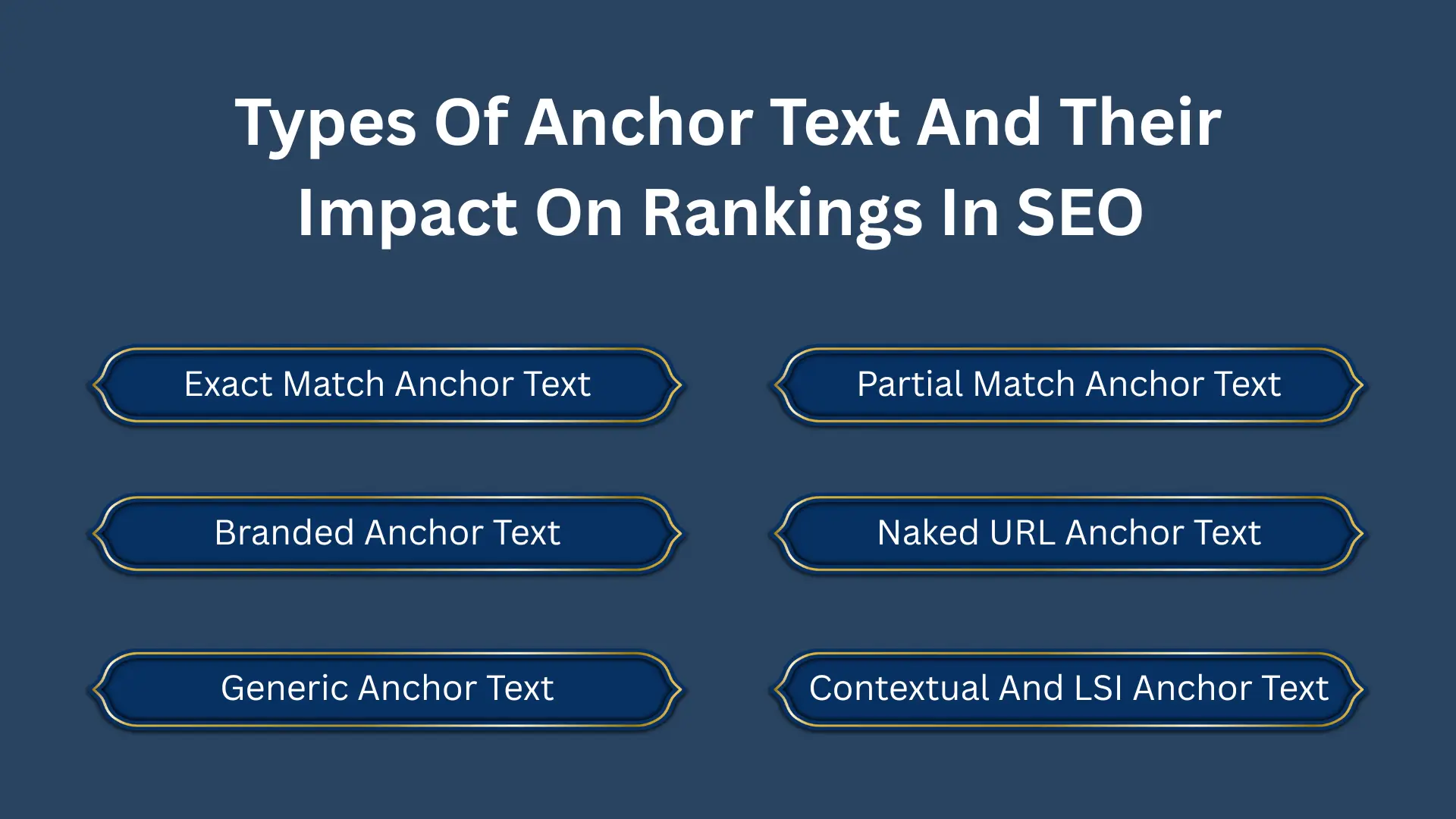
Types Of Anchor Text And Their Impact On Rankings In SEO
Understanding different anchor texts is essential for building a safe and effective SEO strategy. Each type of anchor text sends different signals to search engines and carries different levels of risk and value.
1. Exact Match Anchor Text And Its Direct SEO Influence
Exact match anchor text refers to links where the clickable text is the exact keyword you want to rank for. For example, if your target keyword is “anchor text in seo,” then using that exact phrase as the clickable link is considered exact match anchor text.
Example of exact match anchor text:
- “anchor text in seo” linking to a guide page about anchor optimization
- “SEO anchor text” linking to an SEO strategy article
- “what is anchor text in seo” linking to an educational blog post
This anchor text seo strategy is powerful because it sends a very strong relevance signal to search engines. It directly tells Google what the linked page is about, which can improve keyword ranking potential.
However, exact match anchors must be used carefully. Overusing them across backlinks can look unnatural and manipulative. Search engines may interpret this as over-optimization, especially if the same keyword is repeated too frequently across multiple domains.
Exact match anchors work best when used in moderation within high-quality contexts such as editorial backlinks, niche-relevant guest posts, and authoritative references.
2. Partial Match Anchor Text for Balanced Optimization
Partial match anchor text includes variations of the target keyword rather than repeating the exact phrase. It helps create a more natural and diversified link profile while still maintaining relevance.
Example of partial match anchor text:
- “Guide to anchor text in SEO strategies”
- “Understanding anchor text meaning in backlinks”
- “Best SEO anchor text practices for link building”
- “How anchor text links influence rankings”
These variations help search engines understand that your content is relevant to a broader set of related queries, not just one fixed keyword. This improves semantic SEO strength and helps your page rank for multiple search variations.
Partial match anchors are widely used in modern SEO because they reduce risk while maintaining strong topical relevance. They are especially effective in guest posting, where natural sentence flow is important.
3.Branded Anchor Text for Authority and Trust Building
Branded anchor text uses your brand name as the clickable link instead of targeting keywords. It is one of the most important elements in building long-term authority and trust.
Example of branded anchor text:
- “Guest Posting Solution” linking to your homepage
- “Guest Posting Solution SEO services”
- “Guest Posting Solution link building guide”
For a brand like Guest Posting Solution, branded anchors help establish strong entity recognition across the web.
This type of anchor text signals to search engines that your brand is being mentioned naturally by different sources. Over time, this strengthens your website’s authority and trust profile.
Branded anchors are also considered one of the safest types of anchor text because they are rarely seen as manipulative. Most strong backlink profiles naturally contain a high percentage of branded links.
4. Naked URL Anchor Text for Natural Linking Patterns
Naked URL anchor text refers to links that display the full URL instead of a keyword or phrase.
Example of naked URL anchor text:
- https://guestpostingsolution.com/
- https://example.com/seo-guide
- https://website.com/blog/anchor-text
These links are commonly used in citations, forums, blog comments, and reference lists. While they do not pass strong keyword relevance signals, they contribute to a natural and balanced backlink profile.
Search engines consider naked URLs as neutral and organic because they often appear naturally when users share links without optimization intent.
Although they are not powerful for ranking specific keywords, they play an important role in making your link profile look authentic and diverse.
5. Generic Anchor Text for User Experience Flow
Generic anchor text uses non-descriptive phrases like “click here,” “read more,” or “visit this page.” These anchors are mainly used for navigation and user experience rather than SEO targeting.
Example of generic anchor text:
- “Click here to learn more about anchor text definition.”
- “Read more about SEO strategies here.”
- “Visit this page for the full guide.”
While generic anchors do not contribute much keyword value, they improve readability and make content easier to follow for users. They help guide readers naturally through content without forcing keywords into every link.
However, from an SEO perspective, they should not be the primary linking strategy. Overuse of generic anchors can reduce keyword relevance signals and weaken overall SEO performance.
The best approach is to use them sparingly alongside branded, partial match, and contextual anchors to maintain balance and readability.
6. Contextual And LSI Anchor Text For Semantic SEO Strength
Natural anchor text includes context-based phrases that are not forced or keyword-heavy. LSI (Latent Semantic Indexing) anchors support topic relevance without repeating exact keywords.
Examples include:
- “How search engines interpret links.”
- “link building strategies for SEO”
- “contextual SEO signals”
These variations help search engines understand the broader topic of your content and improve ranking potential across multiple related queries.
How Search Engines Evaluate Anchor Text In SEO For Ranking Decisions
Search engines do not evaluate and define anchor text in isolation. Instead, they analyze multiple signals to determine whether a link is natural, relevant, or manipulative.
Context Surrounding Anchor Text Links
Search engines do not evaluate anchor text in isolation. They analyze the surrounding content to understand context. This means the same anchor text example can have different SEO value depending on how it is used.
For instance, the phrase “SEO guide” used in a digital marketing article carries more weight than the same phrase used in an unrelated context. This contextual evaluation helps search engines determine the true anchor text meaning.
Authority And Trust Of Linking Websites
The authority of the linking website also affects how anchor text is interpreted. A link from a trusted, high-authority site carries more weight than a link from a low-quality or spammy website.
Search engines also evaluate the “link neighborhood,” meaning the overall quality of websites linking to and from the source page. High-quality neighborhoods strengthen anchor text signals, while spam-heavy environments weaken them.
Spam Detection And Over-Optimization Patterns
Search engines actively monitor anchor text patterns to detect manipulation. Some warning signs include:
- Repeated use of exact match anchor text across multiple links
- Unnatural keyword stuffing in anchors
- Sudden spikes in backlinks with identical anchor text
- Low-quality or irrelevant linking domains
If these patterns appear, search engines may reduce rankings or ignore those links altogether. This is why natural diversity in anchor text links is essential.
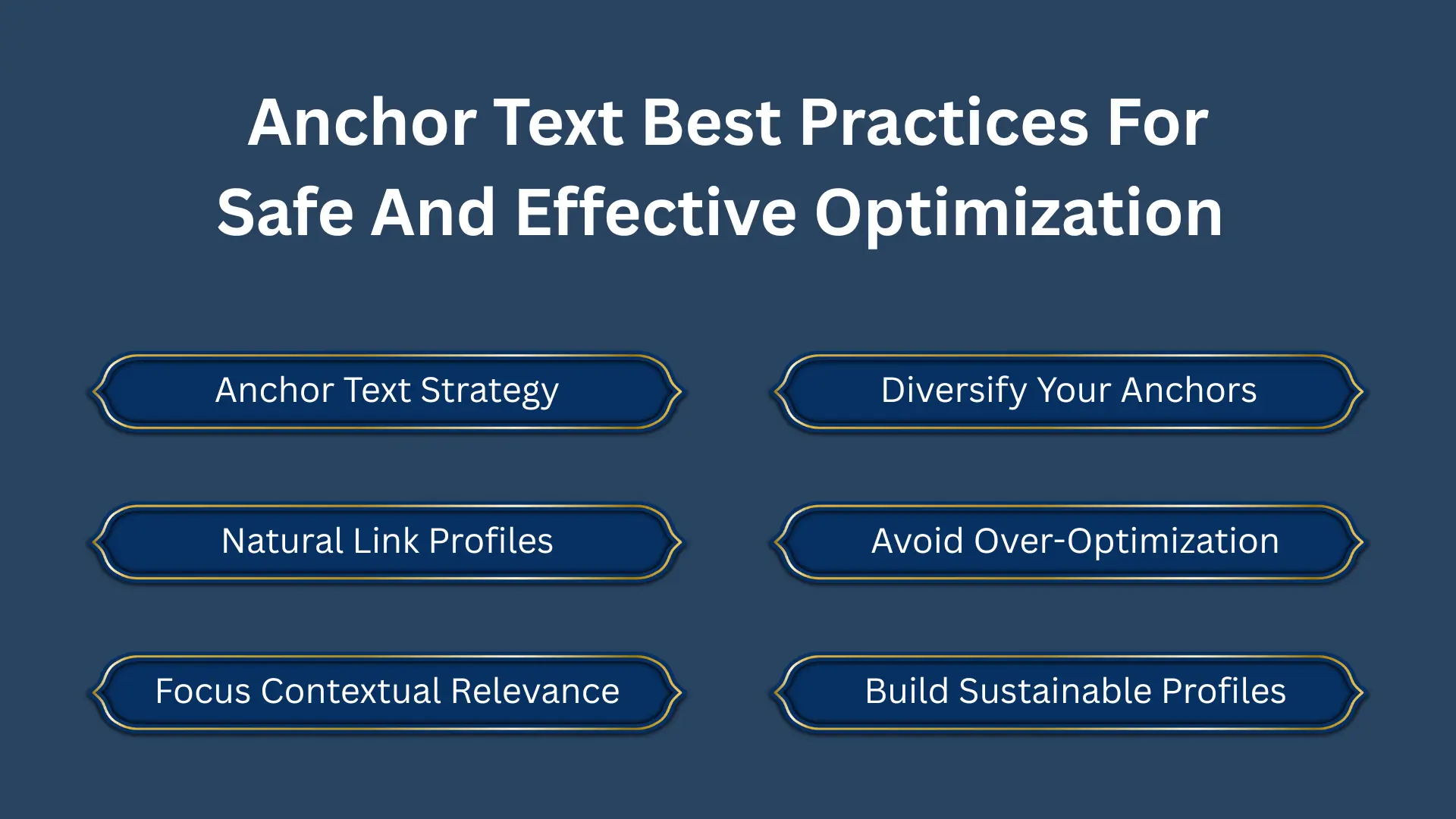
Anchor Text Best Practices For Safe And Effective Optimization
A strong SEO strategy requires careful planning of anchor text distribution. One of the most important practices is diversification. A healthy backlink profile includes a mix of branded, partial match, generic, and contextual anchors.
Anchor Text Diversification Strategy For Natural Profiles
A strong SEO strategy always includes anchor text diversity. Instead of relying on one type of anchor, you should combine multiple formats such as branded, partial match, and natural phrases.
A balanced profile typically includes:
- Branded anchors for authority
- Partial match anchors for relevance
- Naked URLs for natural signals
- Generic anchors for usability
This combination creates a realistic link profile that mimics natural linking behavior across the web.
For more useful insights, explore our other blog post, “How Internal Linking Services Boost Your Site’s SEO Performance”. Discover more to deepen your understanding.
Avoiding Over-Optimization And Keyword Stuffing Risks
Over-optimization happens when too many links use exact match anchor text. This can make your backlink profile look artificial.
To avoid this:
- Avoid repeating the same keyword in every anchor
- Focus on contextual relevance instead of forced keywords
- Monitor your backlink profile regularly
- Maintain a natural variation in anchor text seo usage
Search engines prioritize authenticity, so natural linking always performs better long-term.
Building Sustainable Anchor Text Profiles Over Time
A strong anchor text profile is built gradually. It comes from earning links through valuable content, guest posting, and editorial mentions rather than aggressive link building.
Over time, this creates a stable and trustworthy SEO foundation that supports long-term rankings.
Guest Posting And Anchor Text In SEO Strategy For Backlink Building
Guest posting allows you to control how your anchor text links appear in external content. When done correctly, it helps you build a natural and diversified anchor profile.
In guest posting, anchor text should always match the context of the article. This ensures that links appear natural and editorially placed rather than forced.
Choosing The Right Anchor Text For Guest Posts
When selecting anchor text for guest posts, it is important to:
- Match the topic of the content
- Prioritize branded anchors where possible
- Use partial match variations instead of exact match repetition
- Follow publisher guidelines
This approach ensures that your links remain safe and effective.
Common Anchor Text In SEO Mistakes That Harm Rankings
One of the biggest mistakes is overusing exact match anchor text. While it may seem like a direct way to rank for a keyword, it often creates an unnatural pattern that search engines may flag.
Another issue is using irrelevant anchors that do not match the destination page content. This confuses both users and search engines.
Ignoring diversity is also a major problem. A healthy SEO profile requires a mix of branded, natural, and keyword-based anchors. Without this balance, rankings may become unstable.
Final Verdict On Anchor Text In SEO Strategy
Anchor text in seo remains a foundational element of link building and search optimization. When the simpler option works: For new websites or low-competition niches, basic branded and natural anchor texts are often enough to build initial visibility without risk.
Why professional strategy matters: A structured anchor text in seo strategy ensures keyword relevance, prevents over-optimization, and builds a strong backlink profile that supports long-term rankings.
Market condition insight: As search engines continue refining link analysis systems, balanced and natural anchor text distribution is now essential for stable SEO growth and competitive visibility.
FAQs
What is a safe ratio for exact match anchor text?
There is no fixed rule, but SEO experts generally keep exact match anchor text low, often under 5 to 10 percent, and rely more on branded, partial, and natural variations for safety.
How does anchor text affect SEO performance in guest posting?
In guest posting, anchor text helps search engines understand topic relevance between the article and target page, improving contextual authority, keyword association, and overall backlink quality when used naturally.
Can a poor anchor text strategy hurt website rankings?
Yes, poor anchor text practices like over-optimization, repeated exact match anchors, or irrelevant links can trigger spam signals, reduce trust, and lead to lower rankings or algorithmic penalties over time.
What is the difference between keyword and anchor text?
A keyword is a search term users enter into search engines to find information, while anchor text is the clickable text in a hyperlink that connects one webpage to another. Keywords help content rank, whereas anchor text helps search engines understand the linked page’s topic.