Ecommerce Link Building Strategies: Scaling Product Page Authority
Most ecommerce brands obsess over product photography, checkout speed, and ad spend. Ranking an ecommerce store isn’t just about optimizing product titles or writing better descriptions. Thousands of online stores already do that. The real difference often comes down to authority.
Google treats backlinks as signals of trust. A product page backed by relevant, high-quality links has a much stronger chance of appearing above competitors, even when both pages target the same keyword. Yet product pages rarely attract links on their own. Most shoppers visit, compare prices, and leave. Publishers rarely reference a product page unless it adds something unique.
That’s where smart ecommerce link building strategies make the difference.
Instead of chasing random backlinks, successful brands build authority around categories, buying guides, research, and industry relationships, then channel that authority toward their commercial pages through a thoughtful internal linking structure. This creates sustainable ranking growth instead of temporary SEO wins.
What Is Ecommerce Link Building?
At its core, ecommerce link building is the process of earning relevant backlinks that strengthen the authority of an online store. Unlike traditional SEO campaigns that often focus on blogs or service pages, link building for an ecommerce website requires balancing informational content with commercial pages that actually generate sales.
The challenge is simple.
People naturally link to useful resources, research, and expert opinions. They rarely link directly to a product listing unless it provides exceptional value. That means ecommerce SEO isn’t only about getting links. It’s about creating an ecosystem where authority flows toward the pages that matter most.
A successful campaign combines digital PR, guest posting, editorial outreach, internal linking, and content marketing into one strategy rather than treating them as separate activities.
Why Ecommerce Websites Struggle to Earn Backlinks
Most product pages follow a familiar format. They include images, specifications, pricing, shipping details, and customer reviews. Helpful for buyers, certainly. Link-worthy for publishers? Usually not.
Imagine you’re writing an article about hiking boots. You’re far more likely to reference a comprehensive buying guide explaining boot materials than a single product page selling one pair of boots.
That difference explains why many ecommerce websites plateau in search rankings. They optimize products but never create content that attracts authority naturally.
Another common issue is scale.
Large ecommerce stores may contain thousands of product URLs. Building individual backlinks to every SKU simply isn’t realistic. Instead, authority needs to be built strategically and distributed through category pages, resource hubs, and internal links.
How Ecommerce Link Building Differs From Traditional SEO
Many SEO tactics work across industries, but ecommerce introduces challenges that don’t exist for local businesses or service providers.
Commercial pages have higher conversion value but lower link appeal. Products frequently go out of stock or become discontinued. Seasonal inventory changes create shifting priorities. Categories expand over time, making internal authority distribution more complex.
Traditional SEO often focuses on increasing blog traffic. Ecommerce SEO focuses on increasing qualified buying traffic.
That distinction changes how links should be earned.
Instead of measuring success only by referring domains, experienced SEO teams evaluate how backlinks influence category rankings, product visibility, and revenue.
Why Product Pages Need Authority More Than Blog Content
A blog article can generate traffic, but a product page generates sales.
That’s why authority eventually needs to reach commercial pages.
Many brands celebrate earning backlinks to educational articles while their product pages remain buried beyond page two of Google. The missing piece isn’t more blog content. It’s a strategy that transfers authority from informational assets to commercial pages through contextual internal links.
Think of blog content as the engine and product pages as the destination.
Without connecting the two, valuable authority gets trapped where it can’t produce meaningful business results.
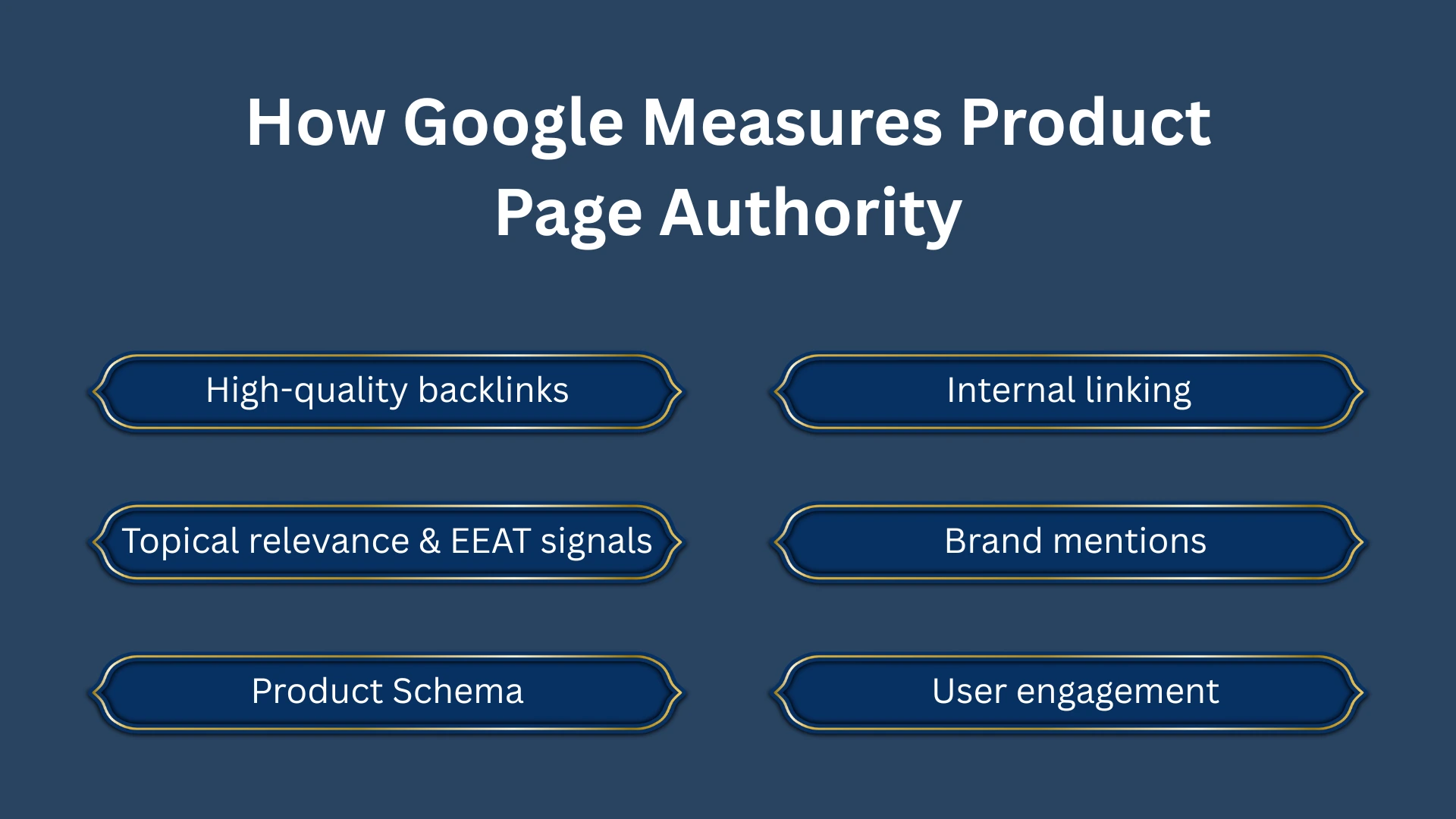
How Google Measures Product Page Authority
Google doesn’t use a single metric to measure page authority. Instead, it evaluates multiple trust signals that work together to determine rankings.
- High-quality backlinks: Relevant backlinks from trusted websites build credibility and authority.
- Internal linking: Pass authority from blogs and buying guides to category and product pages through strategic internal links.
- Topical relevance: Earn links from websites within your industry to strengthen niche authority.
- Brand mentions: Unlinked mentions across reputable websites help improve brand trust and entity recognition.
- EEAT signals: Display expert content, authentic reviews, transparent policies, and secure checkout pages to build credibility.
- Product Schema: Use structured data to help Google understand product details and improve rich result visibility.
- User engagement: Pages that satisfy search intent with longer visits and better engagement often perform better in search results.
Why Most Ecommerce Link Building Campaigns Fail
Many ecommerce brands invest in SEO but struggle to improve rankings because their strategy focuses on the wrong areas. Avoid these common mistakes:
- Building links only to the homepage: Spread authority to category and product pages, not just the homepage.
- Ignoring category pages: Target high-intent category pages that drive commercial traffic.
- Using over-optimized anchor text: Maintain a natural mix of branded, generic, and partial-match anchors.
- Choosing low-quality guest posts: Prioritize relevant, authoritative websites over high DA alone.
- Relying on spammy link schemes: Avoid PBNs and automated backlinks that risk Google penalties.
- Poor internal linking: Pass authority from blogs and guides to commercial pages.
- Focusing only on Domain Authority: Measure success through rankings, organic traffic, and revenue, not DA scores alone.
If you’re building links for an ecommerce store, our Ecommerce SEO guide covers the broader strategy.
Ecommerce Link Building Strategies That Actually Work
Strong backlinks don’t happen by accident. They come from consistent outreach, valuable content, and genuine relationships. The most successful brands don’t rely on a single tactic. They combine several ecommerce link building strategies to create a backlink profile that looks natural and continues to grow over time.
If you’re building links for an ecommerce store, focus on relevance before volume. A handful of editorial links from respected websites within your niche will almost always outperform dozens of unrelated backlinks.
1. Digital PR Campaigns
Digital PR has become one of the most effective ways to earn authoritative backlinks.
Instead of pitching products, create stories that journalists actually want to cover. Original research, consumer surveys, industry trends, or unique sales data can generate media attention that traditional outreach rarely achieves.
Suppose an online furniture store analyzes five years of customer purchasing trends and publishes insights about changing home office habits. News websites, bloggers, and industry publications are far more likely to reference that research than another promotional article.
Those editorial links carry lasting SEO value because they’re earned naturally.
2. Guest Posting on Relevant Industry Websites
Guest posting remains one of the safest and most scalable approaches to link building for ecommerce website campaigns.
The key is relevance.
Choose websites that publish content related to your products, industry, or audience. An outdoor gear brand should contribute to adventure blogs, travel publications, or hiking communities instead of general marketing websites.
Well-written guest posts establish expertise while creating contextual backlinks that support category pages, buying guides, or resource hubs.
The focus should always be on educating readers first. The backlink is a byproduct of valuable content.
3. Blogger Outreach
Many niche bloggers have loyal audiences that trust their recommendations. That trust makes blogger outreach especially valuable for ecommerce businesses.
Reach out with personalized emails instead of mass templates. Explain why your product or resource genuinely fits their audience. If your content solves a problem or adds useful information, bloggers are much more likely to reference it.
Authenticity matters. People can spot generic outreach emails within seconds.
4. Product Review Outreach
Product reviews create backlinks while also increasing buyer confidence.
Send products to reputable reviewers, industry experts, or creators who regularly publish detailed evaluations. Honest reviews tend to perform better than scripted promotions because readers trust balanced opinions.
Not every review needs to be glowing. Credibility often increases when reviewers discuss both strengths and limitations.
5. Resource Page Outreach
Many educational websites maintain curated resource pages for specific industries. These pages exist to help readers discover useful tools, guides, and businesses.
If your ecommerce store publishes comprehensive buying guides, calculators, or educational resources, they may qualify for inclusion.
Resource pages often remain online for years, making them valuable long-term backlink opportunities.
6. Broken Link Building
Broken link building requires more effort than sending cold emails, but it consistently produces quality backlinks.
The process is straightforward.
Find outdated pages with broken links, create a better replacement, then notify the website owner.
You’re helping them improve their content while earning a relevant backlink. That’s why this strategy continues to work despite changing search algorithms.
7. Competitor Backlink Replication
Your competitors have already invested time discovering valuable link opportunities.
Learn from them. Tools like Ahrefs or Semrush reveal which websites link to competing ecommerce brands. Analyze those backlinks carefully.
Don’t copy everything.
Instead, identify high-quality editorial placements that align with your business and develop stronger outreach than your competitors used.
Sometimes improving an existing idea produces faster results than starting from scratch.
8. Niche Edits and Link Insertions
Existing articles with established authority often provide stronger SEO value than newly published pages.
A niche edit places your resource naturally into relevant content that already ranks well. This strategy works best when the added link genuinely improves the article.
Avoid forcing links into unrelated paragraphs. Editors recognize that immediately.
9. Manufacturer and Supplier Backlinks
Many ecommerce businesses overlook one of their easiest backlink sources.
Their suppliers. Manufacturers frequently maintain dealer directories, authorized retailer pages, or partnership listings.
If you stock recognized brands, request inclusion on their website. These links are highly relevant and strengthen topical authority.
10. Affiliate and Partnership Opportunities
Affiliate relationships extend beyond commissions.
Strategic partnerships with complementary businesses often lead to editorial mentions, collaborative content, webinars, or co-branded resources that generate natural backlinks.
For example, a fitness equipment store might collaborate with a nutrition brand on a complete home wellness guide. Both audiences benefit. Both businesses gain authority.
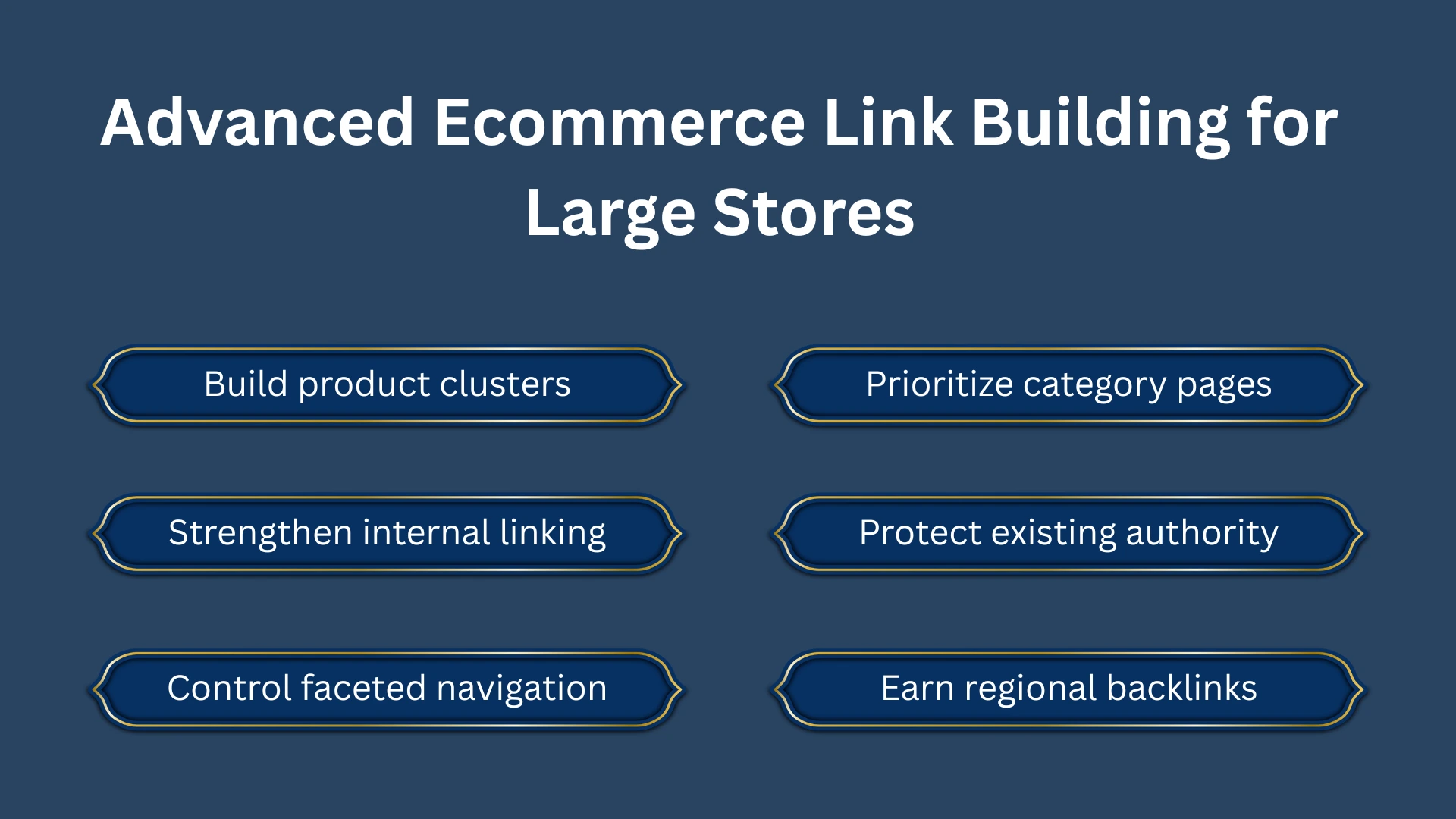
Advanced Ecommerce Link Building for Large Stores
Managing five thousand products isn’t easy. That’s where advanced ecommerce link building becomes essential.
Instead of thinking page by page, successful enterprise stores build authority at the category and topic level.
- Build product clusters: Group related products under categories and support them with buying guides to strengthen multiple pages at once.
- Prioritize category pages: Focus outreach on high-value category pages targeting competitive commercial keywords.
- Strengthen internal linking: Connect blogs, guides, categories, and products to distribute authority effectively.
- Protect existing authority: Redirect discontinued product URLs to relevant alternatives or categories.
- Control faceted navigation: Use canonical tags and proper indexing to prevent duplicate content issues.
- Earn regional backlinks: Build links from country-specific publications and industry websites to improve local search authority and international visibility.
Why Choose Guest Posting Solution for Ecommerce Link Building
Successful ecommerce SEO depends on more than acquiring backlinks.
It requires a strategy that aligns every link with measurable business goals.
At Guest Posting Solution, every campaign begins with competitor research, backlink gap analysis, and an evaluation of your existing authority. Instead of relying on generic outreach lists, the team identifies websites that are topically relevant to your niche and capable of driving meaningful SEO value.
The focus stays firmly on white-hat practices.
Each campaign also considers internal authority flow, helping backlinks support the pages that influence rankings, organic traffic, and conversions. The result isn’t simply a stronger backlink profile.
Conclusion
Strong ecommerce link building strategies create lasting authority, not just more backlinks. Focus on earning relevant links, strengthening category and product pages through internal linking, and publishing valuable content that attracts natural mentions.
A consistent, white-hat approach improves rankings, organic traffic, and long-term revenue. As search engines and AI-powered search prioritize trust and expertise, investing in strategic ecommerce link building helps your online store stay competitive and achieve sustainable growth.
FAQs
Can AI-generated content replace link building?
No. AI can assist with research and drafting, but authority still comes from trusted editorial mentions, genuine expertise, and high-quality backlinks earned through valuable content and authentic relationships.
How many backlinks does an ecommerce website need?
There isn’t a fixed number. The quality, relevance, and authority of backlinks matter more than quantity. Analyze your competitors’ backlink profiles to estimate how many high-quality links are needed to compete for your target keywords.
How often should an ecommerce website build backlinks?
Link building should be an ongoing process. Consistently earning relevant, high-quality backlinks creates a natural growth pattern and supports long-term improvements in rankings and organic traffic.