Competitor Keyword Research: The Smart Way to Win SEO 2026

Competitor keyword research means studying which search terms your competitors already rank for, then using that data to find realistic opportunities for your own site. It trades guesswork for proven demand: instead of betting on keywords nobody has validated, you build on search behavior that’s already driving traffic and revenue somewhere in your market.
Most businesses still pick keywords by volume alone. A tool spits out a list, the highest numbers get circled, and content gets built around them. The result is predictable: a lot of writing, very little conversion. The real opportunity sits in the keywords competitors have already turned into paying customers, and those rarely top the volume charts.
A data-backed competitor strategy flips the process. You align your content with intent that’s already been tested in the market, sharpen keyword performance, and build a roadmap around outcomes you can actually measure, not just rankings you can screenshot.
What Is Competitor Keyword Research?
Competitor keyword research is the process of identifying the keywords your competitors rank for in search engines and using those insights to discover valuable opportunities for your own SEO strategy.
Instead of guessing which keywords might perform well, you study websites already earning visibility in Google Search. This allows you to identify keywords that attract qualified visitors, match user intent, and support business goals.
A complete competitor keyword analysis goes beyond exporting a list of keywords. It helps you understand:
- Which pages generate the most organic traffic
- What search intent competitors satisfy
- Which keyword clusters support their rankings
- How they structure content around important topics
- Where keyword gaps create opportunities for your business
The goal isn’t to copy competitors. It’s to learn what works, improve on it, and create content that delivers more value to users.
Why Competitor Keyword Research Matters More Than Traditional Keyword Research
Traditional keyword research usually starts with search volume. You enter a topic into a keyword tool and receive hundreds or thousands of suggestions. While this provides useful ideas, it doesn’t explain which keywords actually generate meaningful business results.
Competitor keyword research starts with real-world performance.
Instead of relying on assumptions, you analyze websites that already rank for your target audience. These rankings demonstrate that Google has validated the content and users are actively searching for those topics.
Here’s how both approaches compare:
| Traditional Keyword Research | Competitor Keyword Research |
|---|---|
| Focuses mainly on search volume | Focuses on proven ranking opportunities |
| Generates broad keyword lists | Identifies validated keywords |
| Limited competitive insight | Reveals competitor strengths and weaknesses |
| Difficult to prioritize | Easier to identify high-value opportunities |
| Often traffic-focused | Balances traffic with conversions |
Another advantage is understanding search intent.
A keyword with thousands of monthly searches may bring visitors who only want information. Another keyword with far fewer searches may attract buyers ready to request a quote or purchase a service.
Competitor analysis helps you distinguish between these opportunities and prioritize keywords that contribute to revenue instead of vanity metrics.
How to Find Competitor Keywords for Better Growth
Successful competitor keyword research follows a structured workflow rather than collecting thousands of random keywords.
Step 1: Identify Your True SEO Competitors
Your biggest business competitors aren’t always the websites competing with you in Google Search. Search your primary products, services, or target keywords and note the websites that consistently appear on the first page. These are your SEO competitors. Studying their rankings gives you a realistic benchmark and reveals the strategies already working within your niche.
Step 2: Analyze Their Top-Performing Pages
Instead of reviewing an entire website, focus on the pages generating the most organic traffic. These are often service pages, product pages, buying guides, comparison articles, and in-depth resources. Analyzing these high-performing pages helps you understand which topics, content formats, and keywords Google rewards in your industry.
Step 3: Extract Their Ranking Keywords
Once you’ve identified the best-performing pages, uncover the keywords driving their visibility. Look beyond primary keywords and collect long-tail keywords, semantic variations, question-based searches, commercial modifiers, and local search terms. Grouping related keywords together helps you build topical authority and create content that targets multiple relevant search queries.
Step 4: Organize Keywords by Search Intent
Every keyword reflects a user’s goal, so organize your keyword list by search intent. Informational keywords answer questions, commercial keywords help users compare solutions, and transactional keywords target people ready to take action. Mapping keywords to the customer journey makes it easier to create content that satisfies user intent and improves conversion opportunities.
Step 5: Prioritize High-Value Keyword Opportunities
Not every keyword is worth targeting first. Evaluate each opportunity based on business relevance, keyword difficulty, search volume, traffic potential, conversion potential, and competitive landscape. Prioritizing high-impact keywords allows you to focus your SEO efforts on opportunities that can generate qualified traffic, improve rankings, and deliver measurable business results.
For more useful insights, explore our other blog post, “How to Perform Effective Competitor Analysis SEO”. Discover more to deepen your understanding.
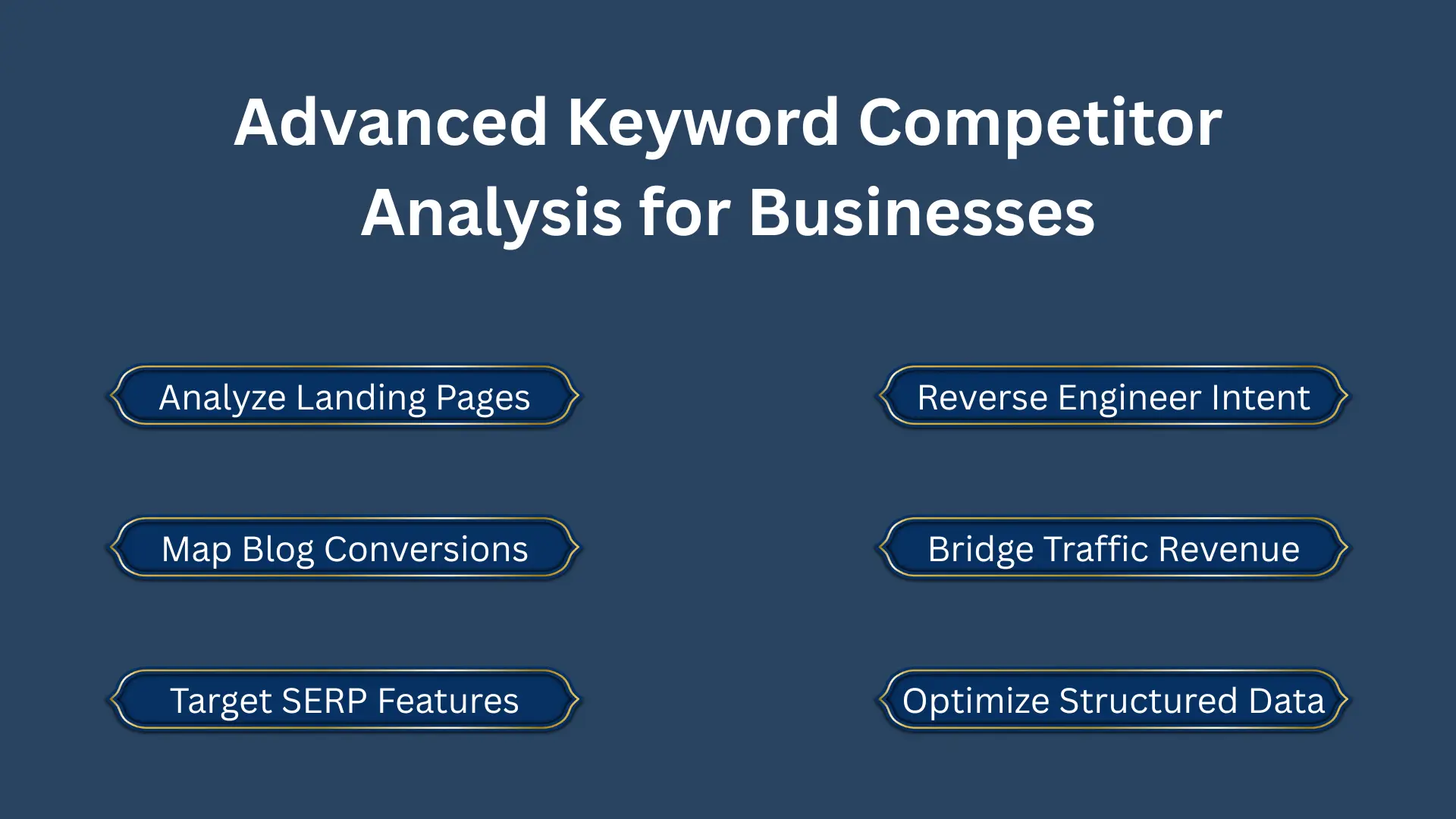
Advanced Keyword Competitor Analysis for Businesses
Competitor analysis exposes strengths and weaknesses in how a rival approaches search. Used well, it helps you build sharper, more conversion-focused pages, not a copy of what’s already out there.
1.Reverse Engineering Competitor Landing Pages
Landing pages are where conversions happen, so analyzing a competitor’s service and pricing pages tends to surface bottom-funnel keywords, high-intent queries, and language patterns tied directly to conversion. These terms often have lower search volume, but they carry more business value per visit.
2.Competitor Blog-to-Conversion Keyword Mapping
Many competitors use their blog to attract traffic, then move readers toward a product or service page through internal links. Mapping that path means identifying which posts drive traffic, tracing how they connect to commercial pages, and building the same flow on your own site.
3.Hidden Keyword Opportunities in SERP Features
SEO isn’t limited to the traditional ten blue links anymore. People Also Ask boxes, featured snippets, and structured answers all offer extra visibility. Content with clear headings and direct, well-structured answers has a better shot at appearing there. Ignoring these features caps your visibility even when your ranking is solid.
Competitor Keyword Research for Different Business Goals
Competitor keyword research is not a one-size-fits-all strategy. The way you analyze and use competitors’ keywords should align with your business model, sales cycle, and customer journey. Different businesses require different keyword priorities because user intent varies across industries and buying stages.
Understanding search intent is critical here. Keywords generally fall into categories such as informational, commercial, and transactional, each representing a different stage in the buyer journey. When you align competitor keyword analysis with these intent types, your SEO strategy becomes more targeted and conversion-focused rather than traffic-driven.
1. Lead Generation Businesses
Lead generation businesses, such as service providers, consultants, and local companies, should prioritize high-intent and action-driven keywords.
Focus on:
- Service-based keywords
- High-intent queries
- Location-based modifiers
These keywords often reflect users who are ready to take action, such as booking a service or requesting a consultation. Transactional queries, for example, typically include action terms and indicate users are prepared to convert.
Competitor keyword analysis in this space helps identify which service pages are generating leads. By analyzing competitor landing pages, you can uncover patterns like keyword placement, CTA positioning, and content structure that influence conversions.
Local intent also plays a key role. Keywords with geographic modifiers (e.g., “near me” or city-based searches) trigger location-specific results and require a localized SEO strategy to compete effectively.
2. E-commerce Stores
E-commerce businesses operate in a highly competitive environment where buyer intent and product visibility determine success.
Prioritize:
- Product keywords
- Comparison keywords
- Buyer-intent searches
Competitor keyword research helps uncover which product pages, category pages, and comparison articles drive the most traffic and sales. Instead of targeting generic keywords, focus on transactional and commercial queries, where users are actively evaluating or ready to purchase.
Commercial keywords often include terms like “best,” “top,” or “review,” indicating users are comparing options before buying . These keywords are essential for capturing mid-funnel traffic and guiding users toward a purchase decision.
Additionally, analyzing competitor product pages reveals:
- Pricing strategies
- Keyword-rich product descriptions
- Internal linking to related products
This allows you to optimize your own product pages not just for rankings, but for conversion efficiency.
3. Agencies & SaaS Companies
Agencies and SaaS businesses require a more layered approach because their sales cycle is longer and involves multiple touchpoints.
Target:
- Problem-solving keywords
- Funnel-based queries
- Educational + commercial keyword mix
These businesses must capture users at different stages of the funnel. Informational keywords help attract users seeking solutions, while commercial and transactional keywords move them closer to conversion. Informational queries are typically used by users looking to learn, making them ideal for building trust and authority.
Competitor keyword analysis helps identify:
- Blog topics that generate traffic
- Keywords used in case studies and landing pages
- Funnel pathways from content to conversion
For example, a SaaS company might attract users through a blog post targeting “how to improve email marketing,” then guide them toward a service page optimized for “email marketing software pricing.”
This combination of educational and conversion-focused keywords creates a complete funnel strategy that not only drives traffic but also nurtures leads and builds long-term authority.
Free vs Paid Competitor Keyword Research (Strategic Comparison)
| Feature | Free Keyword Research Tools | Paid Keyword Research Tools |
|---|---|---|
| Cost | Free to use | Subscription-based, monthly or annual |
| Data accuracy | Rough estimates, limited precision | Granular, verified data |
| Keyword suggestions | Shallow, surface-level lists | Deep coverage, including long-tail and semantic variants |
| Competitor analysis | Manual SERP checks | Automated gap analysis with historical trends |
| Search intent insights | Minimal classification | Full intent breakdown: informational, commercial, transactional |
| Scalability | Fine for a single small site | Built for agencies and multi-site campaigns |
| Best for | Beginners and early-stage startups | Agencies and businesses running serious SEO programs |
Common Mistakes in Keyword Competitor Analysis
Many businesses fail not because of a lack of effort, but because of poor strategy. Common mistakes include:
- Targeting high-volume keywords without intent
- Ignoring conversion-focused keywords
- Copying competitor keywords blindly
- Not filtering keyword opportunities
Focusing only on search volume often leads to poor results, as high-volume keywords don’t guarantee relevance or conversions. Success comes from balancing intent, competition, and business value.
Turning Competitor Keywords into a Scalable SEO Strategy
Keyword research alone does not drive results. Execution does.
A scalable strategy includes:
- Building keyword clusters
- Creating a structured content roadmap
- Mapping keywords to specific pages
The goal is to connect: keywords → content → conversions
Competitor keyword research helps identify gaps, refine content strategy, and significantly improve organic visibility when implemented correctly
This transforms SEO from a one-time effort into a long-term growth system.
Why Businesses Choose Professional Competitor Keyword Research Services
Execution takes expertise, which is why most businesses eventually bring in a professional team rather than run this in-house indefinitely. The payoff usually shows up as faster implementation, sharper keyword prioritization, and a better return on the time invested.
Want to uncover competitor keywords that actually drive leads and sales? Guest Posting Solution builds keyword strategies around competitor research and execution, not guesswork.
Conclusion
Competitor keyword research isn’t about copying a rival’s playbook. It’s about decoding the intent and performance behind what’s already working in your industry, then building past it. That shift moves you beyond surface-level SEO and into patterns that actually influence rankings, traffic, and revenue.
Pair keyword insight with real buying intent and you get a growth path that’s predictable rather than lucky. Over time, the businesses that win aren’t the ones that matched their competitors. They’re the ones that kept refining the data into sharper decisions long after the first campaign ended.
FAQs
How do you find competitors’ keywords effectively?
Combine SEO tools, SERP analysis, and manual review of competitor pages to extract keywords that are both driving traffic and matching real search intent, not just showing up in a volume report.
What counts as a keyword opportunity in SEO?
A keyword with realistic ranking potential once you weigh competition, search intent, and how relevant it is to your business, not simply a term with a high search volume.
Is competitor keyword analysis actually useful for growth?
Yes. It surfaces keywords that are already proven, cuts down the guesswork in campaign planning, and gives you a data-driven starting point that tends to outperform keyword lists built from volume alone.