On-Page SEO Services: Learn How to Perfect Every Page
Your site should rank well. Yet, many sites fail. And you may feel frustrated because your pages don’t show up the way you hoped. Even worse, you may not know what is holding your site back. But the truth is simple. A hidden on-page issue often stops a site from ranking. Many owners, marketers, and content creators face this same problem. However, some know the power of On-Page SEO Services.
These services go far beyond adding keywords. Instead, they target every element on a page. They align what users want with what search engines value. And today, factors like speed, user experience, structured data, and mobile design matter more than ever. So on-page SEO sits at the core of real rankings.
With the right approach, you don’t hope for results. Instead, you build them. So this post walks you through on-page SEO with simple, expert tips. And it ends with a practical On-Page SEO Checklist 2025 you can use on every page.
What Is On-Page SEO?
First, let’s break it down. On-page SEO includes everything you can optimize on your page. It covers your content, your HTML, your media, and your internal links. And it aims to match your page with what your visitors want.
Next, it deals with the technical parts you control. That includes title tags, meta descriptions, headers, URLs, and image alt text. And it also includes user experience. So you look at load time, mobile layout, and ease of navigation.
Unlike off-page SEO, which deals with backlinks, on-page SEO sits in your hands. And while technical SEO sounds like a separate world, it connects directly to your pages. So both work together to boost rankings.
Why Is On-Page SEO Important?
You may think your content is enough. But content alone no longer wins. So here is why on-page SEO matters more today:
1. Relevance & Intent
First, on-page SEO aligns your content with search intent. When people search, they have a goal. So your headings, meta tags, and structure must match that goal. And when they do, search engines trust your page more.
2. Better User Experience
Next, Google focuses on Core Web Vitals. These metrics track how fast your page loads, how stable it feels, and how fast it reacts. And poor scores hurt your rankings. So on-page SEO fixes this. It compresses images, cleans your code, and makes your layout stable.
3. Higher Click-Through Rates (CTR)
Then, good on-page SEO improves CTR. When your title and meta speak to users, they click more. And structured data creates rich snippets, which attract even more attention.
4. Improved Crawlability & Indexing
Search engines need to understand your page. So they scan your headers, URLs, and internal links. Clear structure leads to better indexing. And this removes duplicate content issues.
5. Long-Term ROI
Paid ads stop when you stop paying. But on-page SEO keeps working. Each optimized page becomes an asset that grows with time. And with updates, it keeps pulling traffic.
6. Scalability
Large sites need systematic optimization. On-page SEO help scale across many pages. So you get consistent structure and performance everywhere.
In short, on-page SEO is not optional. Instead, it is the core difference between a weak site and one that ranks, engages, and converts.
On-Page SEO Factors That Make or Break Rankings
Now let’s explore the most important factors.
1. User Experience & Core Web Vitals
Visitors need fast and stable pages. So these metrics guide your work:
- LCP: Measures how fast the biggest element loads.
- CLS: Tracks layout shifts during loading.
- FID: Measures how fast your page reacts to the first click.
Services improve these by compressing images, using lazy loading, caching files, and cleaning code. And these steps make your site fast and smooth.
2. Content Quality & Relevance
Content drives SEO. So you must make it clear, deep, and helpful.
Experts do this by:
- Matching content with intent.
- Using semantic keywords.
- Covering related topics in detail.
- Answering common questions.
- Strong content proves expertise.
3. Title Tags & Meta Descriptions
Your title and meta act like your shop window. So they must be clear and keyword-rich. They must also match intent. And they must be compelling enough to grab a click.
4. Header Tags (H1, H2, H3)
Headers guide both users and search engines. So structure your content with a logical flow. Add keywords, but keep them natural. And break your content into sections that people can scan fast.
5. URL Optimization
Your URLs should be short, clean, and relevant. Remove extra words. Avoid long strings. And add canonical tags when you have similar pages.
6. Image & Multimedia Optimization
Images help readers. But they slow down pages when not optimized. So, rename file names, add alt text, compress files, and use modern formats like WebP. And make sure videos load fast and don’t block rendering.
7. Internal Linking & Navigation
Internal links help users discover more content. And they help search engines understand your site. So use keyword-rich anchors that still feel natural. And support navigation with menus and breadcrumbs.
8. Schema Markup / Structured Data
Schema helps search engines understand your page. So add relevant schema types like:
- FAQ
- Article
- Product
- Breadcrumb
These improve clarity and can create rich snippets.
9. Mobile Friendliness
Most users browse on mobile. And Google uses mobile-first indexing. So your site must look clean on small screens. Fonts, buttons, and layout must be easy to tap and read.
10. E-E-A-T: Experience, Expertise, Authority, Trust
Show users you know your field. Use author bios, clear facts, and trustworthy references. Add reviews and testimonials when valid. And keep your content accurate.
11. Maintenance & Continuous Optimization
SEO is never a one-time fix. So check your pages often. Update slow pages. Refresh outdated content. Test different versions of your headings or meta. And keep improving your site step by step.
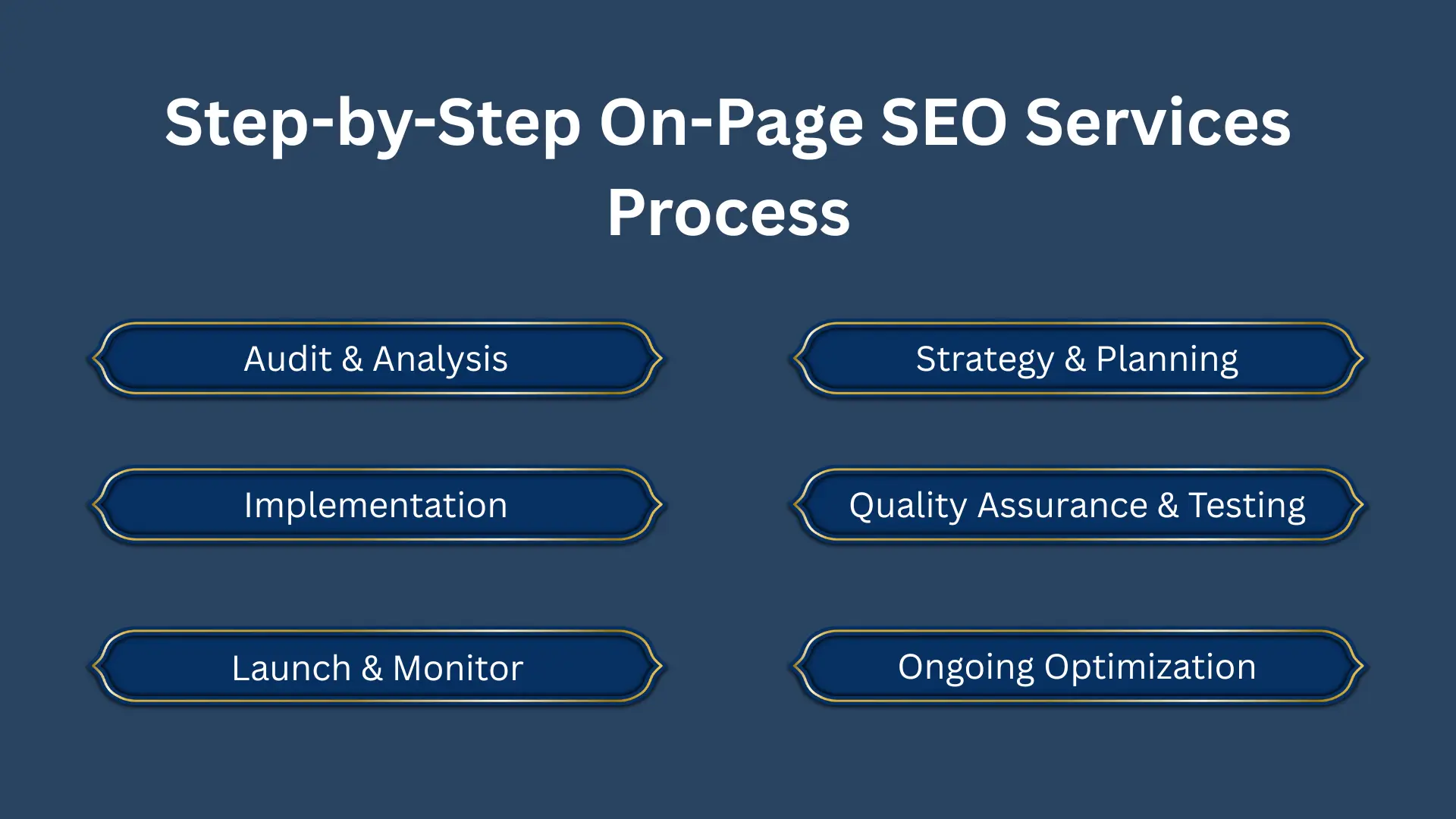
Step-by-Step On-Page SEO Services Process
A strong on-page SEO process works best when it follows clear steps. So let’s walk through how a professional team (like Guest Posting Solution) handles everything from the first audit to long-term improvements.
1. Audit & Analysis
First, the team starts with a complete on-page audit. They check your content, layout, headings, URLs, and media. Then they dig deeper into technical issues, because speed and stability matter. They review Core Web Vitals, mobile performance, schema, and internal linking. After that, they run a content-gap analysis. This step shows where your content falls short of search intent or keywords.
2. Strategy & Planning
Next, the team builds a clear plan. They start with keyword research that includes primary terms and semantic keywords. Then they map these keywords to the correct pages. This helps match each page with the right user intent. After that, they set priorities. High-traffic or weak pages come first so you get results faster.
3. Implementation
Then the real work begins. The team improves your content so it reads better and ranks higher. They add semantic keywords and clean up the structure. After that, they fix technical issues. They compress images, optimize code, and enable lazy loading. Then they improve schema markup, refine internal links, and fix header tagging. Finally, they update meta titles, descriptions, and URLs.
4. Quality Assurance & Testing
Once the changes are live, the team tests everything. They check load speed again. They validate schema with Google’s Rich Results Test. Then they confirm that search engines can crawl and index each page. This step prevents mistakes that can hurt rankings.
5. Launch & Monitor
After testing, they launch the optimized pages. Then they set up tracking. They monitor traffic, bounce rate, CTR, and user behavior. They also check page speed and engagement. Tools like Google Analytics and Search Console help track every change.
6. Ongoing Optimization
Because SEO is never done, the team keeps improving your pages. They schedule monthly or quarterly audits. Then they refresh evergreen content to match new trends and user needs. After that, they run A/B tests on titles, CTAs, and internal links. This ongoing process helps maintain and grow performance over time.
On-Page SEO Checklist: Optimize Every Page
Here is a practical on-page SEO checklist that covers everything you need to consider when optimizing each page (or when working with an agency like Guest Posting Solution):
- Perform a detailed on-page audit (content, headings, URLs)
- Check and improve Core Web Vitals: LCP, CLS, FID
- Optimize content quality: align with user intent, use semantic keywords
- Craft SEO-friendly, compelling title tags
- Write effective meta descriptions for CTR
- Structure headings (H1 / H2 / H3) logically
- Ensure URLs are clean, readable, and keyword-relevant
- Optimize images: file names, alt text, compression, modern formats
- Implement or improve internal linking strategy
- Use schema markup / structured data wherever relevant
- Make sure the page is mobile-friendly and responsive
- Show trust and authority: author credentials, internal references, external citations
- Validate structured data (use Google’s tools)
- Monitor page performance and UX metrics
- A/B test key elements (headlines, meta, links)
- Refresh content periodically based on performance and new insights
- Maintain a performance-tracking process (monitor via analytics, Search Console)
Common Challenges & How Professional Services Overcome Them
Even with a strong checklist, optimizing on-page SEO can be daunting. Here are common challenges and how a professional service addresses them:
- Slow Page Speed on Large Sites. Agencies run bulk image compression, set up caching, and refine code. They test each fix so the site loads faster.
- Duplicate or Thin Content. Teams run content audits, remove duplicates, and rewrite weak pages. This adds depth and value
- Weak Internal Linking. Experts create a linking plan. They define pillar pages and connect supporting pages with relevant anchors.
- No In-House SEO Expertise. Businesses hire agencies because they bring experience and proven methods.
- Hard to Maintain Optimization. Services set a maintenance schedule. They run audits, update content, and test improvements.
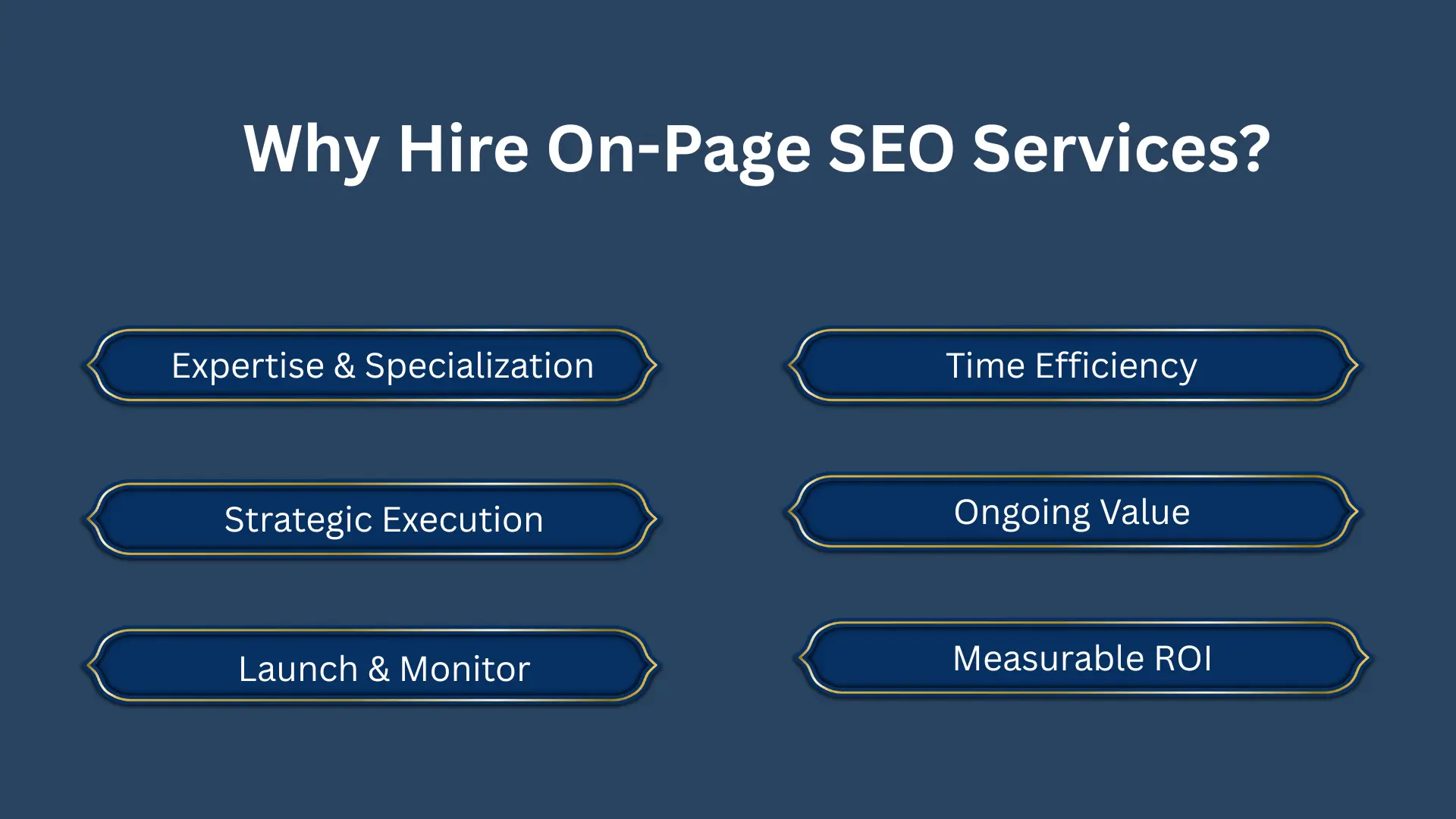
Why Hire On-Page SEO Services?
You might still be wondering whether you should invest in an agency or try to do everything yourself. Here’s why hiring an on-page SEO services provider can make a big difference:
- Expertise & Specialization: Agencies understand the latest on-page SEO factors, from Core Web Vitals to schema markup, and they know how to implement them effectively.
- Time Efficiency: Rather than spending weeks optimizing each page yourself, professionals can scale the process efficiently.
- Strategic Execution: A full audit, roadmap, and implementation plan ensure you’re not just making superficial changes but building a foundation.
- Ongoing Value: Optimization isn’t a one-time effort. A good service will monitor, report, and adjust as needed.
- Measurable ROI: You can see improvements in rankings, engagement, and conversions. And that pays off in the long term.
At Guest Posting Solution, we specialize in providing tailored on-page SEO services that are designed to scale. Whether you’re a growing business with dozens of key pages or a large site in need of systemic optimization, we can help you perfect every page, delivering real, measurable results.
Future Trends in On-Page SEO (2025 & Beyond)
The world of SEO never stands still, and as we look ahead, several trends are already reshaping how on-page SEO works:
Generative Search & AI: Search engines use AI to answer complex questions. So content must match conversational queries. New research points to GSEO, a way to optimize for AI-driven interfaces.
Structured Data & Multimodal Content: Schema will grow more important. Also, optimization for images, video, and captions will matter more for users and AI systems.
Better Page Experience: Core Web Vitals will evolve. Users want fast, stable, and clean layouts. Visual complexity may also affect how search engines judge pages.
Trust & Authority: E-E-A-T stays key. As AI delivers answers, trust signals like author bios and reviews will matter more.
Continuous Optimization: SEO becomes a constant cycle. Teams must audit, test, update, and repeat. Personalization and A/B testing may also grow.
Conclusion
Perfection of every web page that’s the real promise of On-Page SEO Services. It’s not about quick hacks or keyword stuffing. Rather, it’s about building a sustainable, strategic foundation that aligns with both your audience’s needs and what search engines value. From user experience to structured data, from mobile responsiveness to content quality, optimizing on-page SEO is about making every page count.
If you’re ready to take your website to the next level, Guest Posting Solution is here to help. We specialize in delivering professional on-page SEO services designed to optimize every page for performance, relevance, and growth. Let us handle the technicalities and the strategy, while you focus on what you do best: delivering value to your audience.
FAQs
What is the difference between off-page SEO and on-page SEO?
On-page SEO refers to optimizations you make on your own pages content, HTML tags, structure, images, and more. Off-page SEO, by contrast, is about building authority outside your site (backlinks, brand mentions, social signals).
What is the difference between on-page SEO and technical SEO?
On-page SEO deals with content and visible elements on each page (headings, meta tags, internal links), while technical SEO is about the website’s infrastructure, speed, crawlability, indexation, and code-level optimizations.
How often should I perform on-page SEO?
A good cycle is to audit and optimize quarterly or biannually, depending on the size of your site and how often your content changes. But also consider doing mini-optimizations after significant content updates, design overhauls, or when performance metrics drop.