Spanish SEO Outreach: Earn High-Tier.ES Backlinks
To rank in Spain, great content alone isn’t enough. You also need a strong Spanish SEO outreach strategy. This helps you earn quality Spanish backlinks and SEO links from trusted sites.
Good outreach can help your site rank higher on Google.es, reach Spanish users, and grow organic traffic. The key is to focus on relevant sites and useful links, not just link numbers.
This guide covers the full Spanish outreach process. You’ll learn why it matters, how to build an effective strategy, and how to track your results.
What Is Spanish SEO Outreach & Why It Matters
Spanish link building is the process of earning relevant backlinks from websites that reach people in Spain. These can include .es websites, Spanish blogs, industry publications, news sites, and local media.
The goal is not to collect as many links as possible. It is to earn links from trusted websites that match your topic and audience.
A strong Spanish link-building strategy can include:
- Spanish backlinks: Links from Spanish-language websites that fit your niche.
- .es backlinks: Links from relevant websites using Spain’s .es domain.
- Editorial backlinks: Links placed within useful content by publishers.
- Contextual links: Links that fit naturally into a relevant page.
- Spanish publisher outreach: Direct contact with editors, bloggers, and site owners.
- Digital PR: Campaigns that earn mentions from Spanish news and media sites.
Local relevance matters because Google uses many signals to understand the audience and topic of a page. Spanish-language content, Spanish readers, site relevance, and the context around a link can all support a Spain-focused SEO strategy.
The best campaigns also look beyond domain metrics. A relevant site with real Spanish traffic can be more useful than a high-metric site with no connection to your market.
How to Build a Spanish Link-Building Strategy
A strong campaign starts with research. You need to know which links matter, which publishers reach your audience, and where competitors are gaining authority.
1. Analyse Competitor Backlinks
Start by reviewing the backlink profiles of competitors ranking in Spain. Look for the websites linking to their pages, the topics they cover, and the types of links they earn.
Pay attention to:
- Referring domains
- Spanish-language publishers
- .es websites
- Industry blogs
- News and media sites
- Editorial backlinks
- Contextual links
- Link gaps between your site and competitors
This research can reveal publishers you may want to target. It also helps you avoid building links from sites that have little value for your market. Competitor backlink analysis is a common starting point for finding new link-building opportunities.
2. Find Relevant Spanish Publishers
Build a prospect list based on topic, audience, traffic, and editorial quality. Look for Spanish blogs, trade publications, regional media, and trusted websites in your niche.
A good publisher should have:
- Relevant content
- Real Spanish readership
- Stable organic visibility
- Strong topical fit
- Useful editorial standards
Do not choose a site only because it has a high DR or DA.
3. Create Native Spanish Content
Content should feel natural to Spanish readers. Native Spanish writers can adapt the wording, examples, tone, and search intent to the local audience.
Useful formats include guest posts, expert articles, data studies, guides, and digital PR content.
4. Run Manual Outreach
Contact publishers with a personalised pitch. Mention their site, explain why your content fits, and show the value for their readers.
Avoid mass emails and copied templates. Personal outreach is more likely to build lasting publisher relationships.
5. Check Every Placement
Review each backlink after publication. Check the linking page, anchor text, surrounding content, indexability, and relevance.
A smaller number of relevant editorial links can be more useful than a large number of weak placements.
How to Choose a Spanish Link-Building Service
Choosing the right Spanish link-building service can affect the quality of your backlink profile. A low-cost service may give you many links, but poor placements can add little SEO value.
Look for a provider that focuses on relevant Spanish websites, real traffic, and manual outreach.
Check Publisher Quality
Ask how publishers are selected. Good providers review each site for:
- Spanish audience and language
- Relevant industry or topic
- Organic search traffic
- Content quality
- Domain history
- Editorial standards
High domain metrics alone aren’t enough. A relevant website with real readers can be a better fit for your campaign.
Ask About Outreach Methods
Find out how the provider contacts publishers. Manual outreach is usually more useful than sending the same pitch to thousands of websites.
A good service should explain how it finds publishers and handles communication. It should also show how each placement fits your SEO goals.
Review the Link Placement
Ask where your backlink will appear. Contextual links within relevant content are usually more natural than links placed on unrelated pages.
Check the anchor text, linking page, surrounding content, and target URL before approving a placement.
Look for Clear Reporting
A reliable Spanish SEO service should provide details about your placements. Reports may include the publisher, linking page, target URL, anchor text, and key site metrics.
Clear reporting helps you review the quality of every Spanish backlink and track campaign progress.
Avoid Guaranteed Rankings
Be careful with services that promise specific Google rankings. No link-building provider can control Google’s results.
Focus instead on relevant publishers, quality content, natural links, and steady growth in referring domains.
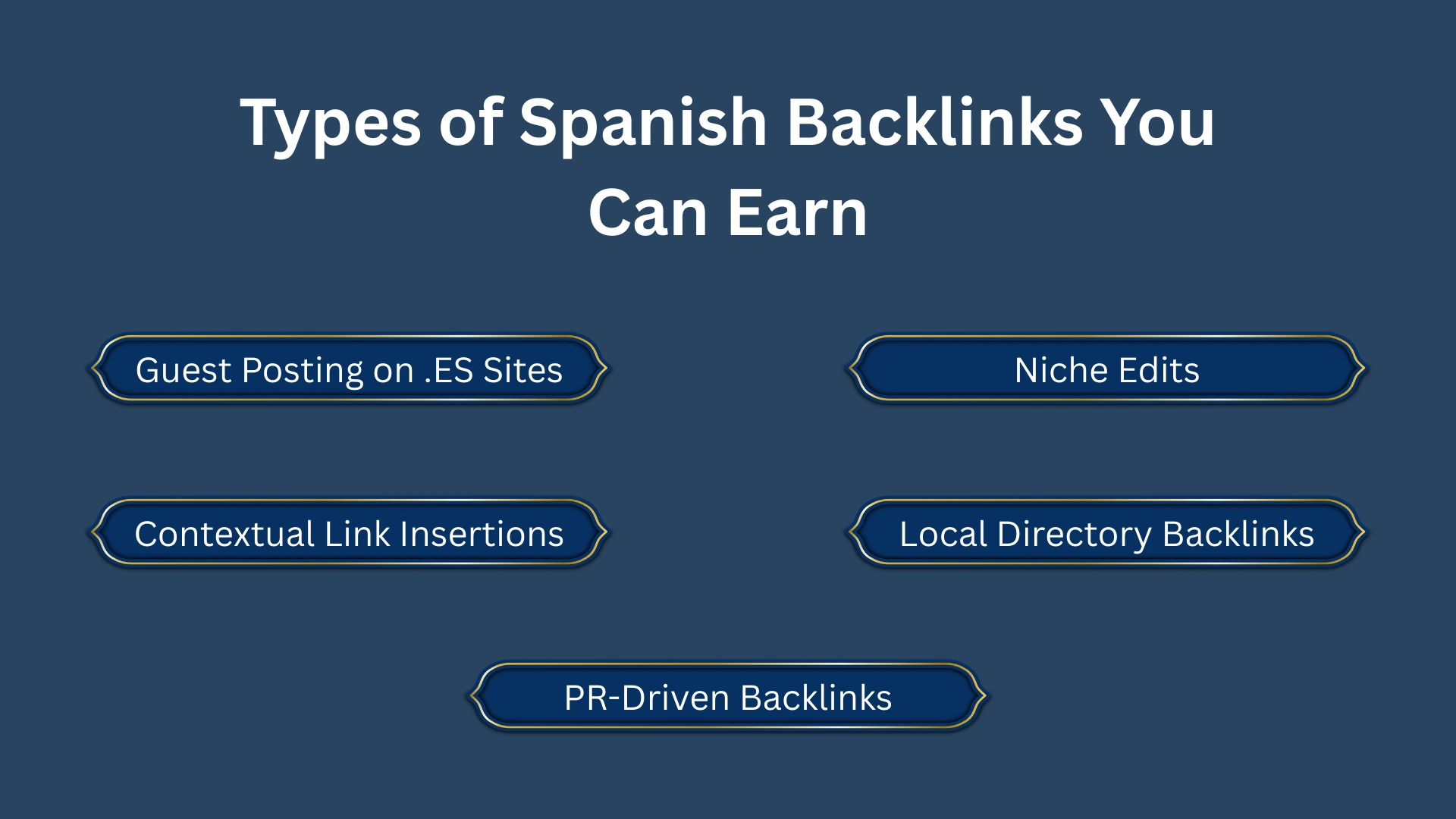
Types of Spanish Backlinks You Can Earn
Earned backlinks can take several forms, each with different SEO benefits and relevance signals.
1. Guest Posting on .ES Sites
Guest posting remains one of the most powerful forms of outreach. These articles are published as editorial content on relevant Spanish sites and include contextual backlinks to your pages. Because these links are naturally integrated into content, they pass significant relevance and authority to your site on Google.es.
High-quality guest posts yield:
- Editorial backlinks that align with niche topics
- Link authority that boosts ranking signals
- Referral traffic from engaged readers
When done correctly, guest posting strengthens both your backlink profile and brand perception in the Spanish market.
2. Niche Edits & Contextual Link Insertions
Not all outreach needs a full article. Niche edits, inserting your link into existing Spanish content, can also provide valuable contextual backlinks. This approach is useful when a publisher’s site already has relevant content where your link fits naturally.
Proper niche edits:
- Respect the existing content’s tone and focus
- Place links in semantically relevant locations
- Avoid forced or irrelevant insertions
Contextual backlinks like these often require less editorial effort and can be a cost-effective way to secure quality links, particularly in competitive niches.
3. Local Directory Backlinks
While directory links aren’t as powerful as guest posts or editorial placements, quality Spanish directories can still contribute to your SEO presence, especially in the early stages of a campaign. Entries in respected Spanish business directories help build initial local relevance and serve as signals of legitimacy to search engines.
Examples include:
- Industry-specific directories relevant to your business
- Local Spanish business listings within your niche
- Reputable regional directories with .es domains
Always prioritize directories that are well-maintained and have real user utility, low-value directories won’t provide SEO benefits and could attract spam signals if misused.
4. Resource & PR-Driven Backlinks
Resource pages, press releases, and data-driven content campaigns can also earn high-authority backlinks. These often appear on mainstream sites and news portals when your piece provides unique value, such as original data, insights, or expert commentary.
Effective methods include:
- Publishing research reports related to your industry with Spanish context
- Creating how-to guides or tools useful to the Spanish audience
- Participating in digital PR campaigns that source expert insights
These types of placements often lead to backlinks on news outlets and respected authority sites, boosting both visibility and link equity.
Technical SEO Aspects for Spanish Backlink Success
Pairing quality backlinks with strong technical SEO practices ensures your outreach efforts convert into measurable gains.
1. Hreflang & Language Targeting
Proper use of hreflang tags helps search engines understand the language and regional targeting of your Spanish pages. For instance, an es-ES tag signals to Google.es that a page is intended for a Spanish audience, increasing the relevance of backlinks earned through outreach. Include hreflang es-ES on pages targeted by Spanish backlinks to reinforce language signals.
2. Anchor Text Strategy for Spanish Outreach
Choosing the right anchors is critical. Mix branded anchors, partial match keywords, and natural phrases to achieve a balanced profile that looks organic to search engines.
Good anchor text strategies include:
- Branded anchors (your company or product name)
- Keyword-relevant phrases in Spanish
- Long-tail anchors that fit the context of the linking content
Balanced anchors reduce the risk of over-optimization while boosting topical relevance.
3. Tracking & Reporting Backlink Value
To measure the effectiveness of your outreach campaigns, monitor key SEO metrics over time:
- Number of .es backlinks acquired
- Referring domain authority and topical relevance
- Movement in Spanish keyword rankings
- Referral organic traffic from Spanish sites
Tracking these metrics helps refine your strategy over time and ensures that your Spanish SEO outreach delivers measurable results.
Benefits of Investing in Spanish SEO Outreach
Investing in a smart outreach strategy focused on Spanish backlink acquisition delivers multiple advantages:
- Boosted rankings on Google.es: With reputable Spanish backlinks, your site signals stronger local relevance to search engines.
- Increased qualified organic traffic: Spanish audiences find your content through trusted local domains.
- Stronger domain authority: Ongoing editorial placements continue to build authority over time.
- Brand credibility in Spanish marketplaces: Local links build trust with both search engines and users.
These combined benefits support both visibility and conversions in Spanish-speaking markets.
How Our Spanish Outreach Services Work (Step-by-Step)
Here’s a typical workflow that ensures strategic execution from start to finish:
- Consultation & Goal Setting: Understand your Spanish SEO objectives and markets.
- Spanish Publisher List & Opportunity Assessment: Identify target domains and content opportunities.
- Outreach & Negotiation: Contact relevant Spanish publishers with tailored pitches.
- Content Creation & Localization: Produce native Spanish content that aligns with editorial standards.
- Placement & QA: Secure and validate links, ensuring they follow SEO best practices.
- Performance Reports & Optimization: Deliver transparent SEO metrics and refine ongoing strategy.
This structured process bridges analysis, creativity, and execution to achieve sustainable results.
Conclusion
Ranking in Spain takes a focused SEO outreach plan. Relevance, clear Spanish content, and strong editorial links all matter. A smart Spanish SEO outreach strategy can boost your visibility on Google.es and help you reach Spanish users.
If you’re entering the Spanish market, link building should be part of your SEO plan. Use relevant Spanish websites, quality content, and .es domains to build trust. Strong Spanish backlinks can improve rankings, grow organic traffic, and help your site compete in the Spanish market.
FAQs
How do Spanish backlinks improve rankings in Spain?
Backlinks from authoritative Spanish domains act as relevance signals for Google.es, signaling that your site is trusted and topically relevant, which helps improve rankings in Spanish search results.
What types of Spanish links are most valuable?
Editorial placements on respected Spanish blogs, news sites, and niche portals are typically most valuable because they combine topical relevance with high domain authority.
How long does it take to see results from Spanish outreach?
Results vary by niche and competition, but quality backlinks often begin influencing rankings and organic visibility within a few months of campaign execution.