Smart Ways for Creating a Professional Content Gap Analysis
In 2026, SEO performance is no longer defined by how much content a brand publishes, but by how precisely it matches search demand that competitors already dominate. This is exactly where content gap analysis becomes a strategic growth engine. Instead of guessing topics, modern SEO teams use structured gap audits to uncover missing keywords, weak coverage areas, and high-value opportunities that directly influence rankings, traffic, and conversions.
A professional content gap analysis (CGA) is not just a keyword comparison exercise. It is a decision framework that connects competitor keyword intelligence, SERP behavior, and content strategy planning into a single system. When executed correctly, it becomes the backbone of scalable organic growth and helps brands move from random publishing to intentional visibility building across Google’s evolving search ecosystem.
What Is Content Gap Analysis in SEO?
A content gap analysis in SEO finds topics, keywords, and questions your website does not cover well. It also shows where competitors have stronger content coverage. The goal is simple: find missed search opportunities and decide how to close them.
A gap can appear in several ways:
- Topic gap: Your site does not cover a useful topic at all.
- Keyword gap: Competitors rank for relevant keywords that your site misses.
- Intent gap: You cover a topic, but your page does not match what searchers want.
- Quality gap: Your content is thin, outdated, unclear, or less useful than competing pages.
- Page-level gap: Your page covers the same topic as a competitor but ranks for fewer related terms.
For example, you may have a page about SEO content strategy, while a competing page also covers keyword mapping, search intent, content clusters, and content audits. Your page may rank for the main term but miss several related searches.
This is where competitor content analysis becomes useful. It shows which topics and search intents competitors cover better. You can then improve an existing page, create a new one, or build supporting content around the missing topic.
The Connection Between Competitor Keyword Analysis and Content Gap Analysis
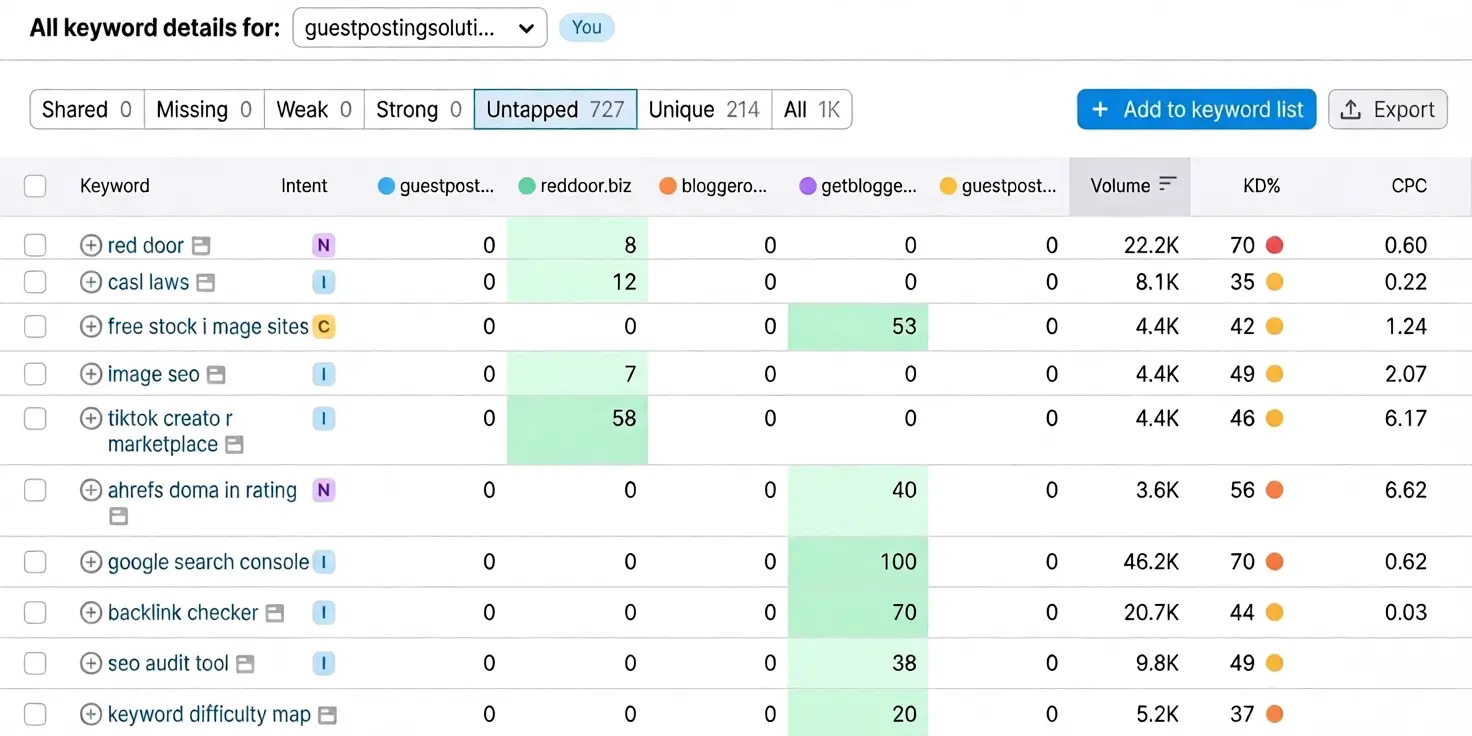
Competitor keyword analysis and content gap analysis are closely linked, but they serve different strategic roles. Competitor keyword analysis identifies what others rank for, while content gap analysis determines what you are missing compared to them and why it matters for growth.
Modern SEO workflows rely heavily on competitor keyword intelligence tools such as Semrush Keyword Gap and Ahrefs Content Gap, which allow marketers to compare multiple domains and extract overlapping and missing keyword sets. These systems highlight not only ranking differences but also SERP positioning strength, keyword intent classification, and visibility distribution across topics .
The real power emerges when competitor keyword data is interpreted through a content strategy lens. Instead of treating keywords as isolated opportunities, advanced SEO teams group them into thematic clusters like “solution comparison,” “buyer intent queries,” or “problem-aware informational searches.” This transforms raw competitor data into structured content opportunities aligned with funnel stages.
In other words, competitor keyword research is the input, while content gap analysis is the decision-making system that turns that input into a publishing roadmap.
Why Your Website Needs a Tactical Content Gap Audit
A tactical content gap audit is no longer optional for brands competing in saturated SERPs. Without it, even high-quality content often fails to rank because it does not align with the dominant search expectations already set by competitors.
One of the most critical reasons businesses need CGA is SERP dominance imbalance. Competitors often accumulate topical authority by covering entire keyword ecosystems instead of isolated articles. This creates content clusters that search engines trust more, pushing incomplete websites downward in rankings.
Another major factor is intent misalignment. Many websites publish content based on internal assumptions rather than actual search behavior. A proper CGA exposes this mismatch by revealing which competitor pages consistently satisfy user intent through formats like comparison guides, FAQ hubs, or decision-stage landing pages.
From a commercial standpoint, the absence of a structured gap audit results in wasted content budgets, low organic ROI, and fragmented authority signals across Google’s ranking systems. Businesses that implement regular CGA cycles consistently outperform those relying on generic keyword research alone.
For more useful insights, explore our other blog post, “How to Perform Effective Competitor Analysis SEO”. Discover more to deepen your understanding.
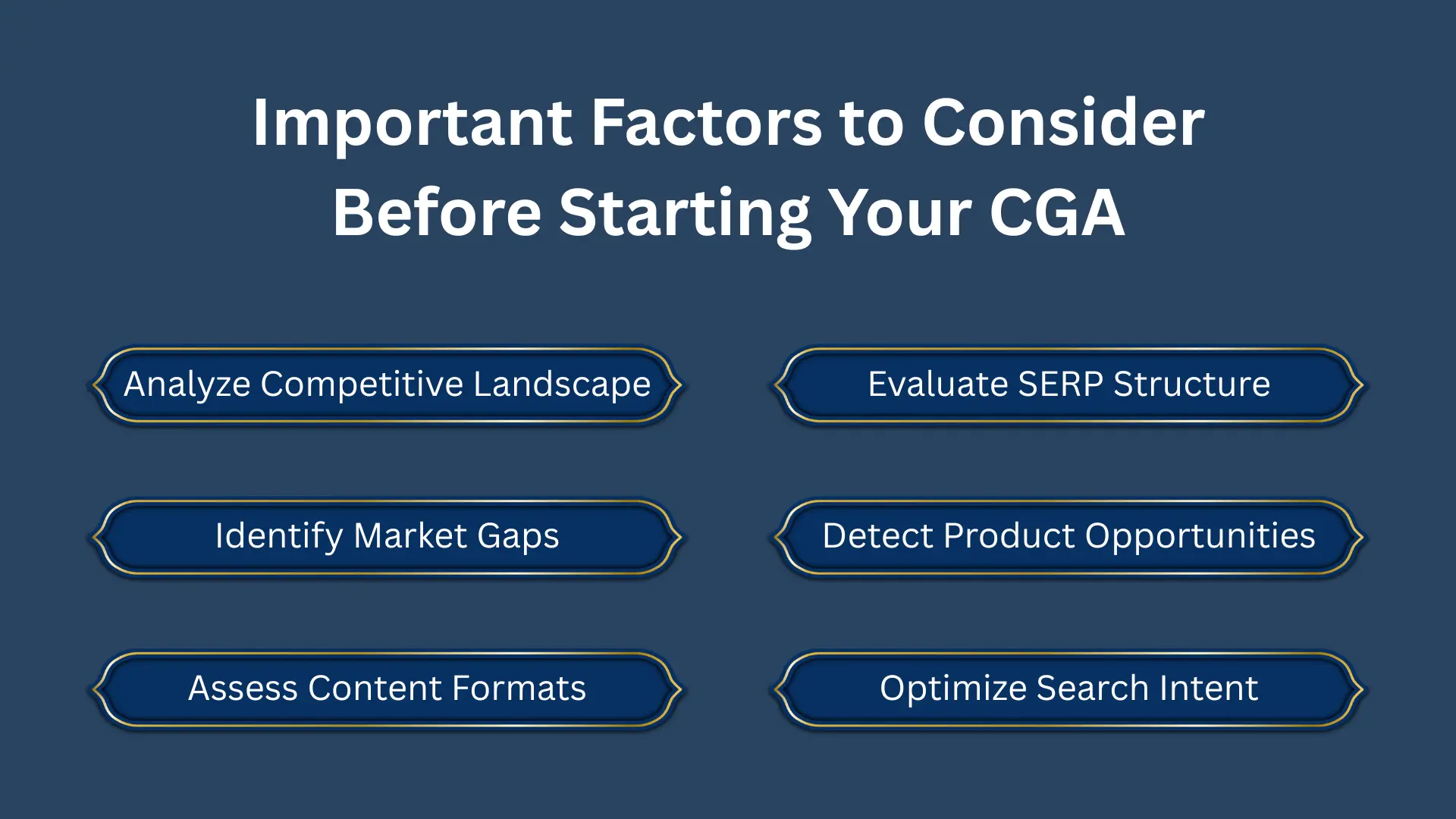
Important Factors to Consider Before Starting Your CGA
Before running a content gap analysis, it is essential to establish a strategic foundation. Without this, data becomes overwhelming and loses directional value.
Analyzing Your Vertical’s Competitive Landscape
Every industry has a different SERP structure. SaaS, comparison content and feature breakdowns dominate. E-commerce, transactional category pages often outperform blogs. B2B services, thought leadership combined with problem-solving content tends to rank better.
Understanding this landscape ensures that your CGA is aligned with how Google currently evaluates authority within your niche. It also helps in identifying whether competitors are winning through content depth, backlink strength, or topical clustering.
Identifying Market Opportunities for New Products
A strong CGA often reveals gaps beyond content itself. Many keyword clusters highlight unmet demand that signals potential product expansion or service refinement. For example, repeated searches around “pricing models,” “alternatives,” or “integration challenges” often indicate monetizable demand areas that competitors are already capitalizing on.
This makes CGA not only an SEO tool but also a product-market intelligence system that supports business growth decisions.
Content Ideation & Formatting: Articles, Videos, and FAQs
Modern SERPs are no longer text-only ecosystems. Google rewards diverse content formats including videos, structured FAQs, comparison tables, and step-based guides. A strong CGA must therefore evaluate format gaps, not just keyword gaps.
For instance, if competitors rank with video explainers while your site only uses text blogs, you are automatically at a disadvantage. Similarly, missing FAQ-rich pages can reduce eligibility for featured snippets and AI Overviews.
How to Use Content Gap Insights to Project Organic Traffic ROI
One of the most valuable outputs of a content gap analysis is the ability to estimate potential organic traffic gains. By analyzing competitor rankings, search volume, and keyword difficulty, SEO teams can forecast how much traffic can be captured by targeting specific gaps.
This process typically involves grouping keywords by intent, estimating ranking potential based on domain authority, and mapping expected click-through rates. High-intent gaps such as “best,” “pricing,” or “comparison” keywords often produce the highest ROI because they sit closer to conversion stages.
Advanced SEO teams also model ROI based on topical clusters instead of single keywords. This approach provides a more realistic projection because it accounts for internal linking strength, content depth, and cumulative ranking effects across a topic ecosystem.
How to Perform a Content Gap Analysis (CGA)
A structured content gap analysis (CGA) transforms raw SEO data into a clear roadmap for traffic growth. Instead of guessing what content to create, CGA helps you identify exactly what competitors rank for, what your website is missing, and where untapped search demand exists. This process builds a stronger SEO content strategy, improves topical authority, and supports sustainable ranking growth across competitive SERPs.
Below is a detailed, execution-focused breakdown of each stage with real-world SEO examples.
Step 1: Competitor Discovery & Domain Analysis
The first stage of a content gap analysis begins with identifying true SEO competitors, not just brands operating in the same industry. These are the websites consistently appearing in Google’s top 10 for your target queries, even if they are not direct business rivals.
For example, if you run a digital marketing agency offering content gap analysis services, your real SEO competitors are not only other agencies like “Neil Patel Digital” or “WebFX,” but also SEO publications such as “Search Engine Journal,” “Backlinko-style blogs,” and tool-based platforms like Semrush Academy pages. These domains often dominate informational keywords like “SEO content strategy,” “keyword gap analysis,” or “how to find content gaps.”
Using tools like Ahrefs or Semrush, you can input your domain and extract overlapping competitors based on shared keyword rankings. In a real scenario, an agency website might discover that a SaaS SEO tool ranks for hundreds of informational queries that the agency has never targeted, such as “topic clustering SEO strategy” or “how to build topical authority.” This immediately expands the competitive set beyond direct industry peers and reveals hidden SERP competitors.
At this stage, the goal is not just listing competitors, but building a search-driven competitor universe that reflects who Google already trusts in your niche.
Step 2: Filtering Non-Branded Keyword Data
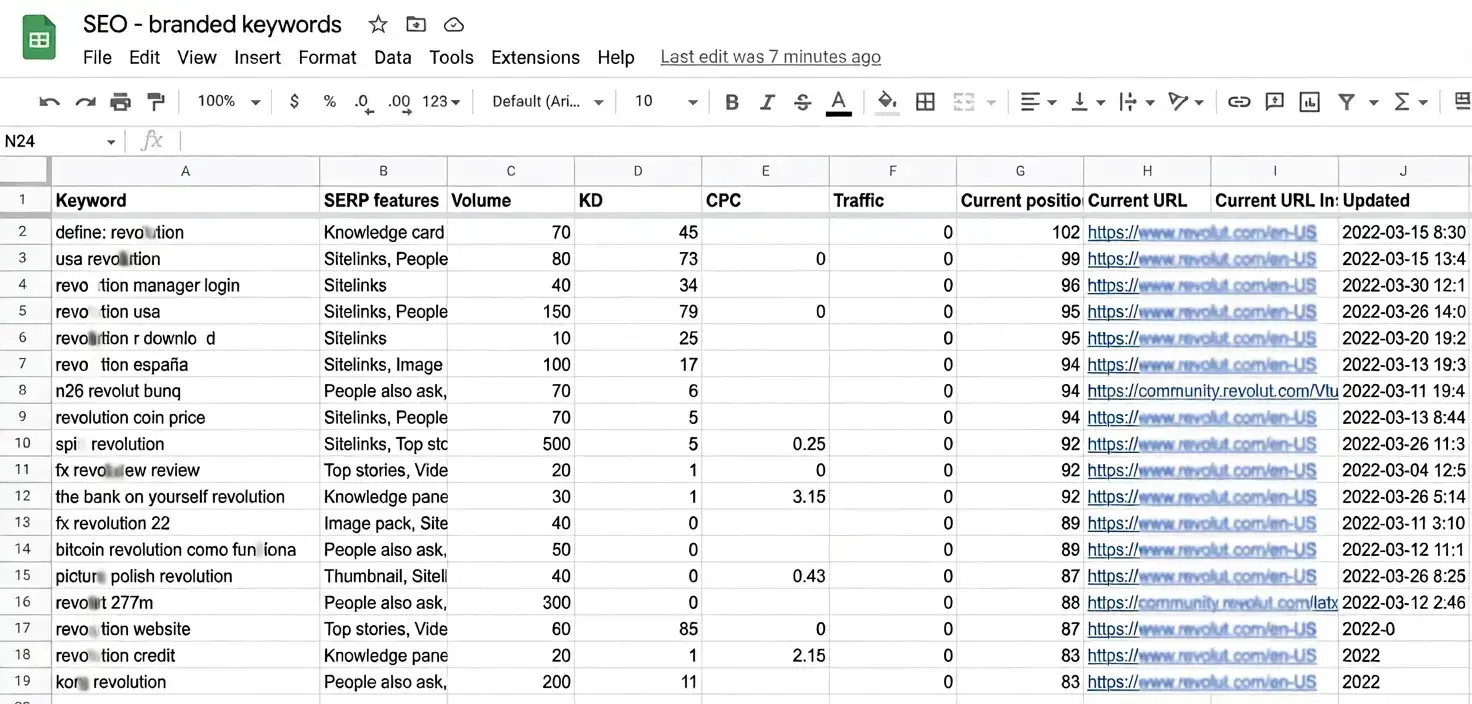
Once competitor domains are identified, the next step is extracting their ranking keywords and filtering out branded search terms. Branded keywords such as “Semrush pricing” or “Ahrefs login” may show high traffic, but they are not opportunities you can realistically capture unless you own that brand.
For instance, if a competitor ranks for “Semrush content gap tool,” that keyword is not useful for your own growth planning. Instead, you focus on non-branded opportunities like “content gap analysis framework,” “SEO competitor keyword research method,” or “how to identify content gaps in SEO strategy.”
Another important filtering layer involves removing irrelevant informational noise. For example, a general blog might rank for “what is SEO,” but if your business targets enterprise-level clients, that keyword may not align with your conversion funnel. Instead, you would prioritize more qualified queries like “enterprise SEO content strategy” or “B2B keyword gap analysis process.”
This step ensures that your dataset reflects intent-qualified traffic opportunities, not inflated or irrelevant keyword volume.
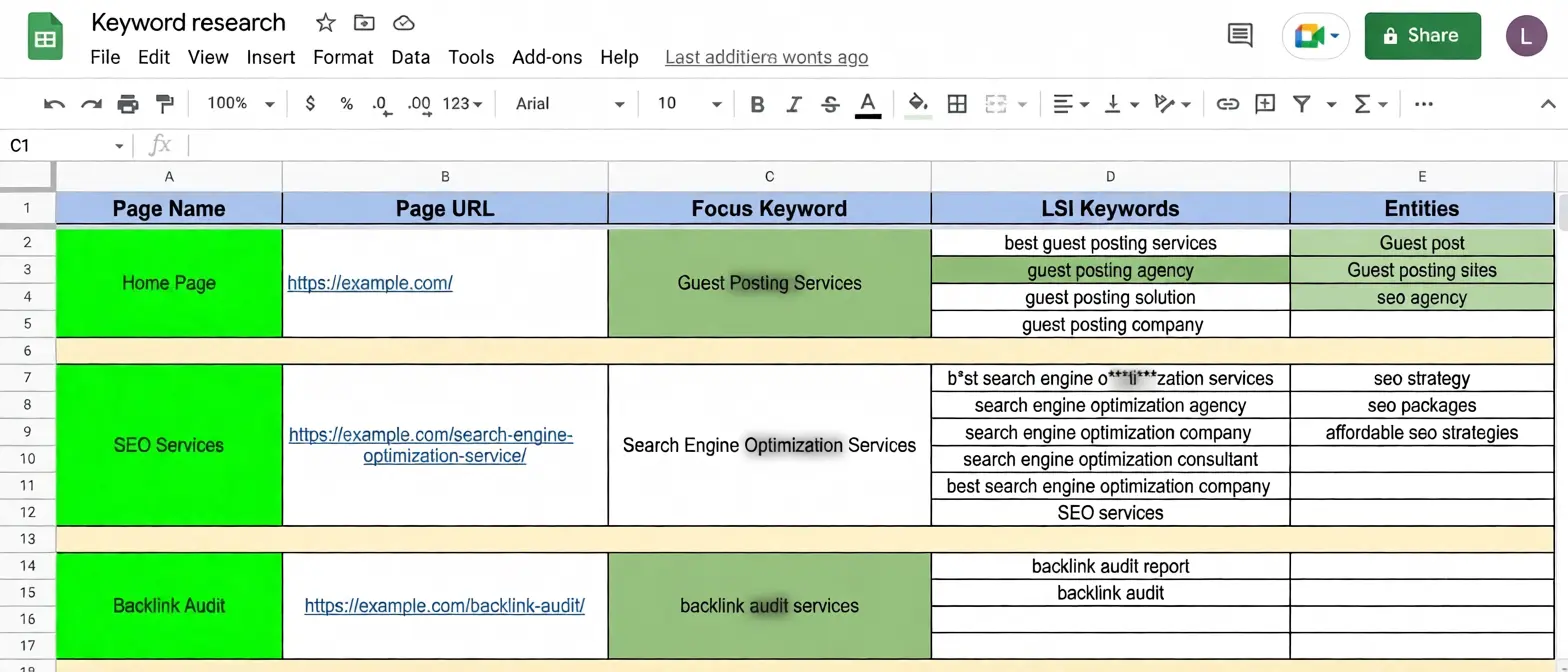
Step 3: Mapping Keywords to the Gap Analysis Template
After filtering, the keyword list is structured into a content gap analysis template that categorizes search terms by intent, funnel stage, and content format.
For example, a keyword like “what is content gap analysis” belongs to the informational awareness stage, best served by a blog article or educational guide. A keyword such as “SEO content strategy agency” falls under the commercial intent stage, requiring a service page or landing page optimized for conversions. Meanwhile, “content gap analysis vs keyword gap analysis” fits into a comparison intent, often performing well as a long-form guide or pillar content.
In a real agency scenario, a keyword cluster like “competitor keyword research tools” might be split into multiple content types: one blog listing tool comparisons, one tutorial explaining usage, and one FAQ section addressing pricing or accuracy concerns.
This mapping process transforms raw keyword exports into a structured SEO content architecture, ensuring every keyword has a defined role in the funnel rather than being treated as an isolated opportunity.
Step 4: Removing Duplicates and Cleaning Keyword Relevance
Raw keyword data often contains duplicates and overlapping search intents. Different users may search the same concept in slightly different ways, but Google typically ranks the same type of content for all variations.
For example, “content gap analysis SEO,” “SEO content gap analysis,” and “how to do content gap analysis in SEO” often lead to identical SERP results. Instead of creating separate pages for each variation, they must be merged into a single content asset.
In practice, an SEO team working on a Guest Posting Solution agency website might find dozens of variations of “SEO content strategy guide,” but after cleaning, these are consolidated into one authoritative pillar page targeting the primary keyword with semantic variations naturally included.
This step also prevents keyword cannibalization, where multiple pages from the same website compete against each other for the same query. Without cleaning, even strong websites lose ranking potential because their authority gets split across multiple weak pages instead of one strong asset.
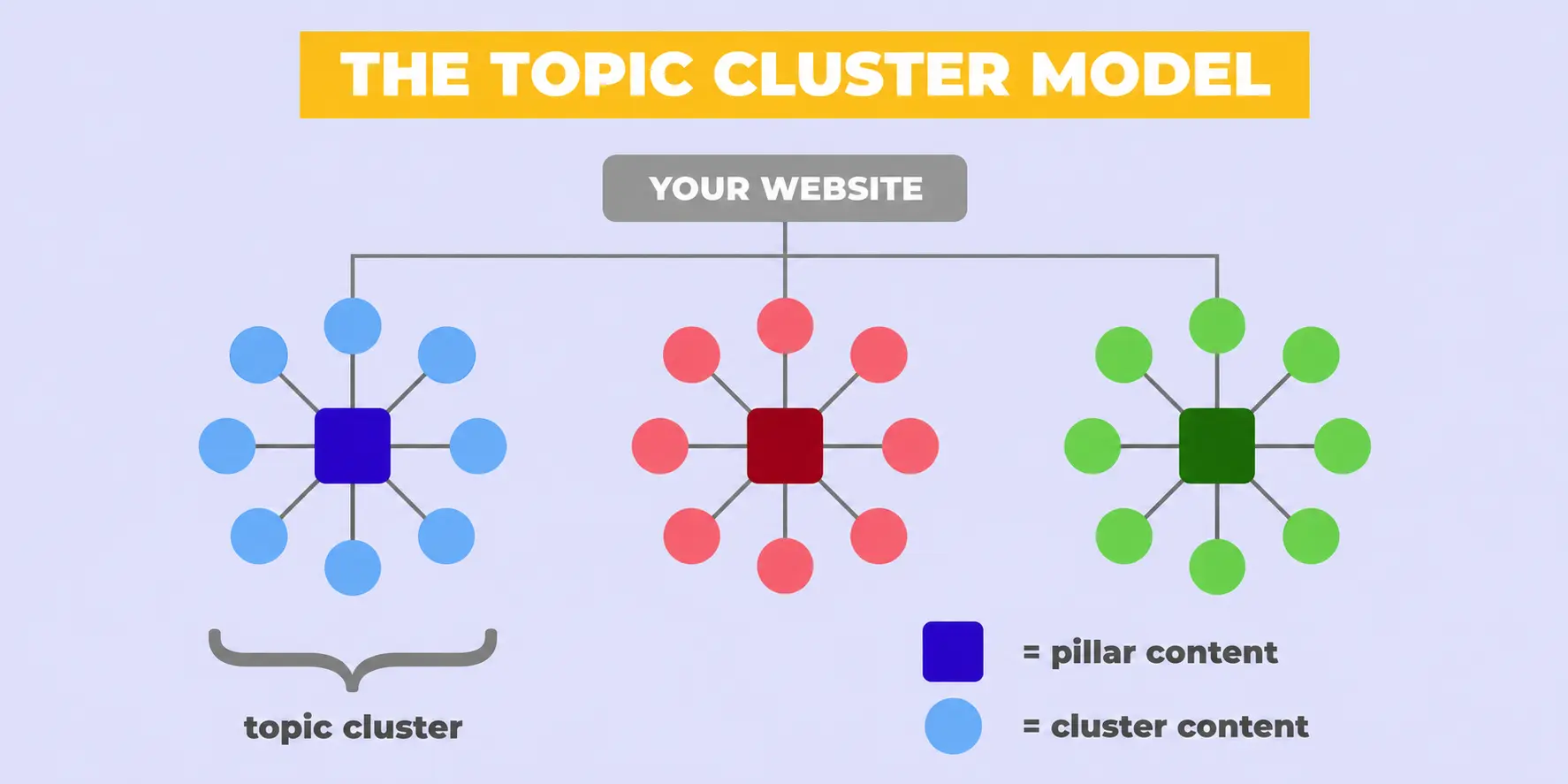
Step 5: Strategic Keyword Grouping & Categorization
The final step in content gap analysis is grouping cleaned keywords into thematic clusters, which form the foundation of topical authority.
For example, an SEO agency targeting “content gap analysis” might create a cluster around:
content gap analysis frameworks, competitor keyword research methods, SEO content strategy planning, and organic traffic growth forecasting. Each cluster supports a central pillar page while interlinking supporting articles.
In a real-world execution, a website might discover that competitors dominate an entire cluster like “SEO content strategy guide,” covering subtopics such as keyword mapping, intent classification, and content auditing. If your site only has one blog on the topic, you are structurally underpowered in Google’s eyes.
A strong CGA result would group these keywords into a content hub model, where one pillar page explains “SEO content strategy,” supported by cluster articles like “how to map keywords to content,” “how to analyze competitor content strategy,” and “how content gaps affect rankings.”
How to Prioritize the Best Content Gap Opportunities
Finding hundreds of missing keywords does not mean you should target all of them. The better approach is to rank opportunities by value and effort.
1. Look for Quick-Win Keywords
Start with keywords where your site already has some visibility. Pages ranking around positions 11–20 can be strong candidates for improvement.
A page may only need better topic coverage, stronger internal links, clearer headings, or a closer match to search intent.
These striking-distance keywords can be easier to improve than terms where your site has no visibility. Competitor gap tools can also reveal keywords where other sites rank well but your page does not.
2. Find New Content Opportunities
Some gaps need a completely new page.
For example, your competitors may have separate content for:
- SEO content strategy
- Keyword mapping
- Competitor content analysis
- Content audit
- Search intent
- Topic clusters
If your site covers only one broad topic, creating focused supporting pages may help build stronger topical authority.
3. Fix Weak Content
A content gap does not always mean missing content.
Your page may already target the right keyword but still fail to answer the searcher’s main questions. In that case, expand the page rather than creating another URL.
Check the top-ranking pages for missing details, useful examples, related questions, and content depth.
4. Consider Business Value
Search volume should not be your only filter.
A keyword with lower traffic can be more valuable if it attracts people who are ready to buy or contact your business. Give more weight to topics that match your services, products, audience, and conversion goals.
5. Group Opportunities Into Clusters
Finally, group related keywords and topics together.
One strong page can target several closely related terms when they share the same search intent. Other terms may deserve separate supporting pages.
This creates a stronger content cluster and gives your website a clearer structure around important topics. Current gap-analysis guidance also recommends grouping keyword opportunities into topics and using those groups to guide content planning.
The goal is not to publish more pages. It is to close the gaps that matter most, improve the content you already have, and build useful coverage around topics your audience actually cares about.
Conclusion
A professional content gap analysis is not a reporting exercise; it is a strategic execution framework that defines how a website grows in organic search. By combining competitor keyword intelligence, SERP analysis, and structured content planning, businesses can move beyond reactive SEO and build predictable traffic systems.
The real value of CGA lies in its ability to reveal what the market is already rewarding and where your brand is currently invisible. When these insights are translated into structured content clusters, SEO shifts from short-term ranking efforts to long-term authority building.
For businesses aiming to scale faster without relying on trial-and-error content publishing, advanced execution through a Guest Posting Solution (agency support for strategic backlink and content amplification) can accelerate authority signals, strengthen topical clusters, and improve ranking velocity across competitive SERPs.
In 2026, winning SEO is not about producing more content; it is about closing the right content gaps faster and more strategically than your competitors.
FAQs
How often should content gap analysis be done?
It should be performed regularly, ideally every few months, to keep up with competitor changes, evolving search trends, and new keyword opportunities emerging in your industry or niche.
Who benefits most from content gap analysis?
SEO agencies, SaaS companies, eCommerce brands, and service-based businesses benefit most because it helps them identify growth opportunities, improve rankings, and build stronger topical authority in competitive markets.
How is content gap analysis different from keyword research?
Keyword research finds new search terms, while content gap analysis compares your site with competitors to identify what they already rank for that you are missing or underperforming in.