How to Extract Brand Mentions from PDFs Using AI & OCR Tools

Modern SEO and digital intelligence now depend heavily on brand mentions, entity signals, and contextual data rather than backlinks alone. PDFs such as reports, research papers, and competitor analysis documents often contain valuable brand references, but this data remains hidden due to unstructured formatting and limited accessibility.
To extract brand mentions from PDF content effectively, identify PDF type, apply PDF OCR (Optical Character Recognition) for scanned files, and use keyword-based extraction with document parsing and brand monitoring tools. Unlike a spreadsheet or database, PDFs are not designed for direct analysis. Brand names, company mentions, and key entities are visually present but not structurally accessible.
This guide explains how to extract, analyze, and use brand mentions SEO strategies from PDF content efficiently.
What Does Extract Text from PDF Actually Mean?
Extracting text from a PDF means converting non-structured document data into searchable, analyzable content. PDFs often contain mixed formats like tables, images, and multi-column layouts, making document parsing essential for SEO analysis.
This process is the foundation of extracting Brand Mentions for SEO because it allows search systems to identify:
- Brand names hidden in text layers
- Mentions embedded in images
- Contextual brand references in reports
- Structured and unstructured brand data
Without extraction, these signals remain invisible to online brand monitoring systems and search engine monitors.
Types of Brand Mentions You Can Find in PDFs
PDFs can contain more than simple brand names. A single report may include linked mentions, unlinked references, competitor names, and brand entities. The context around each mention can also reveal how a source views or describes the brand.
1. Linked Brand Mentions
A linked brand mention includes a clickable link to the brand’s website or another relevant page. These mentions can drive referral traffic and make it easier for readers to reach the brand.
A linked mention is also easier to track than a plain text reference. You can review the destination URL, anchor text, and source to assess its value.
2. Unlinked Brand Mentions
An unlinked brand mention names a company without linking to its website. These mentions are useful for finding potential link reclamation and digital PR opportunities.
For example, a research report may mention a company but provide no website link. You can review the source and decide if a link request makes sense.
Unlinked mentions should not be treated as confirmed Google ranking factors. Their value is better viewed through brand discovery, context, entity recognition, and potential outreach opportunities.
3. Contextual Brand Mentions
Context matters as much as the brand name itself. A mention next to terms such as “SEO services,” “technical SEO,” or “content marketing” gives you more information than the brand name alone.
Contextual analysis helps you understand what a source associates with your brand. It can also reveal new topics, competitors, products, and industry terms.
4. Brand Entity Mentions
A PDF may refer to a company using its full name, short name, product name, or another variation. Named Entity Recognition (NER) can help identify these references as the same type of entity.
For example, a document could use both “Google LLC” and “Google.” A good extraction workflow should group these variations correctly.
5. Competitor Mentions
PDFs can also reveal how competitors appear in reports, studies, market reviews, and industry documents.
Tracking competitor mentions can help you find:
- Frequently cited companies
- Industry topics linked to competitors
- Sources that mention several brands
- Potential PR and outreach opportunities
- Gaps in your own brand coverage
This makes PDF analysis useful for both brand monitoring and competitor research.
For more useful insights, explore our other blog post, “Negative SEO Protection: A Proactive Site Defense Guide”. Discover more to deepen your understanding.
How to Extract Brand Mentions From PDF Content
Extracting brand mentions starts by turning the PDF into searchable data. The right process depends on how the document was created.
A text-based PDF can usually be searched directly. A scanned PDF needs Optical Character Recognition (OCR) before you can analyze its content.
Step 1: Check the PDF Type
Open the PDF and try to select or search its text.
If you can select the words, the document likely contains a text layer. You can move to text extraction.
If the pages behave like images, you need PDF OCR first.
Step 2: Run OCR on Scanned PDFs
OCR converts text inside images into machine-readable content. This makes scanned reports, research papers, and other image-based PDFs searchable.
OCR accuracy can vary. Poor scans, unusual fonts, tables, and low image quality may create errors. Always review important brand names after extraction.
Step 3: Extract the PDF Text
Use a PDF parser, OCR tool, or document extraction platform to create searchable text.
Keep the page number during extraction when possible. Page-level data makes it easier to verify a mention later.
For complex documents, use a layout-aware parser. This can help preserve reading order across columns, tables, and text blocks.
Step 4: Search for Brand Names and Variations
Search the extracted text for your main brand name. Then check common variations.
For example, your search list could include:
- Full company name
- Short company name
- Product names
- Brand abbreviations
- Common spelling variations
- Former brand names
Manual search works for a small PDF. Large document sets need automated keyword scanning or entity extraction.
Step 5: Use Named Entity Recognition
Keyword searches can miss brand variations. Named Entity Recognition can find companies, products, people, places, and other entities in the extracted text.
NER is useful when you do not know every term used to describe your brand. You can then compare the detected entities with your approved brand list.
Step 6: Check the Surrounding Context
Do not record only the brand name. Save the sentence or paragraph around each mention.
Context can tell you:
- What topic the brand appears under
- Which products are mentioned
- Which competitors appear nearby
- How the source describes the company
- Whether the mention is positive, neutral, or negative
This step helps separate useful mentions from false matches.
Step 7: Separate Linked and Unlinked Mentions
Record links separately from plain-text references. For each mention, capture useful details such as:
| Data point | Example |
|---|---|
| Brand | Company ABC |
| Page | 24 |
| Mention type | Unlinked |
| Context | SEO software |
| Source | Industry report |
| Sentiment | Neutral |
| URL | Not available |
This creates a cleaner dataset for SEO analysis and outreach.
Step 8: Review and Prioritize the Results
Not every mention deserves the same level of attention.
Prioritize mentions based on source quality, relevance, context, and outreach potential. A relevant industry report may be more useful than a low-quality document that happens to contain the brand name.
The final dataset can support brand monitoring, competitor research, digital PR, and link reclamation.
Top Methods to Extract Brand Mentions
Different methods exist depending on scale and technical expertise. Common methods include:
- Manual keyword search (for small PDFs)
- OCR-based extraction
- AI-powered parsing tools
- Regex-based matching
- Automated Brand monitoring tools
Each method contributes to the best brand mentions SEO practices when applied correctly.
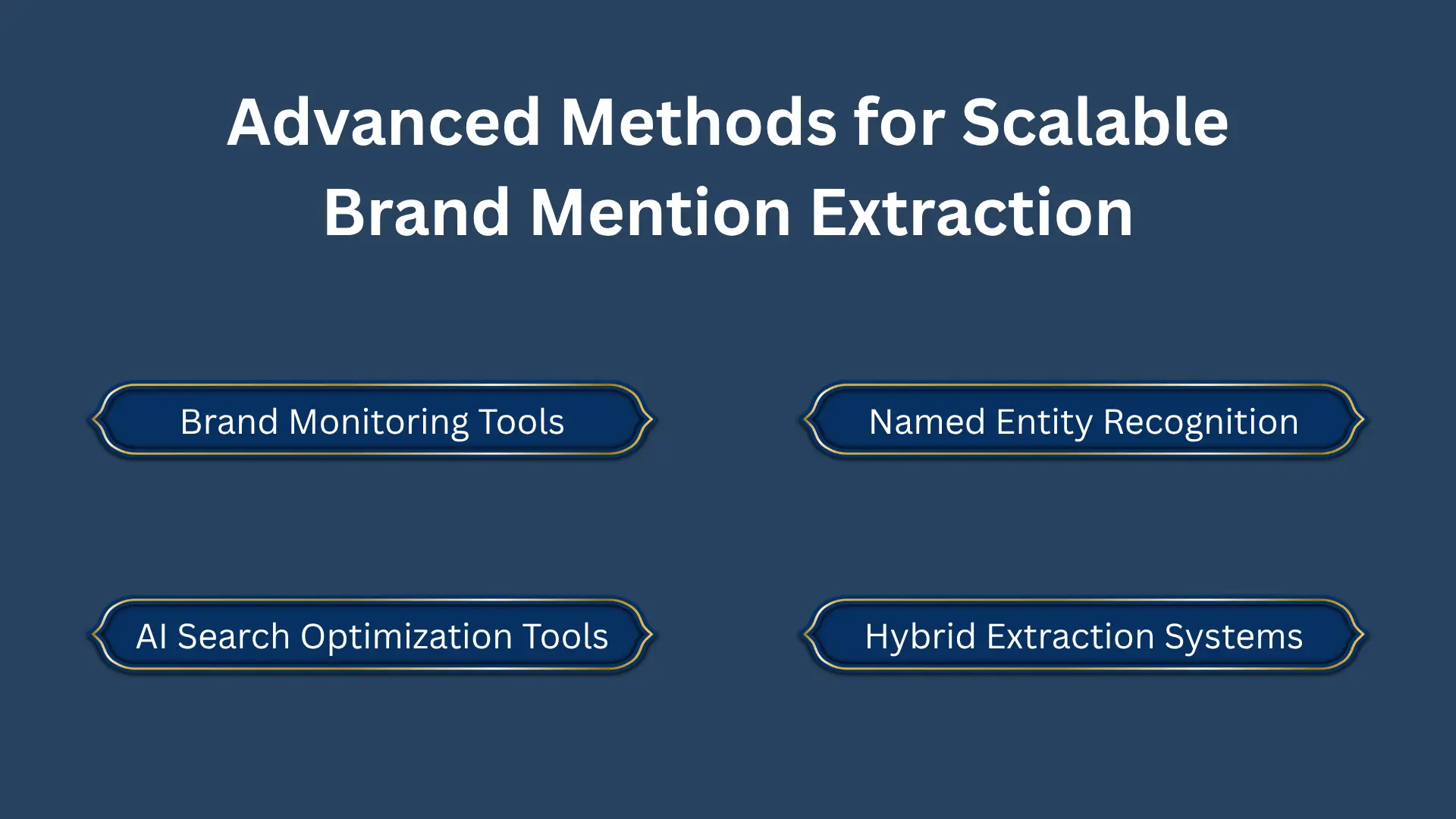
Advanced Methods for Scalable Brand Mention Extraction
Advanced tools enhance scalability and automation. Scaling extraction requires automation and intelligence.
1. Brand Monitoring Tools
Used for continuous scanning of documents and reports to detect Unlinked Brand Mentions in real time.
2. Named Entity Recognition (NER)
An AI-based system that identifies brands as entities across text datasets, improving semantic accuracy.
3. AI Search Optimization Tools
Support AI search visibility by mapping brand presence across structured and unstructured content.
4. Hybrid Extraction Systems
Combine OCR, regex, and AI models for maximum precision in document parsing workflows.
These methods significantly improve search engine algorithms’ understanding of brand relevance. Let’s explore practical tools used in real workflows.
AI and NLP Tools for Brand Mention Extraction From PDFs
AI and NLP tools help turn unstructured PDF content into searchable brand data. They are useful for large document sets and complex brand research.
- Named Entity Recognition (NER): Finds companies, products, people, and locations, even when brand names use different forms.
- Context Analysis: Reviews nearby words to identify brand-topic links, related terms, products, competitors, and content opportunities.
- Fuzzy Matching: Finds spelling errors, abbreviations, punctuation changes, and OCR mistakes that exact keyword searches may miss.
- Entity Resolution: Groups different names that refer to the same company, such as “Example Co.” and “Example Company Ltd.”
- Sentiment Analysis: Classifies mentions as positive, neutral, or negative. Review complex results manually.
- AI PDF Parsing: Reads text, tables, headings, columns, and images to create structured data.
A useful workflow is: PDF → OCR → text extraction → entity detection → context analysis → data cleaning → classification. This makes brand monitoring and SEO analysis easier.
Named Entity Recognition (NER) for Detecting Brand Names
Named Entity Recognition (NER) is an AI technique that identifies brand names, organizations, and entities within unstructured PDF content, enabling accurate extraction of Brand Mentions across complex documents and datasets.
NER improves search engine algorithms’ understanding by classifying brands as entities rather than simple keywords, strengthening entity-based SEO, improving semantic mapping, and increasing visibility in AI Search / Generative Engine Optimization systems.
Context Analysis for Identifying Relevance
Context analysis evaluates surrounding words and phrases to determine whether a Brand Mention is relevant, meaningful, or aligned with industry topics, improving precision in SEO-focused extraction workflows.
This method enhances contextual mentions, ensuring that only valuable references contribute to brand authority signals, reducing noise, and improving accuracy in online brand monitoring systems and brand mentions for SEO strategies.
AI-Powered Parsing for Structured Extraction
AI-powered parsing converts raw PDF content into structured, searchable data by analyzing layout, text blocks, tables, and embedded elements to extract Unlinked Brand Mentions efficiently and at scale.
This process supports advanced document parsing, enabling better text extraction from PDF workflows, improving consistency in Brand Mentions SEO, and allowing businesses to build reliable mention tracking workflows for SEO optimization.
Developer Methods to Extract Brand Mentions From PDF Content
Developers implement scalable systems to extract Brand Mentions from PDFs using automation, scripting, and AI pipelines. These methods support high-volume online brand monitoring, structured datasets, and enterprise-level brand mentions SEO workflows.
1. Python Libraries for PDF Parsing
Python libraries like PyMuPDF, pdfminer, and pdfplumber are widely used for extracting text from PDFs and identifying Brand Mentions across structured and unstructured documents for SEO analysis and automation workflows.
These libraries enable accurate text extraction from PDF, support layout-aware parsing, and allow developers to integrate Named Entity Recognition (NER) models for improved detection of brand authority signals and contextual relevance in Brand Mentions SEO strategies.
Example:
import fitz # PyMuPDF
doc = fitz.open(“document.pdf”)
full_text = “”
for page in doc:
full_text += page.get_text()
print(full_text)
2. Regex-Based Extraction Scripts
Regex-based extraction scripts help developers locate specific brand names and patterns within PDF text using rule-based matching systems that identify both exact and partial Brand Mentions across large datasets efficiently.
This method supports fast detection of Unlinked Brand Mentions, improves mention tracking workflow, and enhances control in online brand monitoring, although it requires careful tuning to reduce false positives and ensure accuracy in SEO applications.
Example:
brands = [“Nike”, “Adidas”, “Puma”]
pattern = r”\b(” + “|”.join(brands) + r”)\b”
matches = re.findall(pattern, full_text, re.IGNORECASE)
print(matches)
3. API Integrations with Monitoring Tools
API integrations allow developers to connect PDF extraction systems with brand monitoring tools, enabling automated detection, tracking, and reporting of Brand Mentions across multiple document sources and real-time data streams.
These APIs strengthen Brand Mentions SEO strategies by enabling scalable data pipelines, improving AI search visibility, and ensuring continuous monitoring of brand presence across digital ecosystems and Search Engine Algorithms environments.
Example:
response = requests.post(“https://api.brandmonitor.com/analyze”,
data={“text”: full_text})
print(response.json())
4. Automated Pipelines for Continuous Tracking
Automated pipelines combine OCR, NLP, and data processing workflows to continuously extract and analyze Brand Mentions from PDFs without manual intervention, enabling real-time updates and scalable monitoring systems.
These pipelines enhance entity-based SEO, support long-term online brand monitoring, and ensure consistent tracking of both linked and Unlinked Brand Mentions, improving overall brand authority signals across AI-driven search and analytics platforms.
These methods enable scalable online brand monitoring and data-driven SEO strategies.
For more useful insights, explore our other blog post, “Podcast SEO Services 2026: How to Rank & Monetize”. Discover more to deepen your understanding.
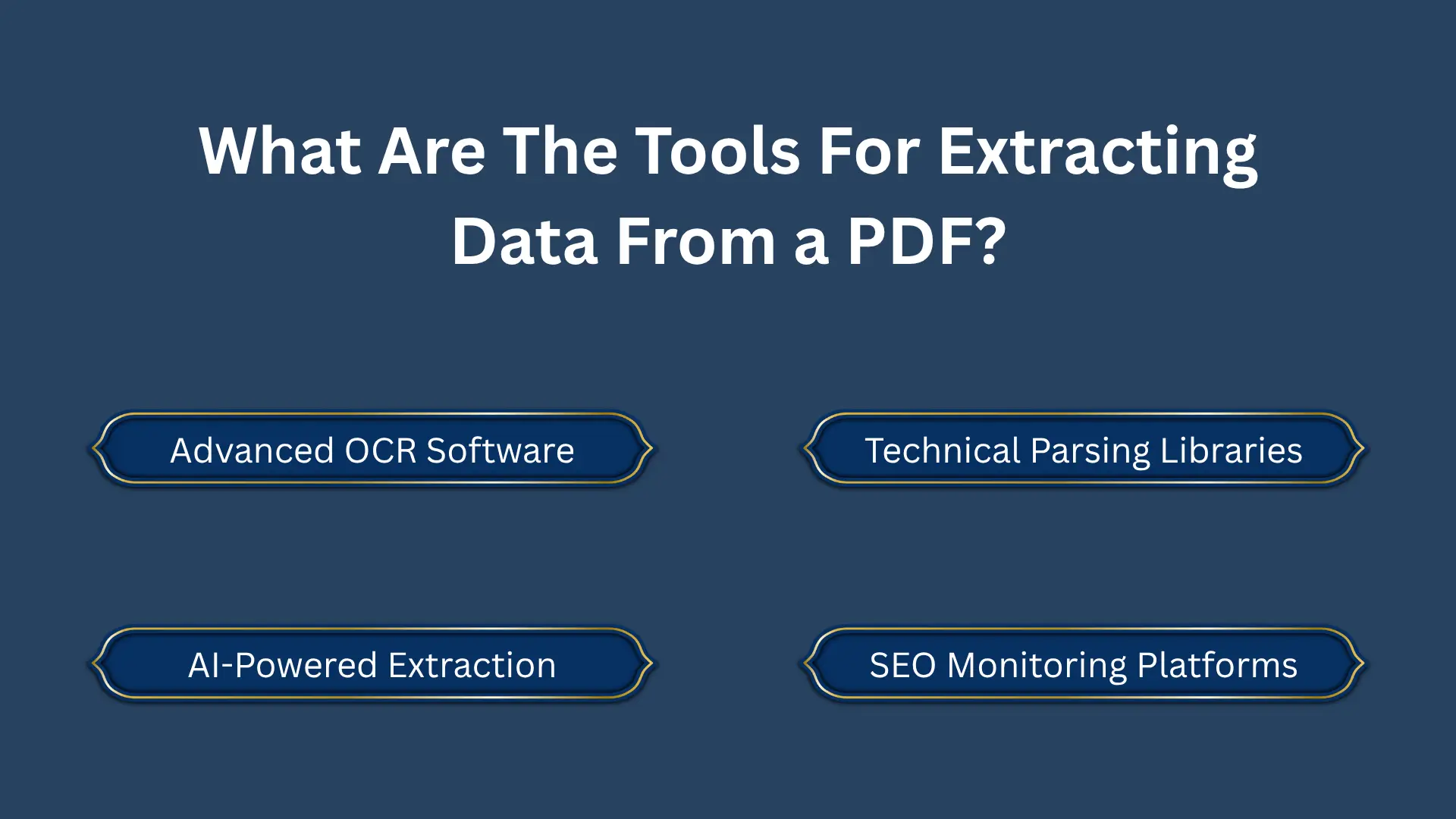
What Are The Tools For Extracting Data From a PDF?
Several tools are commonly used for extracting data from PDFs.
Popular options include:
- OCR tools for scanned documents
- PDF parsing libraries
- AI-based extraction platforms
- SEO-focused Brand monitoring tools
The best choice depends on scale, accuracy needs, and integration requirements.
Challenges in PDF Brand Mention Extraction & Fixes
Extracting mentions from PDFs comes with challenges that can affect accuracy and SEO outcomes.
Common issues include:
- OCR Errors in Scanned PDFs: Use high-quality PDF OCR (Optical Character Recognition) tools like Tesseract or AI OCR for cleaner text extraction.
- Complex PDF Layouts (Columns, Tables, Images): Apply layout-aware parsers and AI-based document parsing tools to preserve reading order and structure.
- Missed or Misspelled Brand Names: Use fuzzy matching, synonym lists, and Named Entity Recognition (NER) to capture variations of Brand Mentions.
- High Noise & Irrelevant Data: Implement filtering rules and context-based scoring to improve contextual mentions accuracy in SEO datasets.
Solving these challenges improves Brand Mentions SEO performance and ensures reliable insights.
Through the Guest Posting Solution outreach network and publishing process, we help businesses track where their content appears.
Conclusion
Most businesses still treat PDFs as static files, not as SEO assets. That gap creates an opportunity.
Extracting Brand Mentions from PDFs is not just a technical task; it is a strategic move that strengthens entity-based SEO, improves AI search visibility, and builds long-term authority.
When you systematically track Unlinked Brand Mentions, clean the data, and convert them into backlinks or contextual signals, you create a powerful competitive advantage.
Brands that invest in structured online brand monitoring, advanced extraction methods, and consistent mention optimization are the ones dominating both search engines and AI-generated results today.
FAQs
Is there a way to extract comments from a PDF?
Yes, PDF tools allow the extraction of annotations, comments, and notes. Advanced tools can parse metadata and embedded content.
What is the tool for extracting data from a PDF?
Tools include OCR software, parsing libraries, and AI-based platforms designed for document parsing and structured data extraction.
How to pull logos from a PDF?
Logos can be extracted using image extraction tools or PDF editors that allow exporting embedded graphics.