Real Estate Backlinks: Win More Local Search Visibility
Ranking a real estate website isn’t just about publishing neighborhood guides or optimizing your Google Business Profile. Hundreds of agents, brokers, and property companies are targeting the same local keywords. The websites that consistently appear at the top usually have one thing in common. They earn high-quality real estate backlinks from trusted and relevant sources.
Google has become much better at understanding authority. A backlink from a respected local newspaper, a real estate publication, or a community organization sends a stronger trust signal than dozens of random directory listings. That’s why real estate link building remains one of the strongest long-term investments for local SEO.
What Are Real Estate Backlinks?
A real estate backlink is a hyperlink from another website pointing to your real estate website. Search engines treat these links as recommendations. When trusted websites reference your content, Google sees that as a signal that your business deserves greater visibility.
Not every backlink carries the same weight.
A link from a respected real estate publication or a local Chamber of Commerce can influence rankings far more than dozens of links from unrelated websites.
Good backlinks usually come naturally through valuable content, local partnerships, guest posting, digital PR, and industry relationships.
How Google Evaluates Real Estate SEO Links
Google doesn’t count backlinks the way it did years ago. Instead, it evaluates multiple trust signals before deciding how much value a link deserves.
Relevance Comes First
A backlink from a real estate blog, mortgage company, home builder, or local news website usually carries more value than one from an unrelated niche. Context matters.
Google wants to see links surrounded by relevant content discussing homes, neighborhoods, property investment, relocation, or housing trends.
Authority Still Matters
High-authority websites pass stronger ranking signals because they’ve already earned Google’s trust over time.
Examples include:
- National real estate publications
- Local government websites
- Universities
- Established news organizations
- Trusted business associations
Authority should never outweigh relevance, though. A local newspaper can often outperform a high-authority website that’s unrelated to real estate.
Editorial Placement
Google values naturally earned editorial links far more than promotional links hidden inside footers or sidebars. An article discussing local market trends that references your research creates a stronger signal than a random directory listing.
Anchor Text
Anchor text tells Google what the linked page is about. Healthy backlink profiles contain a natural mix of:
- Brand names
- Partial keywords
- Generic anchors
- Naked URLs
- Exact-match keywords in moderation
Overusing keyword-rich anchors is still one of the fastest ways to create an unnatural backlink profile.
Trust Signals
Google also evaluates:
- Website quality
- Organic traffic
- Spam history
- Content originality
- User experience
- Link placement
- Overall website reputation
Quality always beats quantity.
How Google Determines the Quality of Real Estate Backlinks
Not all backlinks deserve your attention. Some improve rankings. Others do nothing. A few can even hurt your website. Understanding the difference saves both time and money.
1. Relevant Industry Websites
Links from real estate blogs, broker associations, mortgage lenders, property investment websites, and home improvement companies align naturally with your niche.
2. Local Relevance
Real estate is location driven. A backlink from your city’s Chamber of Commerce, tourism board, local magazine, or community organization tells Google you’re actively connected to the market you serve.
That local relevance often influences Google Maps rankings.
3. Editorial Context
Google prefers backlinks placed inside useful content. Imagine your neighborhood guide being referenced inside an article discussing housing market trends.
That editorial placement appears natural because it genuinely helps readers.
4. Traffic Potential
The best backlinks don’t only pass authority. They also send visitors.
A popular local publication with thousands of monthly readers may introduce new buyers and sellers who never would have found your business otherwise.
5. Fresh Content
Links placed within updated, regularly maintained articles often carry more value than links buried inside outdated pages. Fresh content signals an active website.
6. Indexed Pages
Backlinks only help when Google can crawl and index the page containing the link. Links hidden on orphan pages provide little SEO benefit.
For more useful insights, explore our other blog post, “B2B Link Building Agency: What to Look For Before Hiring”. Discover more to deepen your understanding.
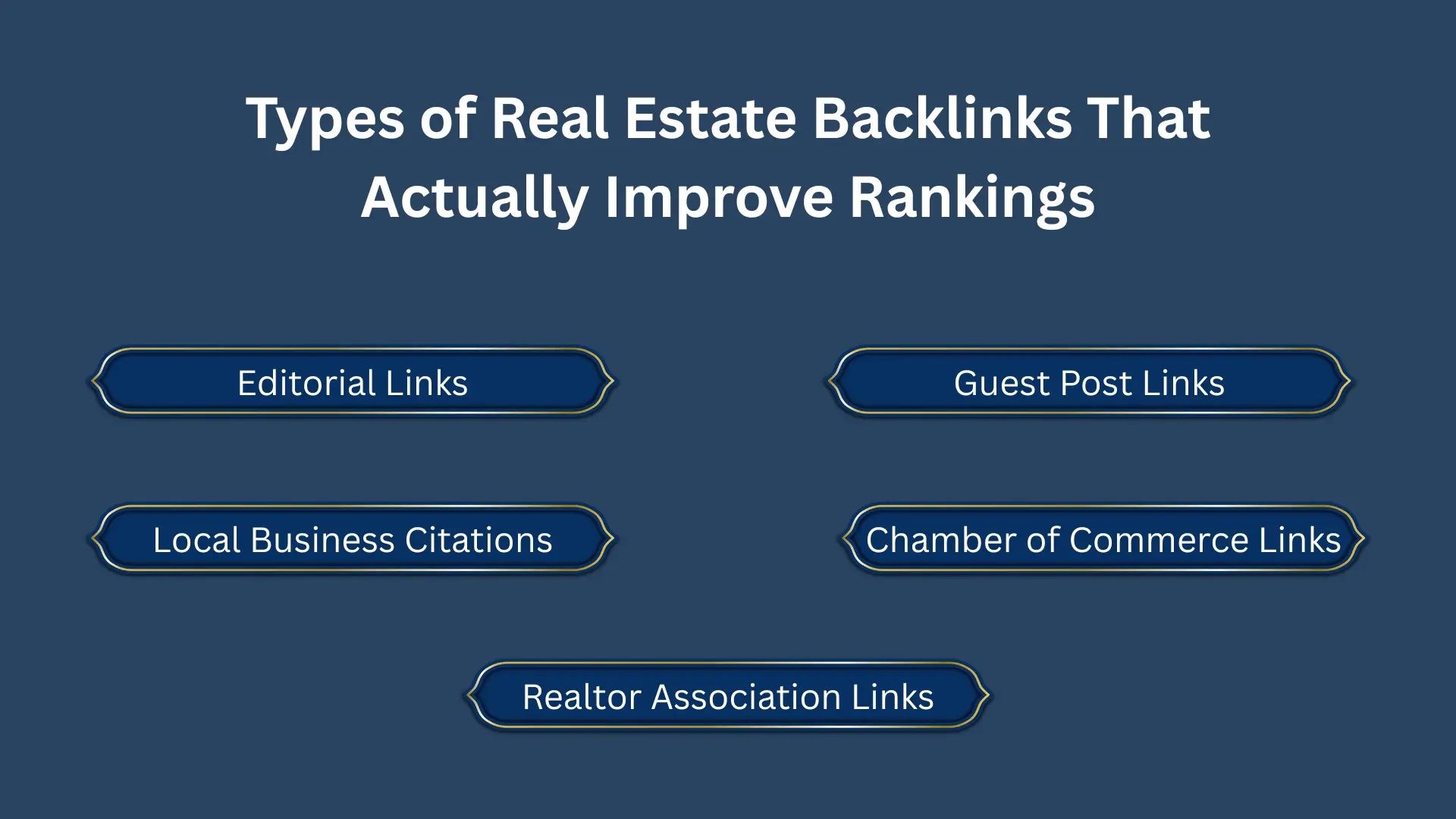
Types of Real Estate Backlinks That Actually Improve Rankings
Successful real estate link building isn’t built around one tactic. It relies on earning links from multiple trustworthy sources that reinforce your expertise across your local market.
Here are the backlink types that consistently produce measurable SEO value.
1. Editorial Links
Editorial backlinks are among the strongest links you can earn. These appear naturally when another publisher references your research, statistics, housing reports, or expert opinions.
2. Guest Post Links
Guest posting remains one of the safest and most scalable ways to build real estate backlinks. Instead of publishing promotional articles, contribute valuable insights to:
- Real estate publications
- Property investment blogs
- Home improvement websites
- Mortgage industry blogs
- Local business magazines
A thoughtful guest article positions your brand as an expert while earning a relevant editorial backlink. Quality always matters more than volume.
3. Local Business Citations
Business directories may not pass massive authority, but they help validate your local presence. Accurate listings across trusted platforms strengthen consistency.
Maintain identical:
- Business name
- Address
- Phone number
- Website
- Business category
Consistency supports local SEO while reinforcing trust.
4. Chamber of Commerce Links
Many local Chambers of Commerce maintain member directories, business profiles, event pages, and community resources. Membership often includes an authoritative backlink that supports local relevance. These links also strengthen your reputation within the business community.
5. Realtor Association Links
Professional organizations frequently maintain public member directories. These trusted industry websites naturally align with your niche and contribute to stronger topical authority.
Examples include:
- Local Realtor associations
- State Realtor organizations
- Housing councils
- Industry committees
Real Estate Link Building Strategy That Actually Works
Many businesses approach link building for real estate by collecting random backlinks wherever they can find them. That rarely produces lasting results.
A smarter strategy focuses on earning relevant authority step by step.
Step 1: Analyze Competitor Backlinks
Your competitors have already shown Google what works. Study the websites linking to the agencies consistently ranking above you. Tools like Ahrefs, Semrush, Moz, Majestic, and Google Search Console reveal:
- Referring domains
- High-performing content
- Lost backlinks
- Link gaps
- Anchor text patterns
This research often uncovers opportunities your competitors already validated.
Step 2: Identify Link Gaps
Not every backlink your competitor earns is worth copying. Focus on quality opportunities they have that you don’t.
Examples include:
- Local newspapers
- Industry blogs
- Community organizations
- Real estate magazines
- Vendor partnerships
- Housing associations
Building a targeted outreach list saves significant time later.
Step 3: Create Link-Worthy Assets
Backlinks become much easier to earn when your content genuinely deserves citations. High-performing real estate assets include:
- Annual housing market reports
- Neighborhood guides
- School district comparisons
- Relocation checklists
- Home buying calculators
- Mortgage affordability resources
- Cost-of-living comparisons
- Local investment reports
These resources naturally attract journalists, bloggers, and community websites looking for reliable information.
Step 4: Build Relationships Before Requesting Links
Successful outreach rarely begins with asking for a backlink.
- Engage first.
- Comment on articles.
- Share their content.
- Mention their work in your own articles.
Real relationships create better editorial opportunities than cold email templates ever will.
Step 5: Use Strategic Guest Posting
Guest posting remains one of the safest ways to scale real estate link building when it’s done correctly. Focus on websites that publish original, relevant content rather than mass guest post networks.
This is where experienced outreach agencies like Guest Posting Solution help businesses secure editorial placements on trusted websites that match their niche, audience, and SEO goals.
Step 6: Measure Results
Link building isn’t complete after a backlink goes live.
Track meaningful performance metrics, including:
- Organic traffic growth
- Keyword rankings
- Referring domains
- Referral visitors
- Lead generation
- Conversion rates
- Domain authority trends
The strongest real estate link building strategy focuses on steady, measurable authority growth instead of chasing backlink counts alone.
Link Building for Real Estate: Outreach Best Practices
Outreach succeeds because of relationships, not templates. Many website owners receive dozens of backlink requests every week. Most go unanswered because they focus on the sender instead of the recipient.
1. Personalize Every Email
Generic emails rarely earn editorial placements. Reference a recent article.
Mention something specific you appreciated. Explain why your content genuinely complements their existing resource. People respond to authenticity.
2. Lead with Value
Instead of asking for a backlink immediately, offer something useful. That could include:
- Original research
- Local statistics
- Expert commentary
- Updated resources
- Exclusive insights
Helpful outreach feels collaborative rather than transactional.
3. Use Natural Anchor Text
Anchor text diversity remains an essential ranking factor. A healthy backlink profile includes:
- Brand names
- Partial keyword phrases
- Generic anchors like “learn more”
- Naked URLs
- Limited exact-match keywords
Over-optimized anchors often create unnecessary risk.
4. Follow Up Respectfully
Busy editors miss emails. A single follow-up after several days is reasonable. Repeated messages every few days usually damage future opportunities.
Local Link Building Opportunities Every Realtor Should Use
Local authority plays a major role in real estate SEO. Google wants evidence that your business actively participates within its community. Several local organizations offer natural backlink opportunities. These include:
- Chambers of Commerce
- Business associations
- Economic development offices
- Community newspapers
- City magazines
- Neighborhood blogs
- Local universities
- Schools
- Housing nonprofits
- Rotary Clubs
- Tourism websites
- Local event organizers
Many real estate businesses overlook these opportunities because they focus only on national websites. That approach misses one of Google’s strongest local relevance signals.
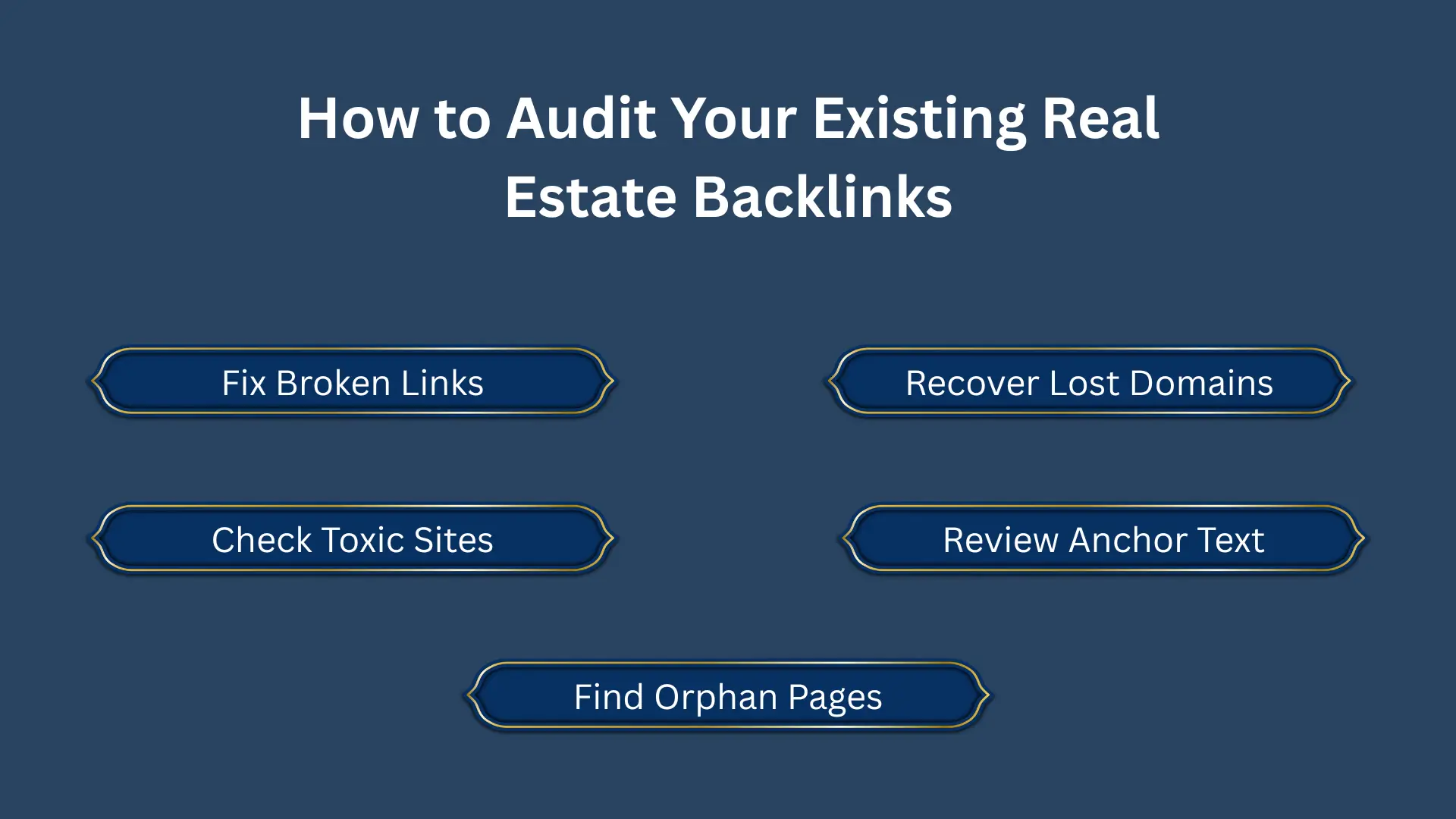
How to Audit Your Existing Real Estate Backlinks
Every backlink profile deserves regular maintenance. SEO isn’t simply about gaining new links.
It’s also about protecting your existing authority. Begin by reviewing your backlink profile using tools like Google Search Console, Ahrefs, Semrush, Moz, or Majestic.
Look for:
- Broken backlinks
- Lost referring domains
- Toxic websites
- Spam patterns
- Redirect issues
- Anchor text distribution
- Orphan pages
If harmful backlinks appear, investigate before submitting a disavow file. Google already ignores many low-quality links automatically. Disavowing links without proper analysis can remove legitimate authority.
How Real Estate Backlinks Support EEAT, GEO, and AI Search Visibility
Search has changed dramatically. Google AI Overviews, ChatGPT, Gemini, and Perplexity increasingly summarize information instead of simply listing websites.
Authority matters more than ever.
1. Strengthening EEAT
Backlinks help demonstrate Experience, Expertise, Authoritativeness, and Trustworthiness. Editorial mentions from respected publications reinforce your credibility far beyond keyword optimization alone. Google increasingly rewards businesses recognized by trusted third parties.
2. Supporting GEO
Generative Engine Optimization focuses on becoming a source AI systems trust. When authoritative websites consistently reference your business, AI models gain stronger confidence in your expertise. Brand recognition becomes part of your visibility strategy.
3. Improving Entity Recognition
Search engines no longer evaluate keywords alone. They understand entities. Consistent mentions across trusted websites help associate your brand with topics like:
- Local real estate
- Luxury homes
- Property investment
- Neighborhood expertise
- Home buying
- Residential sales
That semantic relationship strengthens topical authority over time. The strongest local SEO campaigns combine all three.
Conclusion
Strong real estate backlinks remain one of the most reliable ways to improve local search rankings, build authority, and generate qualified leads. Success doesn’t come from chasing hundreds of links. It comes from earning the right ones through valuable content, genuine relationships, and consistent outreach.
If you’re ready to scale your authority with editorial placements and proven white-hat outreach, Guest Posting Solution can help you build sustainable backlinks that continue delivering results long after they’re earned.
FAQs
How many backlinks does a real estate website need?
There’s no fixed number. A small website with highly relevant editorial backlinks can outperform competitors with hundreds of low-quality links.
Are directory backlinks still useful?
Yes, but only when they come from trusted, relevant, and legitimate directories. They should support your strategy, not become the entire strategy.
How long does real estate link building take?
Most campaigns begin showing measurable SEO improvements within three to six months, although competitive markets may require more time and consistent effort.