Keyword Density in SEO for Smarter Content Optimization

Content relevance drives modern search engine optimization. Search engines no longer rely on basic signals alone. Instead, they analyze user intent, topic coverage, and how well a piece of content answers a query. Because of this shift, keyword density in SEO still plays an important role, though its use looks very different today.
Keyword density helps search engines understand the main topic of a blog post. It shows how often a target keyword appears compared to the total number of words. However, modern search engines also evaluate context, related keywords, and user experience.
As a result, SEO professionals now rely on keyword density checker tools, keyword density analyzer platforms, and AI-driven SEO tools to maintain balance. These tools help avoid keyword stuffing while improving content optimization.
For professional optimization support, including accurate keyword density check and advanced insights, consider Guest Posting Solutions.
What Is Keyword Density in SEO?
Keyword density in SEO measures how many times a keyword phrase appears in a piece of content compared to the total number of words. It is usually shown as a keyword density percentage.
The basic idea is simple. If a main keyword appears too often, it can look unnatural. If it appears too little, search engines may not understand the main topic clearly.
Keyword density helps balance keyword usage so that content stays readable and optimized.
Keyword Density vs Keyword Frequency
Although many people confuse them, keyword density and keyword frequency are not the same.
Keyword frequency shows how many times a particular keyword appears. Keyword density goes further. It compares that frequency to the overall word count. This gives a clearer picture of keyword use inside a blog post.
For example, using a keyword 20 times in 500 words creates a much higher density than using it 20 times in 2,000 words. That difference matters for content optimization.
Why Keyword Density Still Matters
Understanding why it matters helps content writers, SEO experts, and website owners create content that ranks well in search engine results pages (SERPs) while also providing value to readers.
1. Signals Topic Relevance to Search Engines
Modern search engines, including Google, use keyword density as one of many signals to understand what a page is about. When a main keyword is used naturally and along with related terms, Google’s algorithms can accurately identify the main topic. This helps your page show up for relevant search queries.
However, it’s not just about repeating the main keyword; semantic relevance matters. Including keyword variations, related keywords, and long-tail keywords helps Google better understand context and increases your chances of ranking for multiple search queries.
2. Helps Avoid Keyword Stuffing
One of the main reasons keyword density matters is to prevent keyword stuffing. Stuffing occurs when a keyword is overused unnaturally throughout a blog post, meta description, or title tag. High keyword density without context can reduce readability, harm user experience, and trigger Google’s penalties.
By monitoring keyword density, content creators can maintain a balance, using keywords enough to signal relevance but not so much that it becomes spammy.
3. Improves On-Page SEO Metrics
Keyword density is an essential part of on-page SEO metrics. It influences multiple areas of SEO content, including:
- Meta description: Incorporating your focus keyword naturally increases the chance of clicks in SERPs.
- Title tag and page title: Proper keyword usage signals relevance for search queries.
- Headings and body text: Balanced keyword density ensures that the main topic is clear while keeping content readable.
Proper keyword distribution, combined with related keywords and semantic variations, helps create content that aligns with modern SEO best practices.
4. Supports User Intent and Content Strategy
Keyword density matters because it reflects whether a piece of content aligns with user intent. Content with too low keyword density may fail to signal its relevance, while content with too high density can feel forced or unnatural.
A smart content strategy uses keyword density to guide topic coverage and keyword placement. Tools like a keyword density checker or keyword density analyzer help writers see where adjustments are needed to better match search intent.
5. Balances SEO with Readability
Ultimately, keyword density matters because it strikes a balance between SEO optimization and user experience. Modern search engines prioritize helpful content that satisfies the reader’s query. By maintaining optimal keyword density, you improve chances for higher search engine rankings while keeping content easy to read and engaging.
6. Enhances Content Optimization
Keyword density is also linked to broader content optimization practices. By analyzing keyword use, frequency, and distribution, content creators can:
- Refine blog posts for better topic coverage
- Include semantic keywords and keyword variations naturally
- Avoid over-optimization while maintaining focus on the main keyword
This ensures your SEO strategy supports both organic traffic growth and long-term engagement.
How to Calculate Keyword Density in SEO
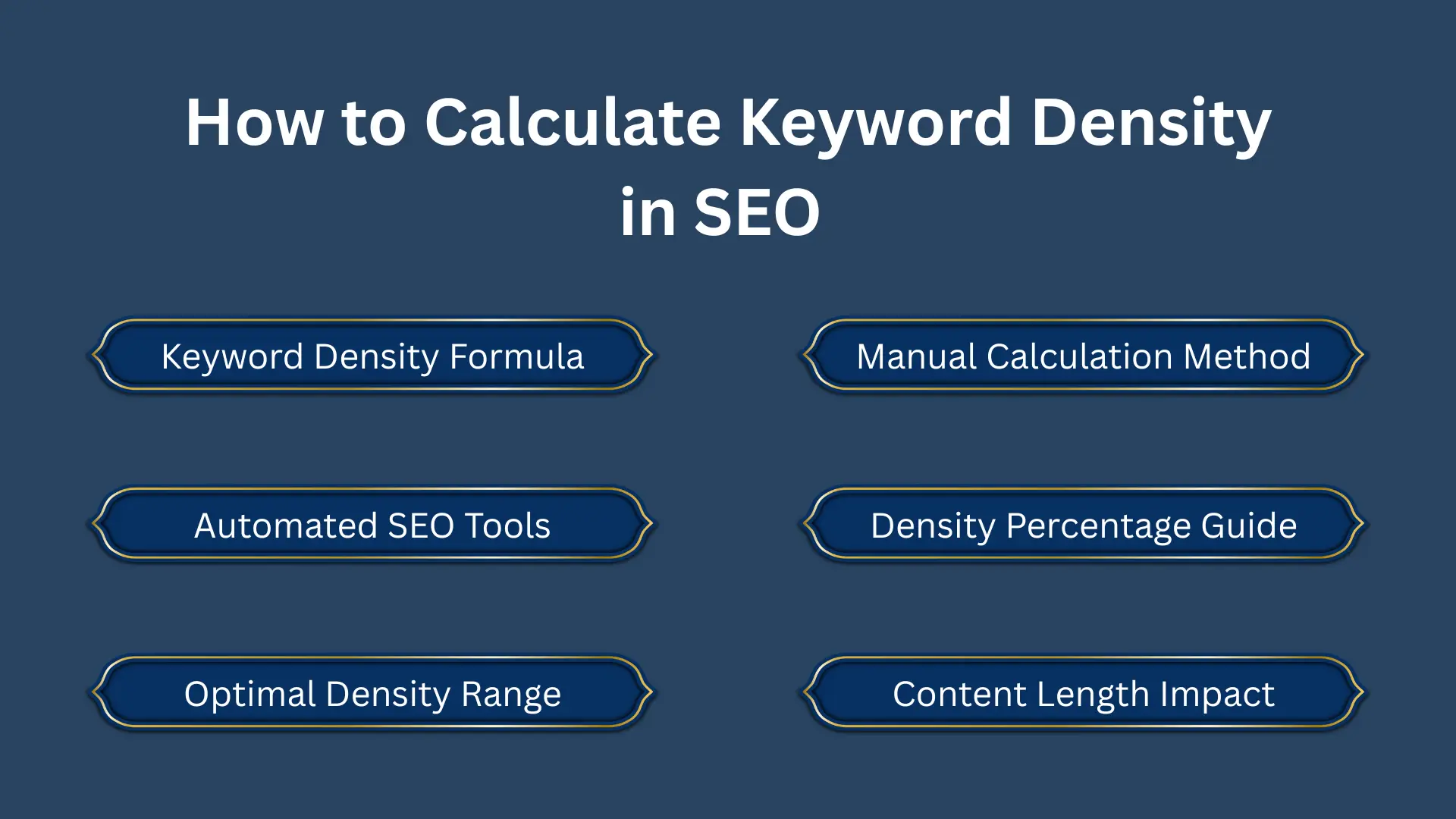
1. Simple Formula
The keyword density formula is straightforward:
Keyword Density = (Number of times a keyword appears ÷ Total number of words) × 100
For example:
- Keyword usage: 15 times
- Total number of words: 1,000
Keyword density percentage = 1.5%
This calculation helps SEO experts maintain optimal keyword density without risking penalties.
2. Practical Walkthrough
Calculating keyword density can be done manually or with online tools.
Manual Method
- Count how many times a particular keyword appears
- Count the total number of words
- Apply the formula
This method works for short blog posts, but becomes inefficient for larger SEO content.
Automated Method
Most content writers prefer a keyword density tool. These tools instantly:
- Check keyword density
- Identify keyword variants
- Highlight keyword frequency
SEO Review Tools, SEO plugins, and free tools offer reliable insights. Many platforms also analyze meta descriptions, page titles, and title tags.
3. What Is a Good Keyword Density?
There is no single fast rule. However, most SEO experts agree that the ideal keyword density ranges between 0.5% and 2%.
That said, optimal keyword density depends on:
- Content length
- Content type
- Search intent
- Keyword difficulty
Long-form SEO content allows more flexibility. Short blog posts require extra caution to avoid high keyword density.
Best Practices for Optimizing Keyword Density
1. Focus on User Intent First
User intent should guide every SEO tactic. Keyword density matters, but relevance matters more. Content that matches search intent performs better on search engine results pages.
Instead of repeating a keyword, focus on answering user questions. Search engines prioritize helpful content that improves user experience.
Quality always outweighs raw keyword density.
2. Target Related Terms (LSI and Entities)
Modern search engines rely on related keywords, keyword variations, and entities. These signals help Google understand topic depth.
Use:
- Related terms
- Long-tail keywords
- Keyword variants
For example, instead of repeating the same focus keyword, include:
- SEO keyword density
- Keyword density check
- Keyword optimization
This approach improves topic clusters and avoids keyword stuffing.
3. Use Tools to Refine Content
A keyword density analyzer helps balance primary and secondary keywords. These tools analyze:
- Keyword use
- Density score
- Topic coverage
Advanced tools also use Term Frequency-Inverse Document Frequency (TF-IDF) to compare your content with top-ranking pages.
Tools to Measure and Improve Keyword Density
1. Online Keyword Density Check Tools
Online tools make calculating keyword density easier and faster. Many SEO tools offer:
- Real-time keyword density check
- Meta tag analysis
- Page title and title tag insights
Popular tools include free tools, SEO plugins, and premium platforms. Some integrate AI Search features to improve accuracy.
2. How Tools Help Content Structuring
Keyword density tools help content writers:
- Identify overused keywords
- Detect missing relevant keywords
- Improve overall content flow
These insights support content strategy and SEO techniques without harming readability.
However, keyword density is only half the battle. If multiple pages on your site are optimized for the same terms, you might be accidentally hurting your own rankings. To stop your pages from competing with each other, read our guide on Keyword Cannibalization: Hidden SEO Issue to Fix Fast.
Balancing Keyword Density with Search Intent
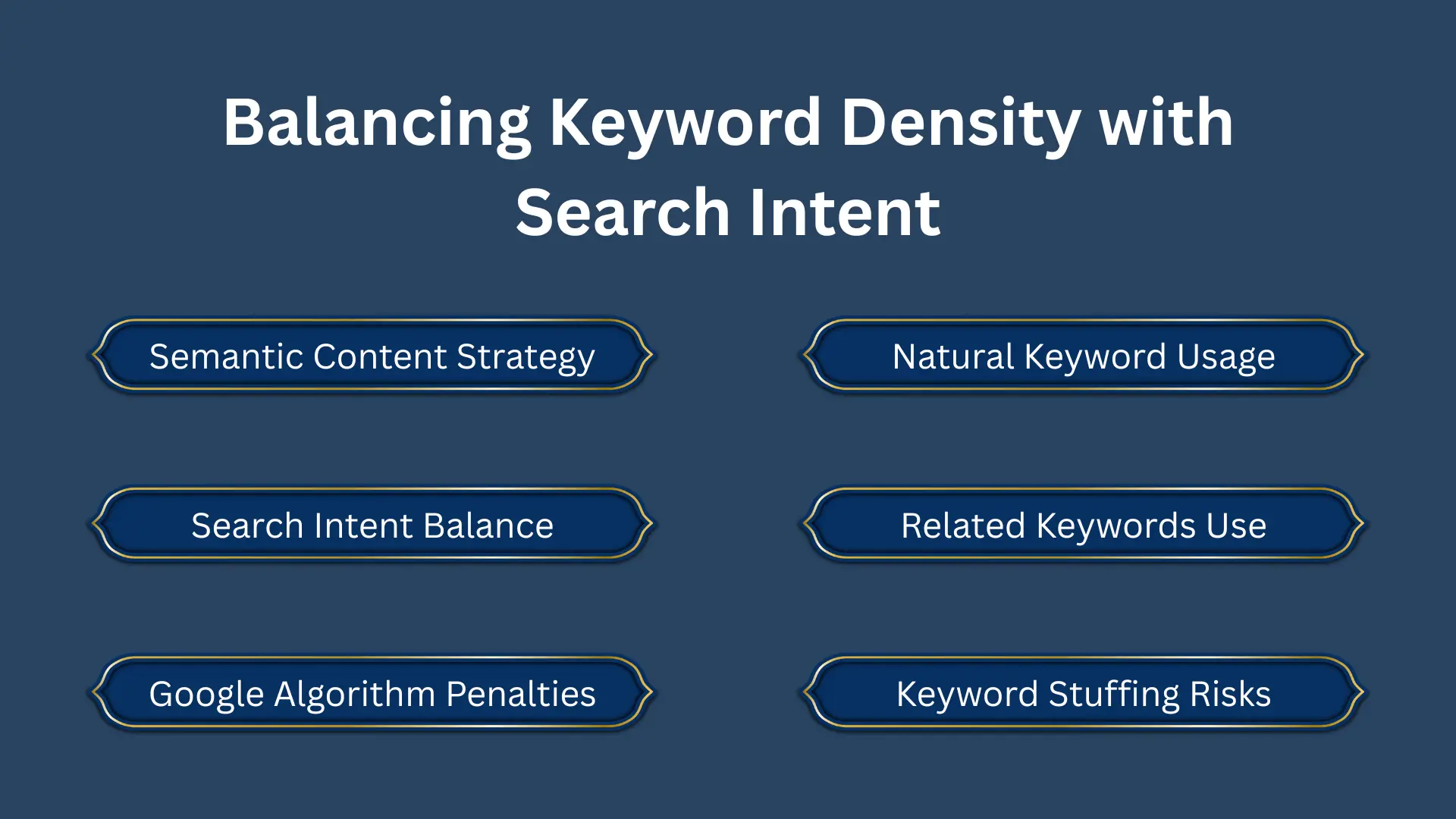
1. Semantic Content vs Exact Match Keywords
Exact match keywords are no longer the main ranking factor. Instead, semantic content drives SEO success.
Google uses AI Search and natural language processing to understand meaning. As a result, content that covers a topic fully performs better than content that repeats a particular keyword.
This shift reduces the importance of strict keyword density while increasing the value of context.
2. Examples of Effective Implementation
Effective SEO content includes:
- Focus keyword in the page title
- Natural keyword use in headings
- Related keywords in body text
This balanced approach sends rich content signals to search engines and improves search engine rankings.
SEO Keyword Density Mistakes to Avoid
One common mistake is keyword stuffing. This practice harms readability and violates SEO practice guidelines.
Other mistakes include:
- Ignoring related keywords
- Over-optimizing meta description
- Sacrificing user experience
Google’s algorithms penalize content that prioritizes keywords over value.
Conclusion
Keyword density in SEO remains an important metric, but it is no longer a standalone ranking factor. Modern search engines evaluate context, relevance, and user intent.
By using keyword density tools, focusing on semantic keywords, and following best SEO practices, content writers can improve search rankings without sacrificing readability.
The key is balance. Optimize keyword usage, support topic coverage, and always create helpful content for your target audience.
FAQs
What’s the ideal keyword density in SEO?
Most SEO experts suggest 0.5% to 2% keyword density, depending on content type, user intent, and overall SEO strategy.
Does too high a density hurt rankings?
Yes. Excessive keyword use can appear as keyword stuffing, damaging readability, user experience, and search engine rankings significantly.
Can LSI keywords replace exact matches?
Yes. Using LSI keywords, related terms, and keyword variants often improves rankings more effectively than repeating exact keywords.