Mobile SEO: Improve User Experience and Rankings on All Devices

Every day, people search, shop, read, and compare almost everything on their phones. As a result, a mobile friendly website is no longer optional. Instead, it has become a core requirement for visibility, engagement, and conversions. Moreover, search engines now evaluate websites primarily from a mobile perspective. Therefore, brands that ignore mobile optimization often struggle with rankings, traffic, and user satisfaction.
This guide explains Mobile SEO: Improve User Experience and Rankings on All Devices in a practical and technical way. In addition, it covers audits, checklists, and strategies you can apply right away. Throughout the article, you will also find clear transitions that connect ideas smoothly and help you scan quickly.
What Is a Mobile Friendly Website?
A mobile friendly website is a site that displays, loads, and functions properly on smartphones and tablets. In other words, content adjusts to different screen sizes without breaking layouts or hiding essential information. At the same time, navigation remains simple, readable, and touch-friendly.
Unlike older desktop-only sites, mobile-friendly websites automatically adapt text size, images, buttons, and menus. As a result, users can scroll, tap, and interact without zooming or horizontal scrolling. Furthermore, these websites load faster and reduce friction across devices.
Importance of a Mobile-Friendly Website Design
Today, most people use their phones to search online. Because of this, a mobile-friendly website design is very important. If a site does not work well on mobile, visitors leave fast. As a result, traffic and trust both drop. Why is making a mobile-friendly website is so important? This question matters because mobile experience directly affects rankings, engagement, and revenue.
Improves user experience
First, a mobile-friendly design improves user experience. Text is easy to read, buttons are easy to tap, and pages fit the screen. Therefore, users stay longer and explore more pages. In addition, simple navigation helps people find information quickly.
Websites load faster
Next, mobile-friendly websites load faster. Since mobile users expect quick results, speed matters a lot. When pages load fast, bounce rates go down. Consequently, engagement goes up.
search engines prefer mobile-friendly websites
Also, search engines prefer mobile-friendly websites. Because of mobile-first indexing, search engines check the mobile version first. So, better mobile design often leads to better rankings. As a result, visibility increases.
Good mobile design builds trust
Moreover, a good mobile design builds trust. When a website looks clean and works smoothly on phones, users feel confident. Therefore, they are more likely to contact, sign up, or buy.
Finally, a mobile-friendly design supports business growth. It helps reach more users, improve SEO, and increase conversions. In short, a mobile-friendly website is not a choice anymore. Instead, it is a basic need for online success.
Key Characteristics of a Mobile-Friendly Website
A mobile-friendly website is built to work smoothly on smartphones and tablets. Below are the key characteristics explained in the simplest way. In addition, each point is easy to scan and understand.
1. Responsive Design
First of all, the layout adjusts to fit every screen size. As a result, content looks clean on all devices.
2. Fast Loading Speed
Next, pages load quickly on mobile networks. Therefore, users do not wait long and leave the site early.
3. Easy-to-Read Text
Also, text appears clear without zooming. This way, users can read comfortably on small screens.
4. Touch-Friendly Buttons
Moreover, buttons and links are large enough to tap easily. Because of this, users avoid wrong clicks.
5. Simple Navigation
In addition, menus are easy to open and use. As a result, visitors find information quickly.
6. Optimized Images and Videos
Furthermore, images resize properly and load fast. This helps save data and improve speed.
7. No Horizontal Scrolling
Most importantly, the content fits the screen width. Therefore, users scroll only up and down.
8. Minimal Pop-Ups
Lastly, pop-ups do not block the screen. Because of this, users enjoy a smooth experience.
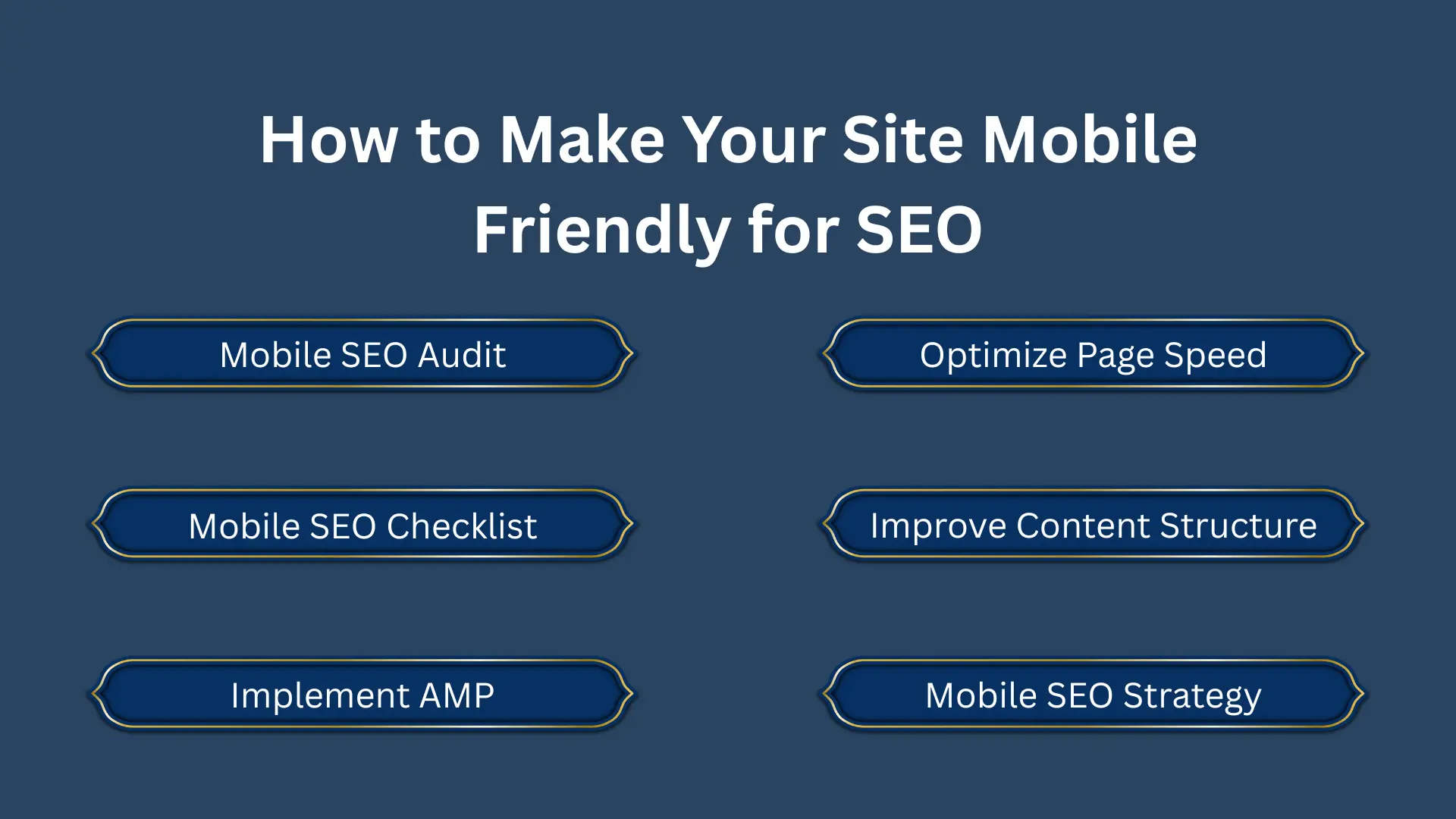
How to Make Your Site Mobile Friendly for SEO
Improving mobile SEO needs both design and technical work. Still, the process feels easier when you follow clear steps.
1. Start With a Mobile SEO Audit
A mobile SEO audit shows hidden problems. It finds slow pages, broken layouts, and mobile indexing issues. Because of this, it becomes the base for all fixes.
2. Use a Mobile SEO Checklist
A mobile SEO checklist keeps the work organized. It helps you avoid missing key tasks. The checklist usually includes:
- Responsive design checks
- Page speed improvement
- Mobile usability testing
- Structured data review
- Font and button size checks
As a result, your optimization stays consistent.
3. Optimize Page Speed
Speed matters most on mobile devices. Large images and heavy scripts slow pages down. So, compress images, reduce code, and enable browser caching. This helps pages load faster and keeps users engaged.
4. Implement Accelerated Mobile Pages
Accelerated mobile pages SEO focuses on fast-loading pages. AMP removes extra code and keeps pages light. While not needed for every site, it works well for blogs and news pages. Because of this, load time drops sharply.
5. Improve Content Structure
Mobile users scan content fast. Short paragraphs help. Clear headings guide readers. Bullet points make information easy to read. Therefore, content becomes mobile-friendly.
6. Develop a Clear Mobile SEO Strategy
A strong mobile SEO strategy connects tech fixes with user needs. Focus on local searches, voice search, and clear intent keywords. This way, content matches how mobile users search.
How to Check If a Website Is Mobile-Friendly
Testing mobile friendliness is easy, and it matters a lot. With the right steps, you can spot problems fast and fix them early.
1. Mobile-Friendly Testing Tools
Online tools check your site in minutes. They review layout, text size, and ease of use. They also flag common issues. These include small fonts, buttons placed too close, and content that does not fit the screen.
2. Manual Testing
Open your website on different phones and tablets. Then, tap through menus and forms. Press buttons and links. Pay attention to load speed. Also, watch how smooth scrolling feels. Any delay or break hurts user experience.
3. Performance Monitoring
Analytics show how mobile users behave. Look at bounce rate, time on site, and conversions. Compare mobile data with desktop data. If mobile results are lower, your site needs improvement.
Regular testing helps your site stay fast, clear, and easy to use on all devices.
Check for Common Issues on Mobile Devices
Even a well-optimized site can face mobile problems. Because of this, regular checks still matter.
Slow Load Times
Large images and heavy scripts slow pages down. As a result, many users leave before the page opens.
Unplayable Media
Some videos use formats phones cannot play. This creates frustration. So, use HTML5-friendly media that works on all devices.
Broken Layouts
Certain elements do not resize well on small screens. Because of that, text may overlap or look messy.
Poor Form Usability
Long forms are hard to fill on phones. For this reason, shorter fields and autofill options work better.
Mobile SEO and User Experience: A Direct Connection
Mobile SEO and user experience go hand in hand. When visitors find easy navigation, quick loading pages, and clear text, they stay longer. Because of this, search engines notice positive behavior and push the site higher in results.
In addition, mobile-first indexing checks the mobile version before anything else. So, a poor mobile experience directly lowers your overall SEO performance.
Guest posting solutions help you to make your website mobile friendly with better visibility and speed.
Mobile SEO in Competitive Growth Strategies
Mobile SEO plays a key role in modern growth plans. Today, most users visit sites on phones. Because of this, pages must load fast and work well on small screens.
Agencies often mix mobile optimization with link building. This approach helps brands grow faster. For example, White Label Link Building: Boost Clients, Links, and Results delivers better results when landing pages are mobile-friendly. If a page is slow or hard to use, visitors leave quickly. As a result, links lose value.
In addition, a clean and clear site structure matters a lot. It guides users smoothly from one page to another. Because of this, traffic from guest posts converts better. Visitors stay longer, read more, and take action.
Final Thoughts
A mobile-friendly website is key to SEO today. It impacts usability, speed, indexing, and rankings. By creating a clear mobile SEO strategy, running regular audits, and using a simple checklist, you can boost long-term growth.
Mobile SEO is more than rankings. It focuses on giving users smooth, fast, and reliable experiences on every device.
FAQs
How to choose the right mobile-friendly solution?
Start by checking your website goals and how visitors behave. Next, pick a responsive design and optimize its performance. This way, you get flexibility, speed, and growth together.
How much does it cost to make a website mobile-friendly?
Costs vary based on complexity. Simple updates cost less, while full redesigns cost more. However, the long-term ROI usually outweighs the initial expense.
What is the difference between a mobile friendly website and a responsive website?
A mobile friendly website works on mobile devices, while a responsive website automatically adapts to all screen sizes. In practice, responsive design is the most effective mobile-friendly approach.