How Paid Link Insertion Improves Search Rankings Fast
Paid link insertion is one of the most efficient link building services available to businesses that want real results from search engine optimization. Unlike traditional guest posts, where you create new content for other sites, paid link insertion places your backlink directly into an existing article on high‑authority websites, often one that already ranks on the search engine results pages (SERPs).
This service leverages indexed content backlinks, links on content that’s already been crawled, trusted, and ranked by Google. As a result, you benefit from authority transfer from those pages without waiting for fresh content to be indexed. When done right, paid link insertion delivers quality backlinks, better organic traffic, and stronger domain authority, accelerating your SEO strategy’s ROI.
For business owners and digital marketers, understanding how paid link insertion works as a white‑hat link building tactic and how it compares to other methods is essential to making smart link building investment decisions. This article breaks down every technical aspect so you can confidently decide if paid link insertion fits your SEO goals.
What Is Paid Link Insertion?
Paid link insertion is a link building tactic where SEO experts pay site owners or publishers to insert links into existing articles or pages that already have authority, indexed content, and real traffic.
Unlike writing a new blog post, paid link insertion focuses on contextual link placement into content that already ranks, and then uses quality backlinks to pass link juice that improves search engine rankings, domain authority, and organic search growth.
Paid link insertion is often referred to in the industry as niche edits, a specific type of white‑hat link building that focuses on relevance, authority transfer, and measurable SEO value.
Why Backlinks Still Matter More Than Ever
Backlinks remain one of the top ranking factors for search engines such as Google. These third‑party links act like public votes for your site, signaling relevance, trust, and authority.
Here are the bottom-line SEO benefits of quality backlinks:
- Authority Transfer: Backlinks from high‑authority websites pass link juice to your target pages.
- SERP Visibility: Pages with strong backlink profiles often show up higher in the search engine results pages.
- Organic Traffic Growth: More visibility typically leads to more clicks and actual visitors.
- Referral Traffic: Backlinks can send real users directly from the referring site.
Search engines use backlink metrics like domain rating, Page Authority, and anchor text relevance to evaluate how much weight to give each backlink. Paid link insertion plays directly into this ecosystem.
Contextual Backlinks: How Paid Link Insertion Works
Paid link insertion isn’t about buying links. It’s about placing relevant links into existing pages that already have authority and indexed content.
Here’s how it typically works:
- A link builder identifies a high‑authority page with relevant content.
- The target website owner is approached with an outreach strategy and publisher outreach.
- With approval, a link (typically a dofollow link) is manually inserted into the existing content where it fits naturally.
- Once live, the backlink starts improving domain authority, passing link juice, and impacting keyword rankings.
Because these pages already exist and have indexed authority, the SEO value is stronger, often stronger than a newly published guest post that still needs time to rank.
This system is especially effective when:
- It’s placed on pages already ranking for relevant keywords.
- The anchor text is natural but optimized.
- The contextual relevance between the content and the link target is high.
Niche Edits vs Other Link Building Strategies
Paid link insertion is often compared with other link building methods, but it’s important to see how it stacks up.
Niche Edits (Paid Link Insertion)
- Uses existing content that is already ranking
- Faster transfer of authority
- Often leads to quicker SEO impact
- Quality backlinks with contextual relevance
New Content Guest Posts
- Adds value with fresh content
- Great for brand building
- Takes longer to index and rank
- Needs more editorial work and content creation
Broken Link Building
- Builds value by replacing dead links
- Good for adding value to the internet
- Often lower authority or relevance
If your goal is immediate authority transfer and SEO ROI, niche edits and paid link insertion are among the most efficient ways to improve backlink profile strength and organic search performance.
Paid Link Insertion vs Traditional Outreach Strategy
Traditional Outreach Strategy, especially with guest posts, involves a lot of email outreach, negotiating with site owners, and writing new content.
Paid link insertion still involves outreach, but it’s focused on:
- Finding existing pieces of valuable content
- Negotiating placement terms with site owners.
- Getting contextual backlinks inserted where they make sense
Manual outreach in paid link insertion is less about selling content and more about finding placement opportunities that already exist, and this often results in better SEO ROI.
The key difference?
Traditional outreach creates new backlinks but requires a longer timeline, while paid link insertion works with authority that’s already built.
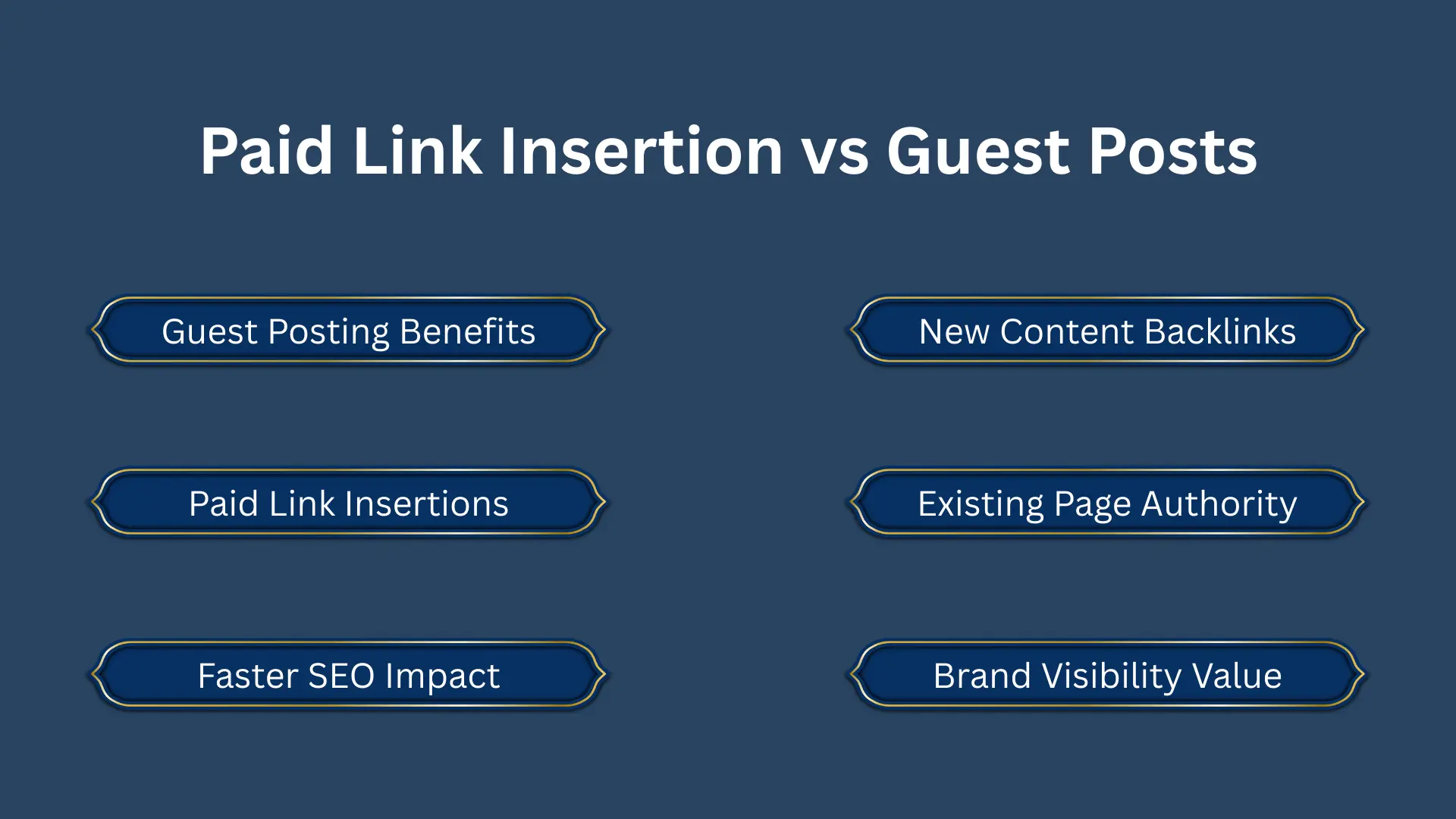
Paid Link Insertion vs Guest Posts
In the SEO world, the two most talked‑about tactics are:
Guest Posts
- You create a brand‑new article
- The site publishes it with your backlinks
- You get inbound links from fresh content
Paid Link Insertion
- Links are added to existing articles
- These pages already have authority and possibly traffic
- Backlink profile strength increases more quickly
Link building comparison clearly favors paid link insertion for faster SEO impact, but guest posts still have a place in content marketing and brand visibility.
SEO ROI: Measuring the Value of Paid Link Insertion
One of the biggest questions any business owner or SEO professional asks is:
What is the real ROI of paid link insertion?
Here are the core metrics to track:
Domain Authority & Domain Rating
Paid links can positively influence your domain metrics over time.
Keyword Rankings Impact
When a backlink is placed on a relevant page, it can accelerate your movement up search results for target keywords.
SERP Visibility
Tracking changes in impressions and position in Google Search Console will show improvements.
Organic Traffic Growth
More visibility = more potential sessions from search.
Referral Traffic
Clicks from the referring site to your homepage or landing page add tangible value.
SEO Tools often used include:
- Ahrefs (for backlink profile tracking)
- Moz (for domain authority metrics)
- SEMrush (for keyword rank tracking)
- Google Analytics & Search Console
A robust measurement strategy ensures you understand not just that paid link insertion works, but how well it works.
Link Insertion Campaigns: Step‑by‑Step Process
Here’s a proven link insertion process many SEO agencies use:
Step 1: Target Website & Page Identification
Begin by identifying high-authority websites that are topically relevant to your niche. Analyze existing articles for indexed content, relevance to target keywords, and traffic. Choosing the right pages ensures that the inserted link passes valuable link juice and improves domain authority efficiently.
Step 2: Backlink Metrics Vetting
Assess key metrics such as Domain Rating, Page Authority, outbound links, traffic, and overall content relevance. Evaluate the page’s SEO profile and historical performance. High-quality vetting ensures you only invest in backlinks that strengthen your backlink profile and contribute to organic search growth.
Step 3: Outreach Strategy
Craft a detailed manual outreach approach targeting website owners or publishers. Introduce your purpose clearly, explain the value of link insertion, and establish credibility. Personalizing outreach increases the likelihood of acceptance and builds long-term relationships for future link building opportunities.
Step 4: Placement Negotiation
Negotiate placement terms, including pricing, anchor text preferences, and optimal positioning within the content. Discuss whether the link will be dofollow, the surrounding contextual relevance, and integration within existing paragraphs. Proper negotiation ensures both parties achieve SEO and content alignment goals.
Step 5: Contextual Insertion
Once approved, carefully place the link inside an existing article where it naturally fits. Ensure the anchor text flows with the content, maintains readability, and complements the surrounding information. Proper contextual placement maximizes SEO value, enhances user experience, and strengthens referral traffic potential.
Step 6: Confirmation & Reporting
After insertion, confirm that the link is live, correctly formatted, dofollow, and indexed by search engines. Track performance metrics, including referral traffic, SERP visibility, and authority transfer. Comprehensive reporting provides transparency and ensures the campaign delivers measurable SEO benefits and ROI.
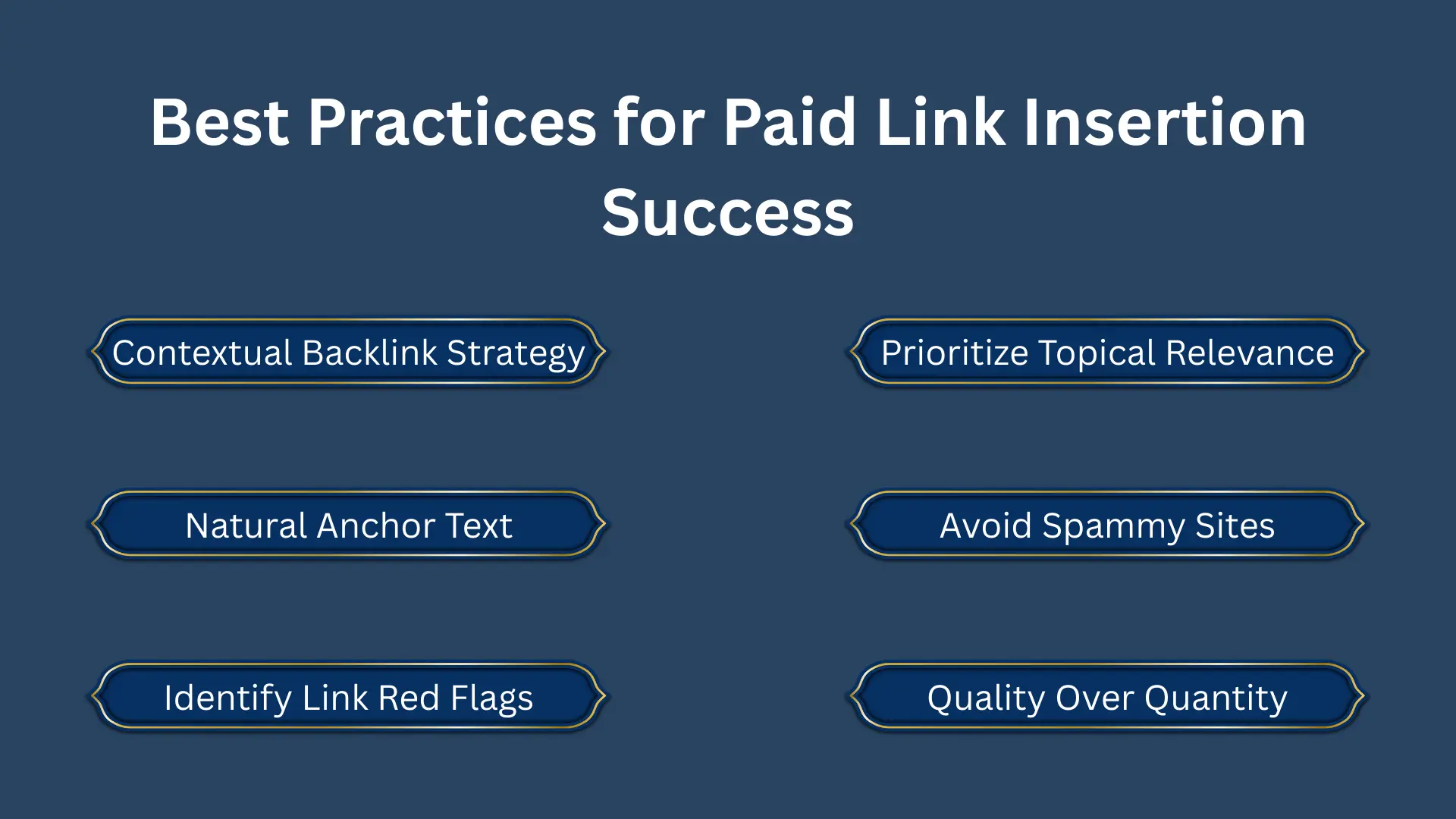
Best Practices for Paid Link Insertion Success
To ensure a successful paid link insertion campaign, follow these best practices:
- Choose contextual backlinks over random links
- Focus on topical relevance, not just domain authority
- Use natural anchor text that fits the content
- Avoid sites with spammy outbound links
- Never participate in link farms or low‑quality networks
- Avoid buying links that violate Google’s guidelines
- Track SEO progress with real tools and data
- Prioritize sites with real traffic and indexed content backlinks
Remember that quality always beats quantity.
Risks, Red Flags & How to Avoid Them
While paid link insertion can be powerful, there are risks if done incorrectly. Red Flags
- Sites with no traffic
- Link spam or link schemes
- Irrelevant content
- Excessive outbound links
- Low domain rating or poor metrics
These can harm your SEO efforts, lead to penalties, or dilute your backlink profile. The rule of thumb? If it looks like buying links, it probably is, and Google may penalize you.
That’s why you must prioritize quality links, relevance, and ethical placement.
Final Thoughts: When to Use Paid Link Insertion
Paid link insertion is among the most effective ways to build backlinks, strengthen your backlink profile, improve domain authority, and grow organic search visibility.
It works especially well when:
- Backlinks are high–quality
- Content is relevant and contextual
- Outreach is strategic and manual
- SEO goals align with growth and authority transfer
When executed correctly, paid link insertion becomes more than a tactic; it becomes a cornerstone of your SEO strategy.
FAQs
Is Paid Link Insertion Safe for SEO?
Yes, paid link insertion is safe when following Google’s guidelines. Prioritizing high-quality backlinks, relevance, and natural contextual placement ensures an ethical, effective, and long-term SEO strategy that boosts domain authority responsibly.
Is Paid Link Insertion Better Than Guest Posts?
It depends on your SEO objectives. For fast authority transfer, improved keyword rankings, and a stronger backlink profile, niche edits excel. Guest posts remain valuable for brand exposure, content marketing, and organic traffic growth.
How Quickly Do Paid Link Insertions Impact Rankings?
When links are inserted into high-authority, indexed pages, their impact on SEO can be visible within weeks. Rankings, referral traffic, and SERP visibility often improve faster than with newly published content.