Enterprise Digital Marketing Agency
Elevate your Online Presence
Enterprise digital marketing can feel like a different world. However, it brings bigger expectations. Moreover, it carries higher stakes. Additionally, it involves far more moving parts than standard marketing. Once a business grows to this level, every decision matters. Furthermore, each choice can affect thousands of customers. Therefore, you can’t rely on random actions. Instead, you need clarity. Also, you need structure. Plus, you need a long-term plan that supports steady growth. Finally, you must keep your momentum. That’s where enterprise-level digital marketing comes in.
Today’s digital landscape pushes large brands through many challenges.
- Handle complex customer journey
- Work across multiple departments
- Deal with advanced data systems and global communication.
It sounds intense, still, it is. Yet, with the right approach, things get easier. Enterprise digital marketing gives brands a stable framework.
This guide walks you through the process. Furthermore, it shows how enterprise marketing works. Plus, it explains what makes it unique. It also highlights how a professional Digital Marketing Agency supports large businesses.
What Is Enterprise Digital Marketing?
Enterprise digital marketing uses a structured, data-focused strategy. It is built for
- large organizations with complex operations
- bigger audiences
- multi-layer decision cycles
Unlike traditional marketing, enterprise marketing covers far more. So it manages complex customer journeys. Then it guides multiple product lines. Next, it supports global teams. Afterward, it handles massive traffic simultaneously. Moreover, it does all this with structure, clarity, and scale.
Instead of chasing short-term campaigns, it builds stable and scalable systems. Thus, it leans on automation, deep data analysis, advanced SEO, CRM tools, multi-channel ads, and strong content frameworks. As a result, it keeps every touchpoint consistent and clear.
Because enterprise buyers think with caution, the messaging must stay sharp. Likewise, the targeting must stay accurate. Meanwhile, the optimization must stay constant.
Key Components of Enterprise Digital Marketing
When you commit to this level of marketing, here are the core building blocks, the pieces that must work together for real impact:
- SEO & Search Marketing at Scale. It’s not just about a couple of blog posts or optimizing a few pages. For enterprises, search marketing involves handling large or complex websites (sometimes across languages or regions), technical SEO, strategic content planning, and ensuring that your brand appears at the top when people search for relevant terms.
- Content Strategy & Brand Storytelling: High‑value content from blogs to in‑depth guides, case studies, and whitepapers that speak to your audience’s needs and build trust. This content isn’t random; it’s crafted strategically to support your brand’s voice, values, and long‑term positioning.
- Paid Media & Advertising (PPC, Ads, Multi‑channel campaigns) Sometimes, organic reach isn’t enough. Enterprise marketing leverages paid ads smartly across search engines, social media, or other channels to reach target audiences quickly, especially when launching campaigns or entering new markets.
- Social Media & Omnichannel Presence: Making sure your brand isn’t just on one channel, but communicates across multiple platforms, social media, web, and email, maintaining a consistent voice and messaging, giving your audience a smooth, unified experience wherever they find you.
- Marketing Automation & Customer Journey Management Using tools that help automate marketing tasks (like email flows, lead nurturing, segmentation), so you reach the right people with the right message at the right time, even when your business is big.
Why Business Owners Start Looking at an Agency?
You know the feeling. Maybe business is growing, but so are the marketing demands. Or maybe growth has plateaued, and it feels like you’re stuck in place.
- You’re stretched too thin. Every time you think about marketing SEO, content, ads, and social media, you end up doing it yourself or delegating bits here and there. But there’s no cohesive strategy. No real rhythm. That dream you had of your brand reaching audiences, converting them, turning them into loyal customers, it just feels… distant.
- The digital landscape keeps shifting. Algorithm updates. New ad‑platform rules. Changing user behaviors. What worked six months ago might not work now. Chains of tools and tactics that once gave you traction now seem outdated.
- You want real growth, not random spikes. Maybe you’ve tried running a few campaigns, but then things slow down. Maybe you got traffic but no leads. Or leads but no conversions. You begin to realize that patchwork marketing won’t cut it. What you need is strategy, consistency, and expertise.
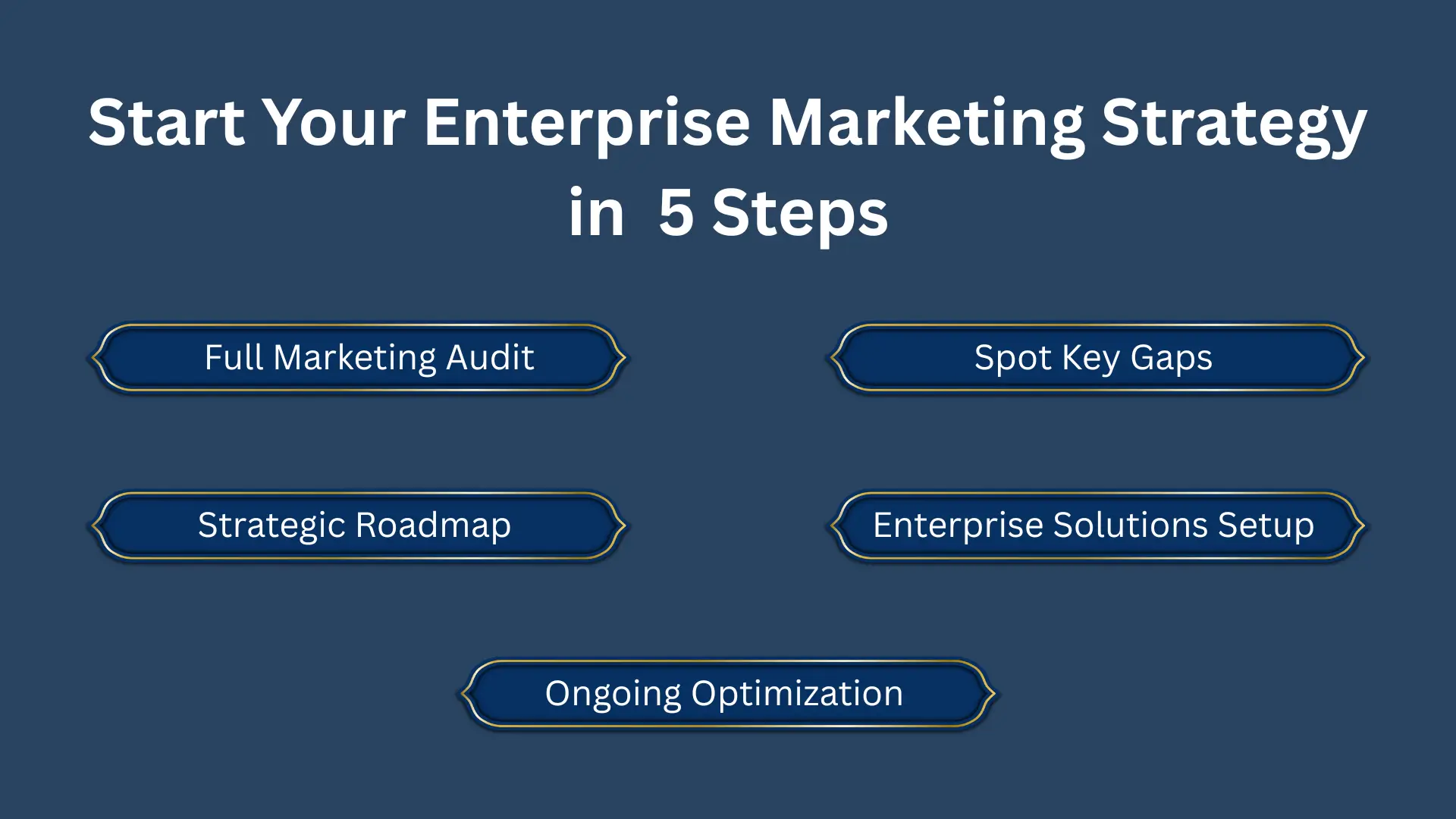
Start Your Enterprise Marketing Strategy in 5 Steps
Building an enterprise marketing strategy may seem overwhelming at first. However, breaking it into clear steps makes the work easier and far more manageable. These five steps help large companies build a strong and scalable marketing system. As a result, they support long-term growth with greater confidence.
1. Conduct a Full Enterprise Marketing Audit
First, review everything. Look at your active campaigns, analytics, website setup, and content quality. Then check customer touchpoints and internal processes. This gives you a clear and honest view of what works well. It also shows where gaps slow growth.
2. Identify Enterprise-Level Opportunities and Weak Points
Next, look for missing systems, outdated tools, or weak branding. Also check for weak keywords, poor funnels, and unclear messaging. Enterprises rely on precision. Thus, finding these gaps early prevents costly mistakes later.
3. Build a Long-Term Strategic Roadmap
Then create a simple and direct plan. List your target audiences, main channels, and content strategy. Add your KPIs, budget details, and quarterly goals. This roadmap keeps all teams aligned. It also ensures every action supports your larger business goals.
4. Implement Enterprise Marketing Solutions and Technology
After that, integrate CRM systems, automation tools, and strong analytics platforms. Add advanced SEO frameworks as well. These tools help manage large audiences with ease. They also improve efficiency and keep messaging consistent across regions and channels.
5. Establish a Continuous Optimization Cycle
Finally, remember that enterprise marketing is never “set and forget.” Track performance often. Then analyze results, update weak processes, and refine your strategy. This keeps your marketing system strong, flexible, and ready to scale.
What a True Enterprise Digital Marketing Agency Brings to the Table
When you hire a top‑tier agency, you’re not buying a few services. You’re investing in a full suite of capabilities that many in‑house teams or freelancers simply can’t match. Here’s what that looks like (and why it matters).
1. Deep Expertise + Specialized Talent Pool
An agency isn’t one person it’s a team of specialists. Experts in SEO, paid media, content creation, analytics, UX/CRO, strategy, and more. You get access to a diverse skill set under one roof.
That means you don’t have to go through the painful (and expensive) process of recruiting, interviewing, onboarding, and training multiple specialists. You can skip steep learning curves, trial-and-error phases, and costly mistakes.
In other words: you get professionalism and experience from day one.
2. Access to Premium Tools & Technologies
To do marketing well today especially at enterprise‑level scale you need more than creativity and effort. You need powerful tools: analytics suites, attribution software, SEO trackers, ad‑management platforms, automation tech, AI‑assisted content engines, and more.
If you try to do all that in‑house, it can get expensive and complicated licenses, subscriptions, training, integration. But a good agency already bears those costs, spreading them across many clients.
3. Faster, Scalable Execution When You Need It
Business doesn’t always grow by a comfortable 5–10% per quarter. Sometimes there’s a product launch, seasonal demand, a sudden opportunity. You need to ramp up fast.
An agency can scale with you. Need to run a major PPC push? Launch a content blitz? Overhaul your website? They’ve got the workforce and workflow ready.
4. Data‑Driven Strategy & Measurable Results
Marketing is no longer guesswork. A solid agency doesn’t just launch campaigns and hope for the best. They track, measure, analyze, and optimize. They dig into user behavior, conversion paths, campaign metrics then use those insights to shape future strategy.
When done right, this means you don’t just get vanity metrics (likes, clicks) you get real business impact: traffic growth, better conversions, consistent leads, improved ROI.
5. Unified, Consistent Brand Presence Across Channels
In today’s world, customers meet your brand everywhere: search engines, social media, ads, maybe in multiple languages and geographies. It’s easy for brand voice and messaging to get messy.
A strong agency keeps your brand consistent, no matter where a potential customer interacts with you.
Common Pitfalls and What to Watch Out For
- Loss of day-to-day control. Because the agency isn’t in your office, you might feel out of the loop. Communication delays, misaligned expectations, or slow approvals can frustrate you.
- Brand‑fit issues or cultural misalignment. If the agency doesn’t take time to deeply understand your brand your voice, mission, audience marketing can feel generic, disconnected, or tone‑deaf.
- Hidden costs, unclear pricing, or long‑term expense without guaranteed returns. Agencies often have overheads to cover; if you’re on a tight budget, long-term engagement can be expensive.
- Dependence on agency performance and risk if they underperform. If your agency becomes complacent, treats you as just another client, or fails to adapt to market changes, your results can suffer.
- Overpromising and underdelivering. Some agencies may make big promises top rankings, huge traffic spikes, overnight success. But often, results are gradual, requiring consistent work and realistic expectations.
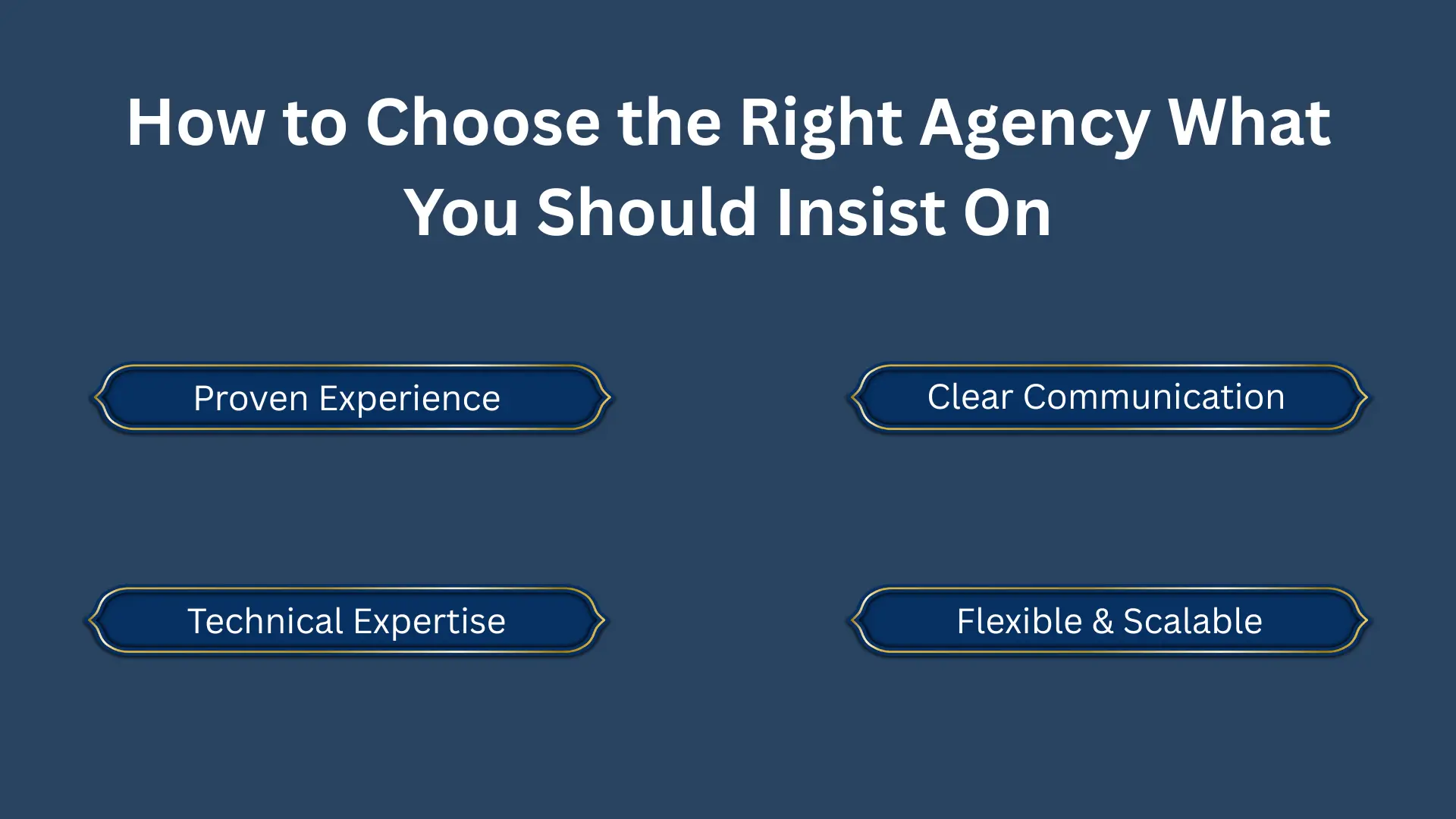
How to Choose the Right Agency What You Should Insist On
If you decide to go the agency route, don’t treat it like picking the cheapest vendor or the most charismatic salesperson. Think of it like choosing a business partner because that’s what it really is.
Here’s what you must look for (and demand) before you sign up:
Proven Track Record & Relevant Experience
Check their history. Do they have proven success with businesses like yours in size, industry, market? Look for case studies, results, honest talk about challenges and lessons learned.
Transparency & Clear Communication
They should be upfront about pricing, deliverables, timelines, and expected outcomes. Communication should be easy, consistent, and frequent enough for you to feel in control but not micromanaging.
Technical Competence & Modern Tools
They should use advanced tools for analytics, attribution, automation, things that give you insights, control, and scalability. If they’re using outdated methods, that’s a red flag.
Flexibility & Scalability
Your business will evolve. Maybe you’ll launch a new product, expand to new markets, or pivot. The agency should be ready to grow with you scaling up campaigns, shifting strategy, and adapting to new goals.
The Future of Enterprise Digital Marketing For Online Presence
The future of enterprise digital marketing is evolving rapidly, driven by technology, data, and changing customer expectations. Large businesses need to move beyond traditional campaigns and adopt advanced, scalable strategies to maintain a strong online presence.
- AI and Automation: Artificial intelligence will play a bigger role in personalization, predictive analytics, and campaign optimization, allowing enterprises to deliver tailored experiences at scale.
- Hyper-Personalization: Enterprises will increasingly target multiple decision-makers within organizations, crafting content that resonates with each role while maintaining brand consistency.
- Advanced Analytics: Data-driven insights will guide strategy, enabling precise tracking of ROI, audience behavior, and engagement across multiple channels.
- Guest Posting & Authority Building: High-quality content partnerships and authoritative placements will continue to strengthen online credibility and search visibility.
Enterprises that embrace these trends with the support of a professional Digital Marketing Agency will secure stronger, more sustainable digital growth in the years ahead.
Conclusion
Still, enterprise marketing can feel overwhelming. Many brands struggle with complex tools and large workflows. But a skilled agency can simplify the process. A strong guest posting team can support that work as well. As a result, you gain clear direction and fast execution. You also see stronger results without extra stress.
With the right partners, you stay focused on growth. They help you remove confusion and build a flexible system. Step by step, your marketing becomes easier to manage.
FAQs
How is enterprise marketing different from regular marketing?
Enterprise marketing works on a large scale. It handles big audiences and long buyer journeys. It also brings many teams together under one plan. Because of this, it needs strong systems that support speed, automation, and data. Smaller businesses do not need this level of structure. They use simple tactics and light tools.
How can enterprises measure marketing ROI effectively?
To measure ROI well, start with strong analytics tools. Use dashboards that track clear KPIs. Then review each channel and see how it performs. Check your data often. This step helps you spot what works and what does not.
Can enterprise marketing strategies scale over time?
Yes. Scalable strategies rely on automation, analytics, and organized workflows. As a result, they grow with your audience and your markets. They also adapt to shifting goals. This structure keeps your system stable even when your business expands.