Black Hat SEO: Shortcuts That Can Damage Your Rankings
SEO keeps changing fast, but the pressure to rank higher often pushes people toward shortcuts. These shortcuts look tempting at first. They promise quick traffic, faster visibility, and instant results. But many of these fall into black hat SEO methods, and they can quietly destroy everything you worked for.
Search engines now detect manipulation better than ever. If you try to trick the algorithm, the risk is high. You may lose rankings, traffic, and even your domain authority. In some cases, a website becomes so damaged that recovery takes years.
This guide explains what black hat SEO is, the tactics you must avoid, the dangerous techniques emerging from AI tools, and how you can turn these methods into safer, white hat strategies.
And how to turn harmful practices into White Hat SEO: The Safe and Honest Way to Rank Higher.
What is Black Hat SEO?
Black Hat SEO means using manipulative tactics to trick search engines into ranking your website higher. These tactics break Google’s Webmaster Guidelines. They also ignore user experience, which is now a major ranking factor. Although these tricks may create temporary gains, they eventually lead to penalties.
The name “black hat” comes from old movies where villains wore black hats. In SEO, these tactics act the same way. They create fake authority, fake content, and fake signals. They may help for a short time. However, they also expose your site to long-lasting penalties.
Most Black Hat SEO Methods involve:
- Manipulating ranking signals
- Automating low-value content
- Deception through cloaking
- Hidden links or hidden text
- Unnatural link schemes
- Misleading or harmful content
Search engines now use machine learning to detect unethical behavior. As a result, black hat SEO has become a losing game.
White hat SEO works with search engines. Meanwhile, black hat SEO fights against them. And in the end, Google always wins.
Top 10 Black Hat SEO Techniques to Avoid
Below are the most common shortcuts still used in 2026. People discuss them in many black hat SEO forums, yet they cause long-term harm.
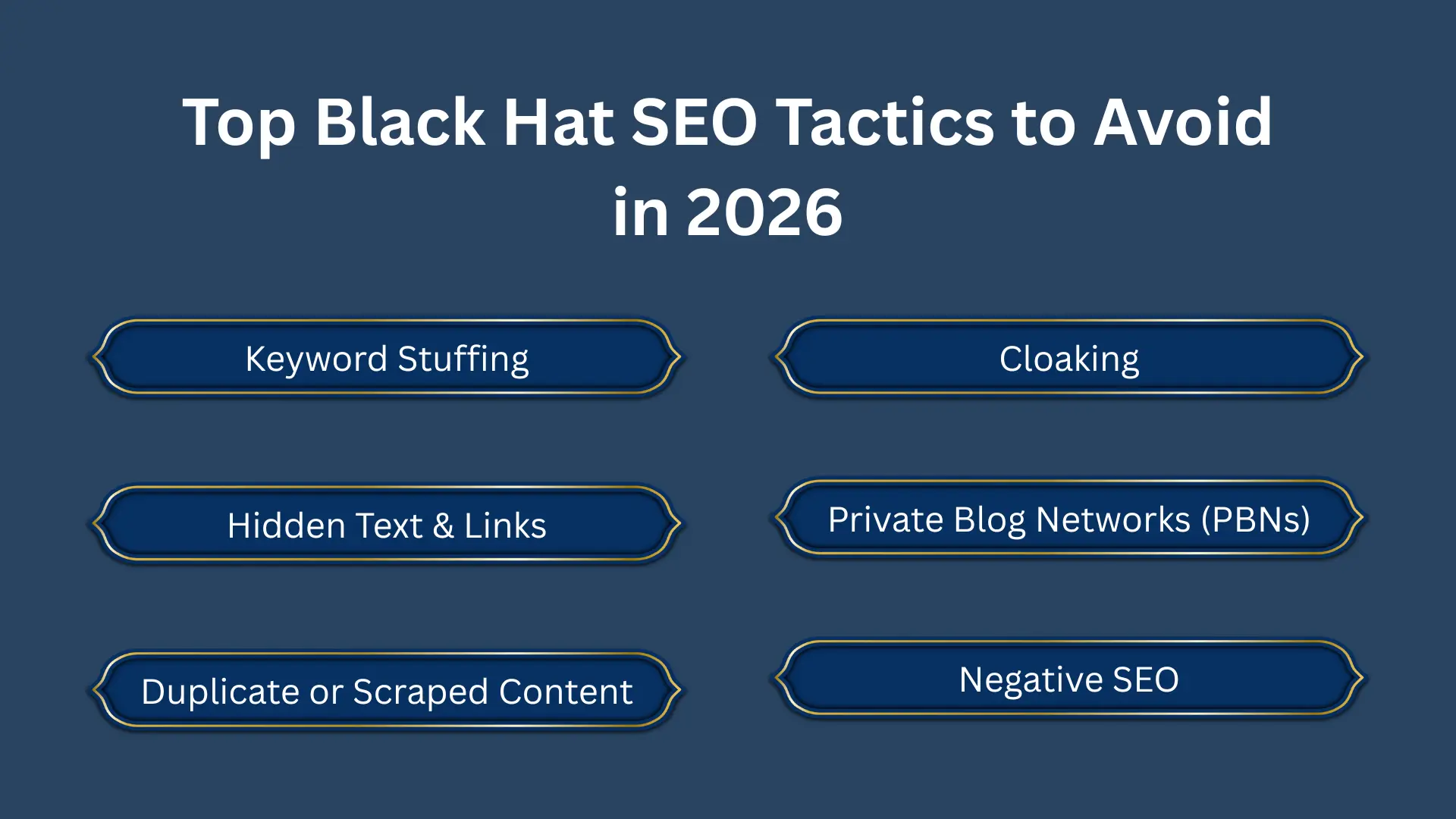
1. Keyword Stuffing
Keyword stuffing happens when someone repeats a keyword over and over. They believe that more keywords mean better rankings.
However, Google reads your content the same way users do. If the text feels robotic, rankings drop.
Moreover, stuffed content weakens readability. Users leave quickly. Bounce rates rise, and trust fades.
Better approach: Use keywords naturally and focus on context.
2. Cloaking
Cloaking shows one version of a page to Google and another to users. The goal is simple: trick the search engine. However, cloaking is one of the most dangerous Black Hat SEO Methods.
Google strictly prohibits it. When detected, your website may lose visibility or get deindexed.
Better approach: Keep your content the same for both users and search engines.
3. Hidden Text and Hidden Links
Some people hide keywords or links using small fonts or matching colors.
They hope Google will read them anyway. Yet search engines easily detect these tricks.
Furthermore, hidden elements confuse users and harm trust.
Better approach: Use readable, visible content that adds real value.
4. Private Blog Networks (PBNs)
PBNs are groups of weak websites created only for backlinks. At first, they may increase authority. Eventually, Google detects unnatural link patterns and removes all link value. Sadly, your main site may also get penalized.
Better approach: Build links through real, relevant, and authoritative sources.
backlinks from relevant, authoritative, and trustworthy sites through ethical outreach.
5. Duplicate or Scraped Content
Copying text from other sites or duplicating your own pages looks easy. However, it destroys originality. Search engines want fresh, unique content. When they see duplication, they push your page down or ignore it.
Moreover, users lose interest when content repeats.
Better approach: Create new, well-researched information for every page.
6. Doorway Pages
Doorway pages are low-value pages made to rank for multiple keywords. They redirect users to another page and provide no real content.
Google views them as deceptive. Because of that, websites using them often receive manual penalties.
Better approach: Build complete, helpful pages that answer user intent.
7. Comment Spam
Many people still try placing backlinks inside comment sections. They think it improves rankings.
However, these links are usually worthless and may trigger spam warnings.
In addition, spam comments make your site look untrustworthy.
Better approach: Earn backlinks through quality content that attracts real engagement.
8. Link Farms
Link farms are networks of sites created to exchange backlinks. They boost numbers but not quality.
Google spots them instantly. Consequently, your site may face harsh penalties.
Better approach: Pursue editorial links from relevant, respected websites.
9. Misleading Redirects
Misleading redirects send users to unrelated pages. They may lead to ads, affiliate pages, or irrelevant landing pages. This confuses visitors and breaks trust.
Google considers misleading redirects a major violation.
Better approach: Use redirects only when necessary, such as during URL updates or site migrations.
10. Negative SEO
Negative SEO means harming another site’s ranking. It may involve toxic backlinks, copied content, or hacking. This tactic is unethical and dangerous. It can also backfire on the attacker.
Search engines track suspicious activities closely. Therefore, negative SEO can damage your own reputation.
Better approach: Focus on improving your own authority and credibility.
New Black Hat SEO Tactics Emerging from AI
AI brought many benefits. But it also created new shortcuts that fall under black hat patterns.
Some marketers push AI tools too far by using them as automated ranking machines.
Google now identifies AI misuse as fast as older spam methods.
1. AI-Generated Mass Content
Generating hundreds of articles a day looks powerful. But if the content lacks originality, depth, or human oversight, it gets flagged.
Google checks for thin content and patterns that match AI templates.
2. AI Link Insertion Tools
Some tools create automatic backlinks on forums, comments, or expired domains.
These links are obvious to search engines and are classified as low-quality digital noise.
3. AI-Assisted Cloaking
Some marketers use AI to generate different content versions for crawlers and users.
This is still cloaking, no matter how advanced the tool is.
4. AI-Based Fake Reviews
Artificial reviews on business pages, listings, or product posts violate Google’s policies. They are tracked through patterns in language, IP clustering, and velocity spikes.
5. AI-Spun Local Pages
Mass-producing city landing pages using fill-in templates triggers local search penalties.
Search engines now pick up repeating sentence structures and replace city names.
Why AI Spam Is Dangerous
AI spam grows fast. But the penalty hits even faster. Search engines now evaluate content based on authenticity and usefulness.
They check how users interact with the page.
If content feels generic or machine-built, it loses trust. Using AI is not wrong. Using it irresponsibly is.
How to Use Black Hat SEO Methods The White Hat Way
Some black hat ideas come from valid ranking factors. When you use the core idea ethically, it becomes a white hat strategy.
Here’s how to turn risky tactics into helpful ones.
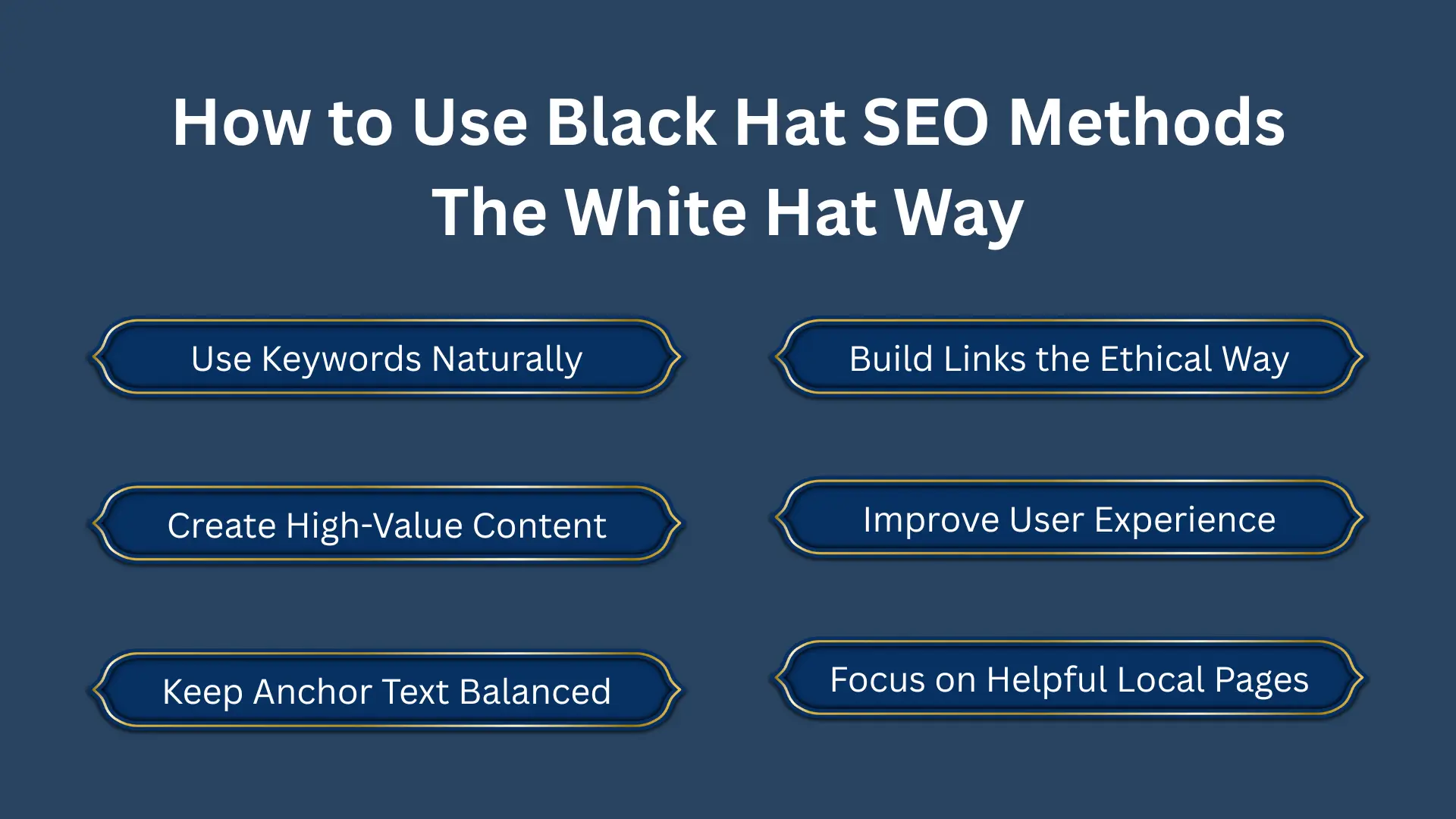
1. Use Keywords Naturally
Instead of stuffing, place keywords where they fit. Use long-tail variations.
Add supportive terms. Build context so readers feel guided, not overwhelmed.
2. Build Links the Ethical Way
Focus on:
- guest posts on quality websites
- genuine mentions
- industry collaborations
- digital PR
- case studies and reports
A reliable Guest Posting Company can help you gain clean backlinks.
3. Create High-Value Content
Use AI as a writing assistant, not a content machine. Add expert opinions, real examples, and personal insights.
Keep readability high. Make sure your content actually helps.
4. Improve User Experience
Black hat tricks often ignore UX. White hat SEO enhances it.
Focus on:
- speed
- clear navigation
- mobile consistency
- useful visuals
Better UX increases trust and ranking stability.
5. Keep Anchor Text Balanced
Use brand names. Use simple text like “learn more” or “visit the guide.” Natural links look real because they are.
6. Focus on Helpful Local Pages
Instead of AI-generated city pages, add real data about each location. Include local needs, local examples, or local FAQs.
7. Be Transparent
Google values honesty. Clear content, honest reviews, and accurate information will always outrank shortcuts.
Is Keyword Stuffing Still a Penalty Risk in 2026?
Yes, keyword stuffing still triggers penalties in 2026. Google uses advanced language understanding systems that detect unnatural repetition quickly.
Keyword stuffing lowers page quality. It also sends a signal that the content is manipulative.
A natural keyword density works better. Include
- synonyms
- semantic phrases
- contextual terms
Search engines prefer pages that read like conversations, not keyword lists.
If your content helps people understand their problem, the keywords naturally appear in the right places.
Conclusion
Black hat SEO may look helpful when you feel stuck. Yet every shortcut comes with consequences. Search engines are smarter today, and they detect manipulation quickly.
Because of this, penalties appear faster, and recovery takes longer. So, choose ethical SEO. Add real value. Build trust.
And if you need guidance, consider shifting toward White Hat SEO: The Safe and Honest Way to Rank Higher with the help of experts or a reliable guest posting company.
FAQs
Can black hat SEO permanently damage my website?
Yes. Some penalties are reversible, but severe spam actions can affect domain trust for years.
In rare cases, websites stay deindexed even after fixes. That is why avoiding shortcuts is safer.
Which black hat SEO tactics trigger Google algorithm penalties?
Any tactic that manipulates rankings can trigger penalties. These include keyword stuffing, unnatural links, cloaking, doorway pages, hidden text, and AI-generated spam.
Google now evaluates websites using both human reviewers and machine checks.
What is hidden text in Black Hat SEO?
Hidden text is content placed on a webpage so users cannot see it, but search engines can.
Examples include invisible fonts, matching text color with the background, placing text behind images, or hiding sections in CSS.